
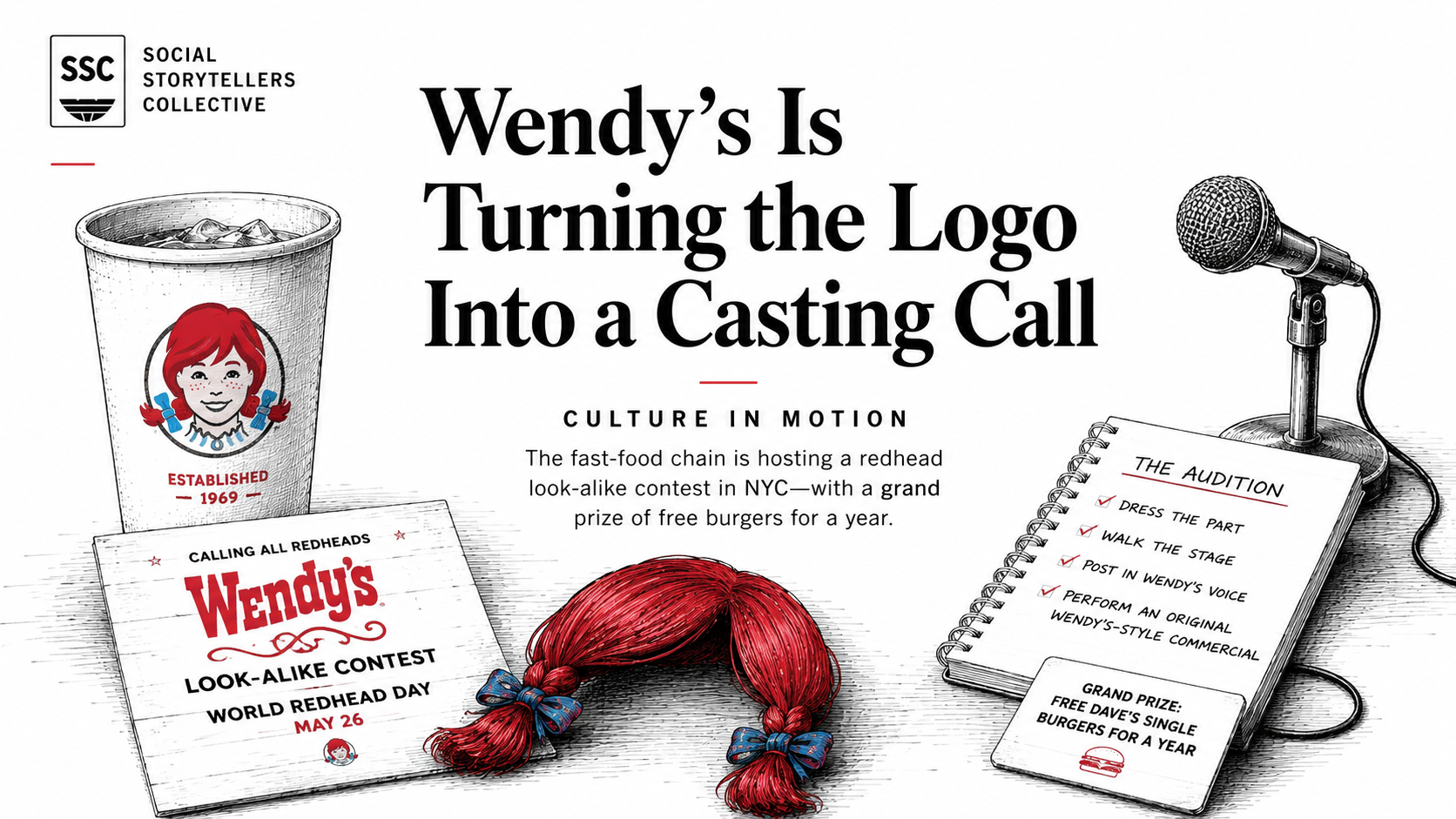
Tomorrow — World Redhead Day, May 26 — Wendy’s is hosting a look-alike contest at Seaport Square in New York City according to the company’s press release, and the brief is specific. Contestants must show up dressed as the chain’s iconic red-haired mascot — red wig, pigtails, freckles, the full costume — then walk a stage, deliver a social-media-style post in Wendy’s voice, and perform an original Wendy’s-style commercial in front of a live crowd. The grand prize is free Dave’s Single burgers for a year. The runner-up prizes are free Frosty desserts for a year. Registration is open on-site the day of the event.
The event sounds unserious because it is designed to. Red wigs, pigtails, crowd applause, and fast-food prizes make the campaign feel like a joke with a receipt attached. But that is exactly why it works. Wendy’s is not promoting a menu item or celebrating a made-up calendar moment. It is converting brand recognition into public participation. The logo is no longer just something customers see. It is something they can audition for.
The contest format tells you everything about the calculation. Contestants are not just wearing a costume — they are performing Wendy’s brand voice. The social-media-style post component asks participants to recreate the sarcasm, fluency, and personality the chain has spent years building online. The original commercial component asks them to understand the brand deeply enough to produce new content in its register. Wendy’s is not creating the campaign content. It is asking its audience to create it — in public, on a stage, in front of a crowd that will record, post, and amplify everything they see.
That is the real prize for Wendy’s. Not the event itself but the content it generates. Every contestant who walks that stage in Seaport Square tomorrow is a piece of brand content the company did not have to produce. Every phone pointed at the stage is distribution Wendy’s did not have to buy. The free burgers for a year keep the whole thing grounded in the logic of the product — tangible enough to be worth competing for, funny enough to be worth sharing, cheap enough relative to the earned media value that the math works decisively in the brand’s favor.
Wendy’s has spent years building a corporate personality defined by wit, self-awareness, and the willingness to be sharper than most brands are comfortable being. The Twitter account became famous for it. The Spotify album happened because of it. The World Redhead Day contest is the offline extension of the same strategy — take a cultural moment that already exists, attach it to the brand’s most recognizable visual asset, and invite the public to do what internet culture already does naturally: turn recognizable symbols into participatory rituals.
A look-alike contest once belonged to celebrity fandom or local novelty. Now the brand is the celebrity. The mascot becomes the figure people imitate. The contest becomes the content engine. The audience becomes the campaign. Wendy Thomas — daughter of founder Dave Thomas and the real face the mascot was built around since 1969 — gave the brand something most corporate identities never have: a human origin story legible enough to be performed by strangers on a stage in New York City for the chance to eat free for a year.
Brand identity now works best when it can be worn, repeated, remixed, and performed by ordinary people. Wendy’sfound the hook in World Redhead Day. What it is actually building is a system where the logo generates its own performers. The company gets attention. The participants get visibility. The crowd gets a moment. And the mascot gets something more valuable than recognition — proof that people are willing to step inside it.
If you are in New York City tomorrow, May 26, the contest runs at Seaport Square. Show up in costume. Know the brand voice. Bring your commercial. The burgers are free for a year.
SSC covers culture, brand strategy, and the hospitality and experience economy.