
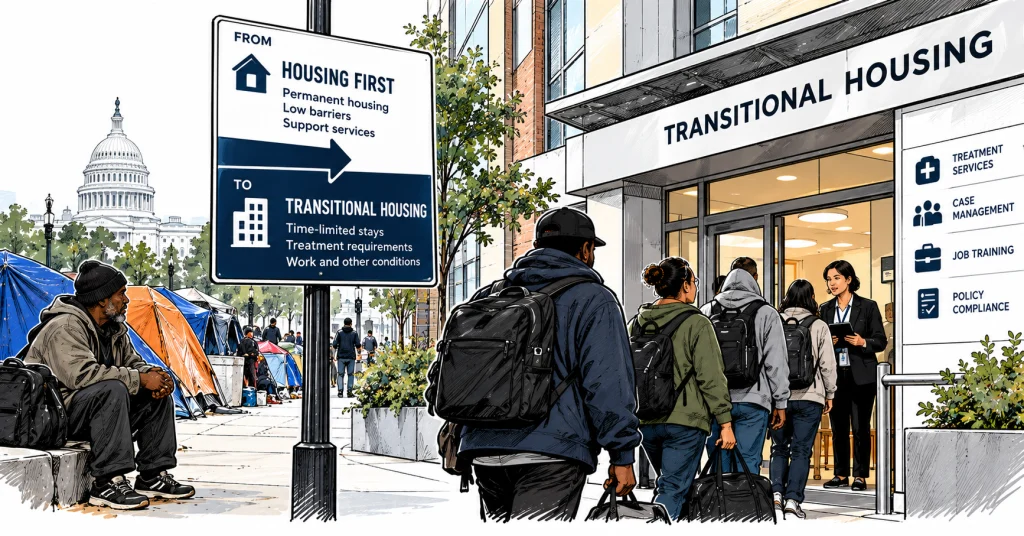
The federal government is moving away from Housing First and toward transitional housing tied to treatment and other requirements. Providers are redesigning programs before the full consequences are known.
The federal government is moving away from Housing First, the approach that has shaped much of U.S. homelessness policy by placing people into permanent housing without first requiring sobriety, treatment or employment. The Trump administration is instead emphasizing transitional housing and mandatory participation in services such as substance-use treatment and job-readiness programs. Housing providers around the country are already changing projects to fit the new federal direction because billions of dollars in future funding may depend on it.
The policy argument is not simply about whether people experiencing homelessness should receive treatment. It is about sequence. Housing First begins from the premise that someone is more likely to address addiction, mental illness, employment and other problems after securing a stable place to live. The administration’s preferred approach gives greater weight to treatment and behavioral requirements during a period of transitional housing, which generally lasts no longer than two years. Administration officials argue that the existing model has produced poor outcomes and can enable addiction; supporters of Housing First point to evidence that it improves housing stability, while research on some health and behavioral outcomes is more mixed.
Funding changes behavior before policy is settled
The immediate consequence is already visible at the local level. The Associated Press found organizations canceling planned permanent-housing projects or converting them into temporary programs in an effort to remain eligible for federal money. In Louisville, for example, providers have begun reworking housing models rather than risk losing support as Washington changes what kinds of programs it wants to finance.
That is how a federal policy shift can alter a local housing system before Congress, courts or researchers settle the broader debate. Nonprofits and local governments operate on grant cycles, construction timelines and annual budgets. They cannot wait indefinitely to see which philosophy ultimately prevails. Once federal funding criteria change, organizations have an incentive to redesign programs around those criteria even when buildings, staff and residents were organized under the previous model.
The financial stakes are substantial. HUD estimated that nearly 750,000 people experienced homelessness in 2025, while the administration’s proposed 2027 budget would eliminate the roughly $4 billion Continuum of Care program, a major source of federal support for permanent supportive housing and other homelessness services. That proposal would require congressional action, so it should not be treated as settled policy. The administration has also pursued executive actions emphasizing treatment and enforcement, drawing legal challenges and criticism from housing and public-health advocates.
The debate becomes concrete when someone loses a unit
There are competing policy judgments underneath this change. Administration officials and supporters of treatment-first approaches argue that permanent housing without stronger behavioral requirements does too little to address addiction, mental illness and long-term self-sufficiency. Housing First advocates counter that removing the stability of permanent housing can make those problems harder to address and can return people with significant medical or behavioral-health needs to homelessness when transitional placements end.
The measurable question now is what happens as the funding follows the new theory. If permanent supportive units are converted into transitional housing, the government is not merely changing terminology. It is changing how long people can stay, what they must do to remain eligible and what local providers are paid to build. Washington is rewriting the order in which housing and treatment are supposed to happen. Across the country, organizations are already rebuilding their programs around that decision.