
Part of Culture in Motion / The Critic’s Desk — an ongoing series examining who defines culture, how it moves, and what it reveals about the moment.
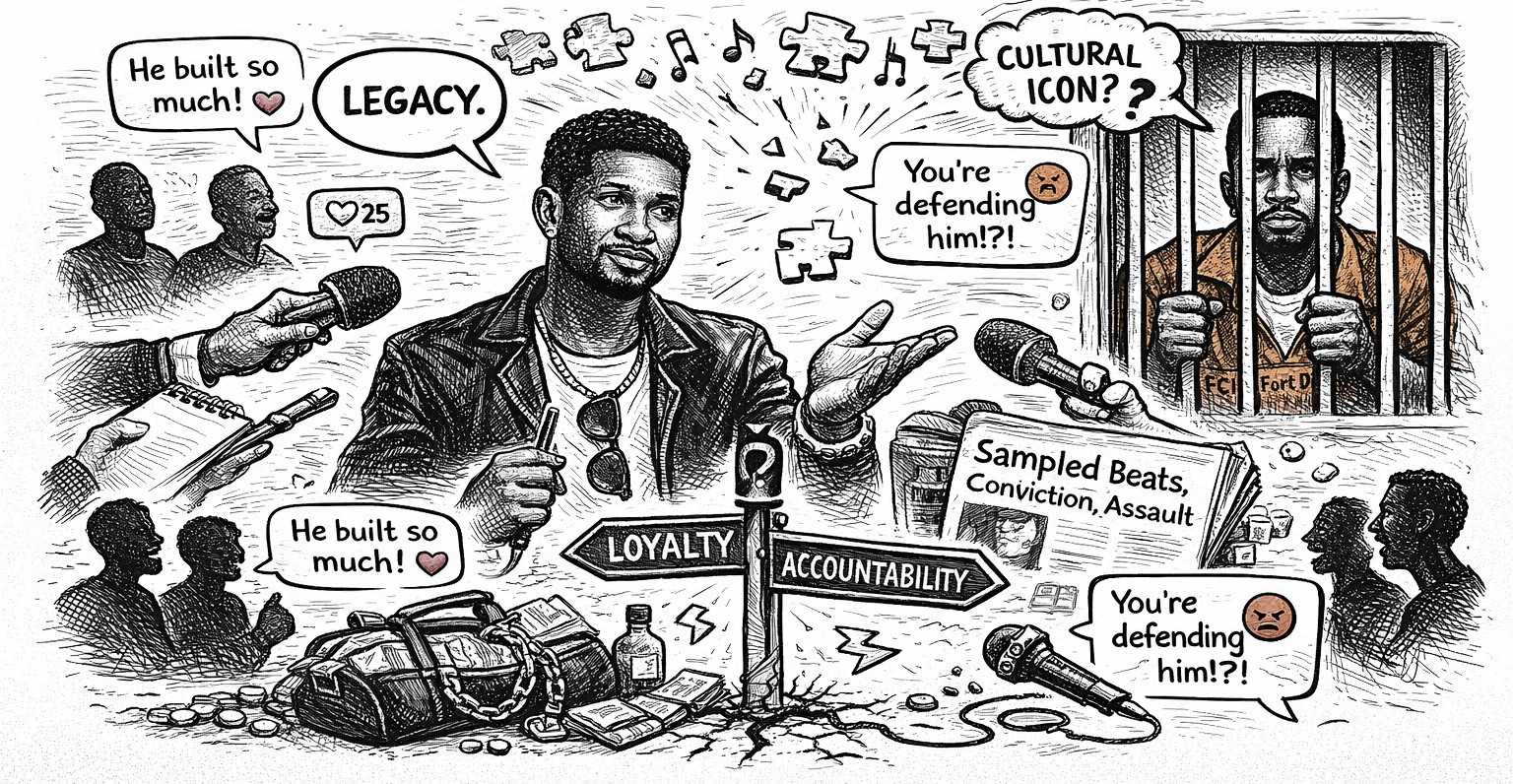
In a Forbes interview this week, Usher was asked to describe Sean Diddy Combs in one word. He said “legacy.” What followed was a careful, deliberate defense of his former mentor — crediting Combs with teaching him the fundamentals of Black entrepreneurship before he had the vocabulary for it, describing him as someone who figured out how to turn culture into commerce before there was a template for doing so. The remarks were not hedged or buried. Usher said what he meant, knowing it would not go down easily.
Combs is currently serving a 50-month federal prison sentence at FCI Fort Dix after being convicted in July 2025 on two counts of transportation to engage in prostitution. His appeals hearing is scheduled for April 9. The trial involved testimony from 34 witnesses. Surveillance footage released during the proceedings showed Combs physically assaulting Cassie Ventura in a hotel hallway. He issued a public apology. A personal letter requesting a presidential pardon was rejected.
The reaction to Usher’s comments split immediately and along familiar lines. Some acknowledged the genuine cultural infrastructure Combs built — Bad Boy Records, the Bad Boy era, the model of Black ownership and monetization in music that an entire generation built careers within — and understood Usher’s position as someone with direct personal experience of that mentorship. Others found it impossible to reconcile the legacy framing with the conviction and the scope of what the trial documented. Jay-Z has stayed notably silent. 50 Cent, who produced the Diddy documentary, donated a portion of its proceeds to domestic violence nonprofits this week — a choice that landed as its own statement.
What Usher asked his audience to do — hold two things at once — is a harder ask than it sounds. As The Apology Industrial Complex examined, the scripts the culture uses to process public figures’ falls are rarely neutral. They are shaped by proximity, by loyalty, and by what it costs to fully name the harm when the person who caused it also built something real that others depended on. The Bad Boy infrastructure was not incidental. It was generative. That is precisely what makes the accounting so difficult — and precisely why it cannot be avoided by substituting the word legacy for the harder conversation. As If Beef Is No Longer a Game, What Is It Now? examined, the culture has a long history of calcifying around loyalty when the alternative requires confronting something it built itself on. The Usher interview is that dynamic made visible in one word.
The question is not whether Diddy’s contributions were real. They were. The question is whether legacy is a framework for understanding — or a framework for avoiding.