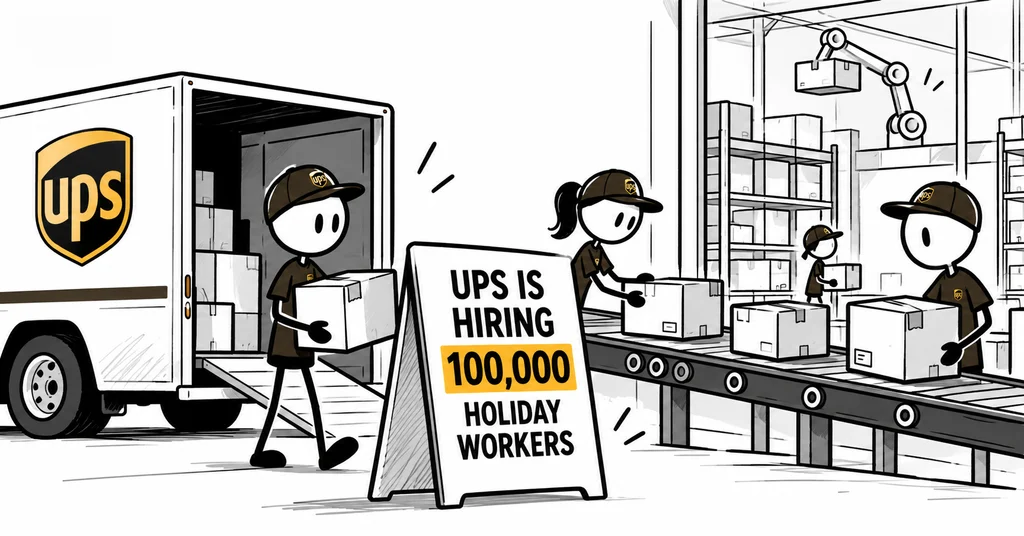
UPS still needs a six-figure temporary workforce to move holiday packages. But the company’s hiring plans sit inside a broader shift toward automation, facility closures and a smaller permanent workforce.
UPS plans to hire 100,000 seasonal workers across the United States for the 2026 holiday rush, filling jobs sorting, transporting and delivering packages during the busiest stretch of the shipping calendar. The number is substantial, but it also shows how the company is changing the way it handles peak demand. UPS hired 125,000 seasonal workers in 2024 and about 110,000 in 2025. This year’s plan continues that smaller staffing footprint even as holiday package volumes still require a major temporary workforce. About UPS-US
The shift is occurring while UPS restructures its permanent operations. The company entered 2026 with approximately 460,000 employees, excluding seasonal workers, down from roughly 490,000 a year earlier. In January, UPS said it planned to eliminate as many as 30,000 operational positions and close 24 facilities as it reduces lower-margin business from Amazon and reshapes its delivery network. Seasonal hiring therefore tells two stories at once: UPS still needs people when demand surges, but it is building a year-round operation designed to accomplish more with fewer permanent positions. United Parcel Service, Inc.
Peak Season Still Needs People
The company is not describing its holiday operation as labor-light. UPS’s October 7 announcement says the 100,000 seasonal employees will work across hundreds of locations, with flexible shifts and potential paths into permanent employment. UPS says many applicants can receive an offer in less than seven minutes. At the same time, the company highlights new or expanded automated facilities in Denver, St. Paul, Syracuse and Portland and expects to move more than 4 billion RFID-enabled packages by the end of 2026. People and technology are expanding alongside each other, but not necessarily at the same rate. About UPS-US
UPS is part of a wider change in holiday employment. Challenger, Gray & Christmas expects retailers to add about 450,000 workers during the fourth quarter, down from 461,500 last year and well below the seasonal hiring surges seen earlier in the decade. Transportation and warehousing employers added 266,500 positions during the final quarter of 2025, the sector’s lowest fourth-quarter total since 2018. The firm points to automation, robotics, existing employees and flexible labor pools as reasons companies can handle demand without rebuilding enormous temporary workforces every holiday season. Challenger, Gray & Christmas
Another Narrower Door Into the Labor Market
That trend connects directly to what SSC has been tracking in The Labor Market Isn’t Collapsing. It Is Becoming Harder to Enter. The challenge for workers is increasingly not a wave of mass unemployment but fewer openings into organizations that are keeping existing employees, automating portions of the work and becoming more selective about when they add people. Seasonal employment has historically provided one of those entry points, particularly for workers seeking quick income or a route into permanent employment.
UPS will still create 100,000 of those opportunities this season, so the door has hardly disappeared. But the direction is worth following. The company is simultaneously hiring temporary workers, closing facilities, eliminating permanent positions and investing in technologies intended to make its network more efficient. The holiday rush once required companies to solve higher demand primarily by adding people. Increasingly, the calculation includes how much of the surge can be absorbed by the workforce and infrastructure already in place.
For workers, the next signal will come after the packages are delivered. The useful numbers will be how many seasonal employees become permanent, how many facilities operate with fewer workers and whether UPS can handle peak volumes while continuing to shrink its underlying labor footprint. The holiday job has not disappeared. The larger employment question is whether it remains the doorway into something longer.