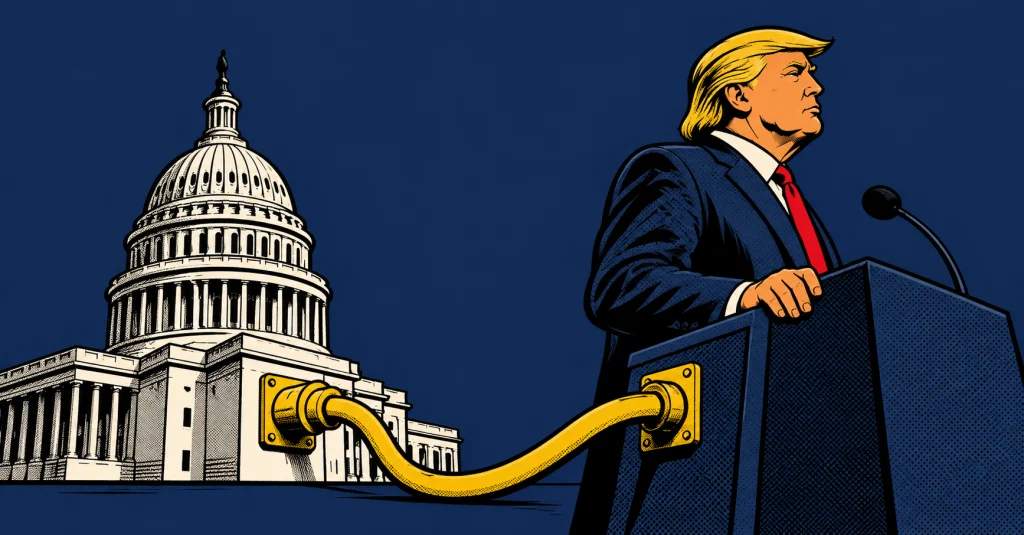
Donald Trump is openly celebrating his expanded authority, describing a second term in which he can do things he once considered out of reach. The bigger story is how decades of congressional retreat helped make that power available.
At a weekend rally in Northern Kentucky, Donald Trump told supporters that his second term has given him far more power than his first. He pointed to moves such as renaming the Gulf of Mexico the Gulf of America and said, “This is a much more powerful term. I can do stuff that’s unbelievable.” He also joked that major corporations that once wouldn’t take his calls now go out of their way to win his favor. The remarks came as Trump campaigned for Republicans less than two weeks before the Nov. 3 midterm elections, and he has made that power part of his pitch to voters.
In a report published Oct. 21, NPR White House correspondent Franco Ordoñez examined how that confidence reflects a presidency increasingly willing to test institutional limits. The report pointed to a Justice Department raid on a congresswoman’s home, which other outlets identified as the Washington residence of Minnesota Democratic Rep. Ilhan Omar. It also cited the removal of trees in Washington, D.C., against a judge’s wishes, and agreements with Russia that run counter to sanctions Congress passed. Earlier this month, the administration also opened investigations into nine universities, including Harvard and Yale, accusing them of using the J-1 exchange visa program to bring in foreign researchers who undercut the wages of American graduate students and researchers.
None of this expansion happened overnight. Tevi Troy, a presidential historian who served in the George W. Bush White House, told NPR that Congress has been steadily giving away its own power for roughly a quarter century. Presidents of both parties have leaned on executive action to move policy without new legislation, from Bush’s signing statements to Barack Obama’s promise to use his pen. Troy argues that Trump goes further by turning those powers against political and cultural opponents, not just using them to get around gridlock. “He doesn’t have an ideology, he has a methodology,” Troy said, calling that methodology unilateralism. Supporters see that willingness to act as a fix for a Washington that rarely moves. Critics question whether the checks on executive authority still work.
The stakes reach well beyond campaign rhetoric. Federal investigations, government contracts, regulatory decisions and security clearances can all be used against universities, businesses, journalists and other institutions, a point Frank Sesno, a former CNN Washington bureau chief now at George Washington University, made to NPR when he called them powerful weapons available only to the executive branch. Congress keeps its constitutional oversight and lawmaking powers, and federal courts can review executive actions, but those safeguards work only when the institutions holding them choose to use them. Trump is making his case for that power at a moment when the public is moving the other way: his approval rating fell to a record-low 31% in a recent Reuters/Ipsos poll, though disapproval doesn’t automatically turn into votes. Trump’s remarks put a basic question in front of voters heading into the midterms: how much power can a president exercise before the other branches of government push back?
Original reporting: NPR — Trump leans into unprecedented power ahead of midterm elections, by Franco Ordoñez, Oct. 21, 2026.