
Trader Joe’s is expanding again, but the story is not just about new stores. It is about how a grocery chain has become a marker of who gets access to a specific kind of consumer experience, and how that access is distributed. Trader Joe’s is one of those stores I visit for specific items — non-dairy brown sugar oat milk creamer, organic olive oil popcorn, tuna steaks, flatbread, almond butter cups, and fresh flowers — which is part of what makes its presence feel intentional rather than routine. In 2026, Trader Joe’s is expected to open roughly 20 new stores, continuing a multi-year expansion that added more than 40 locations in 2025 and dozens more in 2024. The company now operates more than 600 stores nationwide, with recent counts placing it around 630+ locations across the U.S.
That scale becomes more meaningful when placed next to its peers. Whole Foods Market operates roughly 530+ stores globally, a footprint built through national expansion and accelerated under Amazon’s ownership. H-E-B runs more than 420 stores, but with deep regional saturation, particularly across Texas, where it clusters locations to dominate local markets. Trader Joe’s does neither. It does not flood regions or pursue density as strategy. It expands selectively, often entering markets where demand is already proven but access remains limited.
That strategy matters because Trader Joe’s is not just a grocery store. It is a curated environment where pricing, product design, and branding converge into something that feels both affordable and elevated. Nearly everything is private label. The assortment is tightly controlled. The experience is consistent across locations. The result is a retail ecosystem that signals taste as much as it delivers groceries, which makes placement as important as product.
The company’s 2026 expansion map reflects that logic. New stores are planned in places like McKinney, Texas; Johns Creek, Georgia; and West Palm Beach, Florida, alongside additions in Washington, Arizona, Kansas, and Louisiana. These are high-growth suburban and urban-adjacent markets where population density, income levels, and lifestyle patterns align with the brand’s core customer. Even in cities where Trader Joe’s already operates, new locations tend to redistribute access within specific neighborhoods rather than extend reach indiscriminately.
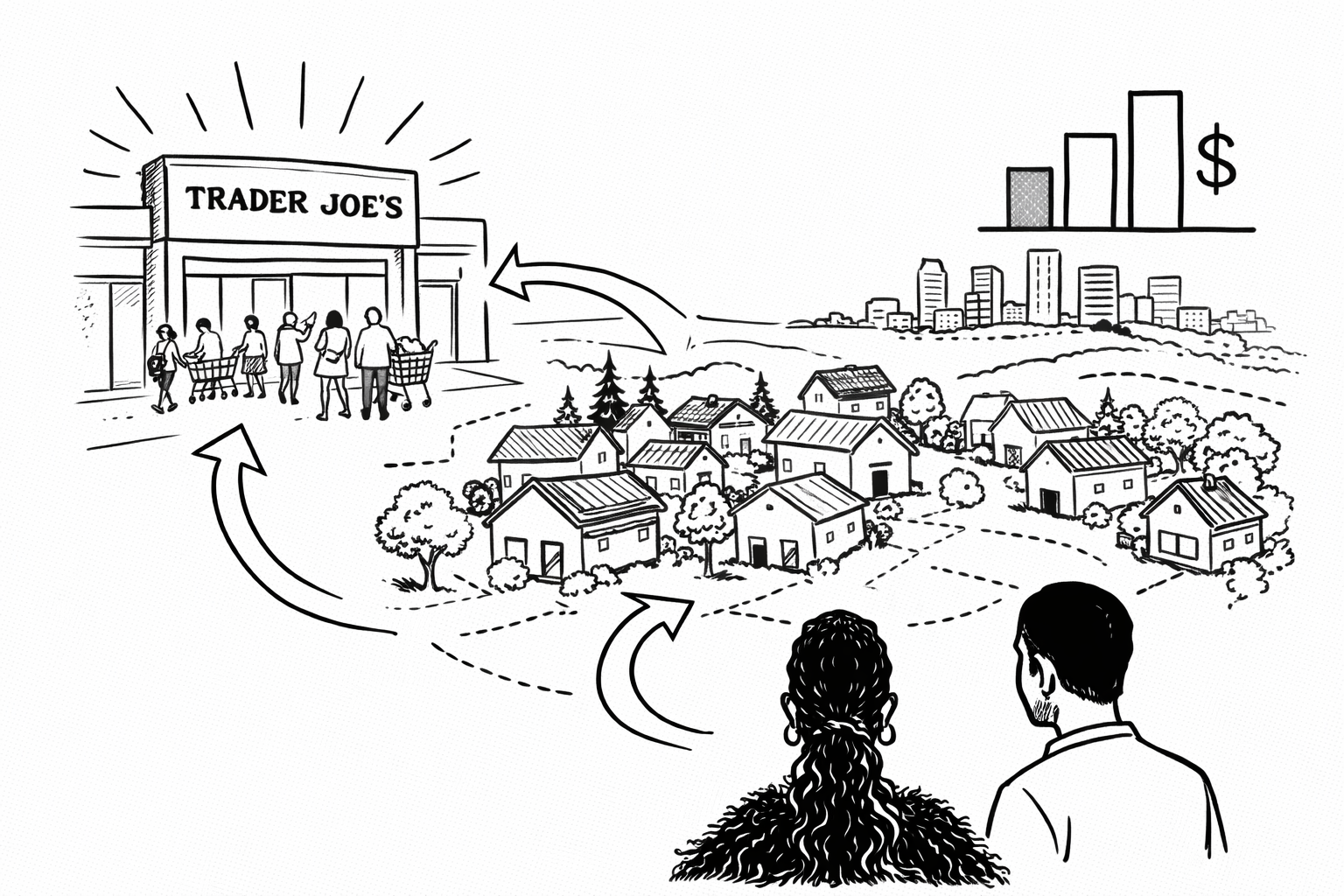
That approach creates a subtle but important dynamic. Trader Joe’s does not just follow growth. It helps define which neighborhoods are read as “ready” for a certain kind of retail experience. In practice, the presence of a Trader Joe’s often signals something about the neighborhood itself — not just demand, but a level of stability, income, and consumer profile that aligns with how the company defines readiness. In a moment when many chains are closing stores or downsizing, Trader Joe’s continues to invest in brick-and-mortar while maintaining discipline. Openings remain steady rather than aggressive, reinforcing a model where scarcity and consistency sustain demand rather than dilute it.
The result is that a new Trader Joe’s does more than change where people shop. It signals something about the neighborhood itself, from perceived stability to consumer profile, and often influences what retail follows. The company’s expansion is not just operational. It is interpretive. It shows how access in America is still being mapped, not only through policy or pricing, but through placement, perception, and the quiet power of where a brand chooses to appear.