
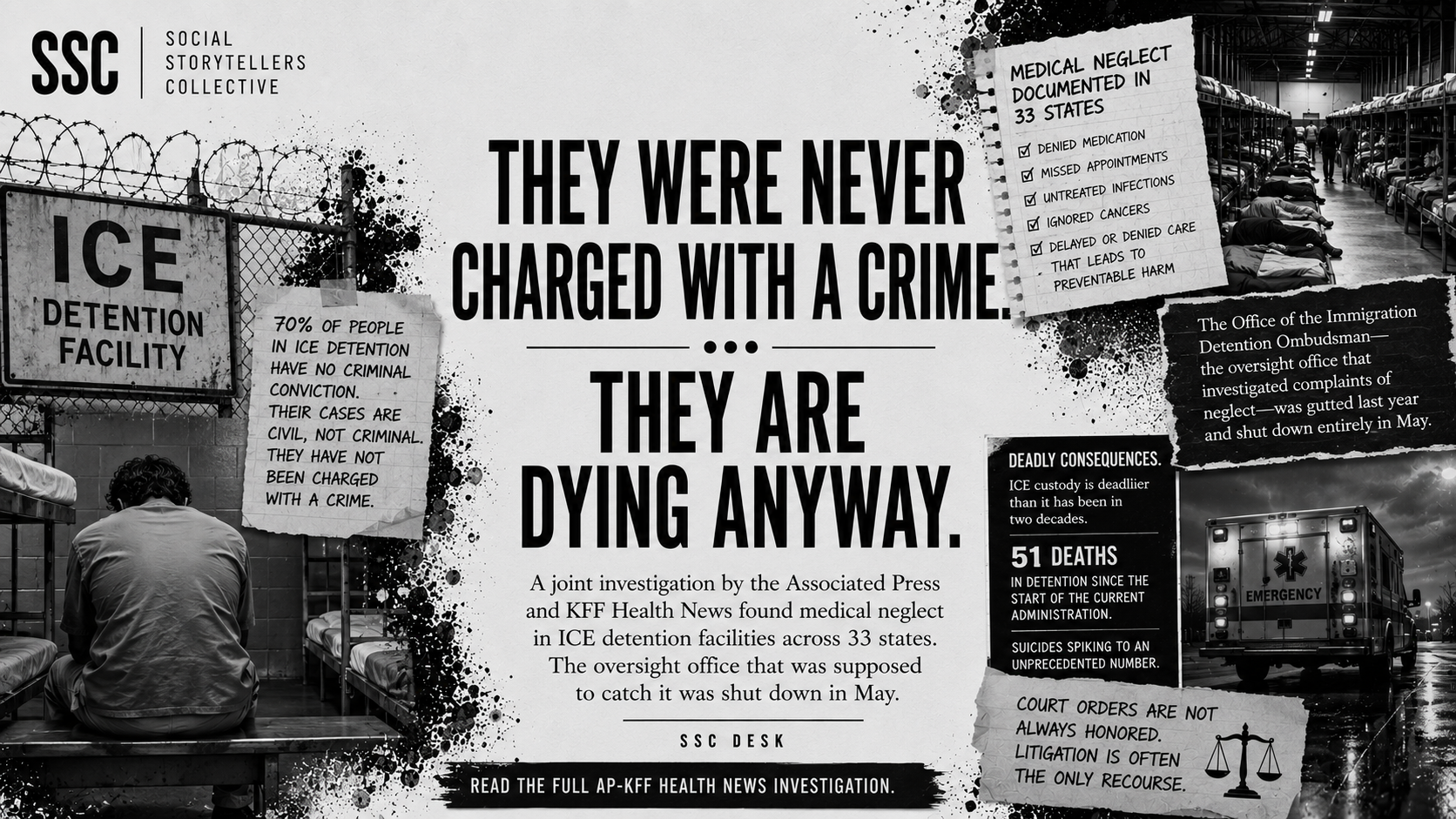
The oversight office that was supposed to catch it was shut down in May.
Seventy percent of the people currently held in U.S. Immigration and Customs Enforcement detention have no criminal conviction. Their cases are civil, not criminal. They have not been charged with a crime, tried by a jury, or sentenced by a judge. They are being held while immigration proceedings — proceedings that can stretch for months or years — work their way through an overloaded system. And according to a joint investigation by the Associated Press and KFF Health News, hundreds of them are not getting the medical care that the law requires the government to provide.
The details documented across more than 300 federal court cases filed in 33 states are not abstractions. An Albanian man pulled out his own tooth after months of untreated dental pain in a New Mexico facility. A Honduran mother of two was hospitalized for a heart problem after being denied her blood pressure medication in Florida. A Venezuelan man’s leg turned purple from flesh-eating bacteria after staffers failed to bring him to a scheduled doctor’s appointment in Vermont. A man with advanced stomach cancer was denied a pillow to ease the pain of sleeping. A woman with legal blindness in one eye and severe glaucoma in the other received her eye drops intermittently — and now says it feels like she is seeing through gauze. A Romanian man had a stroke on a video call with his daughter after a detention facility repeatedly failed to administer his post-cardiac surgery medications. His daughter screamed for help through the monitor. An officer eventually came in and cut the feed.
These are not edge cases. The AP and KFF Health News analyzed thousands of habeas corpus petitions filed since the current administration took office, interviewed more than 50 detainees, family members, and lawyers, and found allegations of medical neglect spanning the entire detention system — including county jails, repurposed offices, and quickly staged facilities with nicknames like “Alligator Alcatraz.” ICE custody is deadlier than it has been in two decades, according to researchers writing in JAMA in April. The Department of Homeland Security reported 51 deaths in detention since the start of the current administration, with suicides spiking to an unprecedented number. DHS did not respond to the findings before publication.
The infrastructure that was supposed to catch these failures no longer exists. The Office of the Immigration Detention Ombudsman — which previously investigated complaints of neglect and could facilitate medical care for detainees — was gutted last year and shut down entirely in early May, citing a lack of Congressional funding. There is now no independent oversight body to call. Attorneys say the only recourse left is litigation, and even court orders are not always honored. A California judge ordered the government to take a man showing signs of prostate cancer to a specialist. Records show they did not take him. ICE told the judge it was an internal scheduling error.
The detained population has more than doubled since the current administration took office — from roughly 40,000 to more than 75,000 as of mid-January. The medical infrastructure has not scaled with it. ICE has spent nearly half a billion dollars on detainee healthcare this year, according to the agency’s own figures — and the AP-KFF investigation documents what that money is and is not producing. Detainees missing weeks of HIV medication during transfers. Blood sugars rising without insulin. Infections progressing to the point of near-amputation. Cancers going untreated while lawyers fight in court for appointments that get missed anyway.
The private contractors running these facilities — CoreCivic and Geo Group among them — told reporters they follow ICE standards and that detainees receive care when it is required. Some said they were unfamiliar with the allegations outlined in the court documents. Others blamed the detainees themselves for lapses in their own medical care.
What the AP and KFF Health News documented is not a system that is struggling to keep up. It is a system that eliminated its own accountability structure at the exact moment its population doubled and its legal obligations expanded. The people absorbing the cost of that decision have not been convicted of anything. They are waiting — for hearings, for rulings, for medications that do not arrive, for appointments that get missed, for someone to pick up the phone. Read the full AP-KFF Health News investigation.