

Airlines are digging out, but stranded travelers are absorbing costs the refund rules don’t cover. China still holds the minerals card ahead of Thursday’s Trump–Xi meeting, Cabo Verde votes, climate negotiators argue over what “clean” means, and SpaceX catches a spaceship while losing its booster.
Sunday’s headlines are about the gap between fixing a problem and actually solving it. The FAA has restored air traffic, but thousands of travelers are still paying for Friday’s failure out of their own pockets. Washington is spending billions to reduce its dependence on Chinese minerals while still needing Beijing’s cooperation to keep factories running. And a small African island nation is choosing a president at a time when many of its young people are deciding their future lies somewhere else. Here are five things that matter today.
1. Flights Are Back, but the Refund Rules Leave Stranded Travelers Paying the Rest

The FAA expects schedules to return to normal by the end of Sunday, but the disruption from Friday’s nationwide ground stop has now spread across three days. More than 6,400 flights were canceled Saturday, on top of more than 9,000 on Friday, according to FlightAware data reported by ABC News, and more than 900 Sunday flights had already been canceled by Saturday night. Transportation Secretary Sean Duffy said the shutdown was caused by either bad equipment or human error as a contractor replaced old copper telecommunications lines with fiber at a remote FAA facility, The Washington Post reported. As SSC reported Saturday, the government is rebuilding a critical system while that system is still running. The trouble didn’t stop there: on Saturday night, a Copa Airlines jet clipped a UPS cargo plane while taxiing at Miami International, an unrelated incident that capped a rough weekend for air travel.
For travelers, the money problem is just beginning. Passengers whose flights were canceled can get a refund if they decline a rebooking. Airlines generally don’t have to cover hotels, meals or other costs when the disruption is outside their control, and an FAA equipment failure falls in that category.
Why it matters: A national infrastructure failure can become a personal financial emergency. A refunded ticket doesn’t cover a night in a hotel, a missed shift at work or a last-minute rental car.
What to watch: Whether schedules fully recover before Thanksgiving travel, and whether investigators say if Friday’s failure came from defective equipment or contractor error.
2. Billions in Mining Investment Haven’t Changed the Math Before Trump Meets Xi
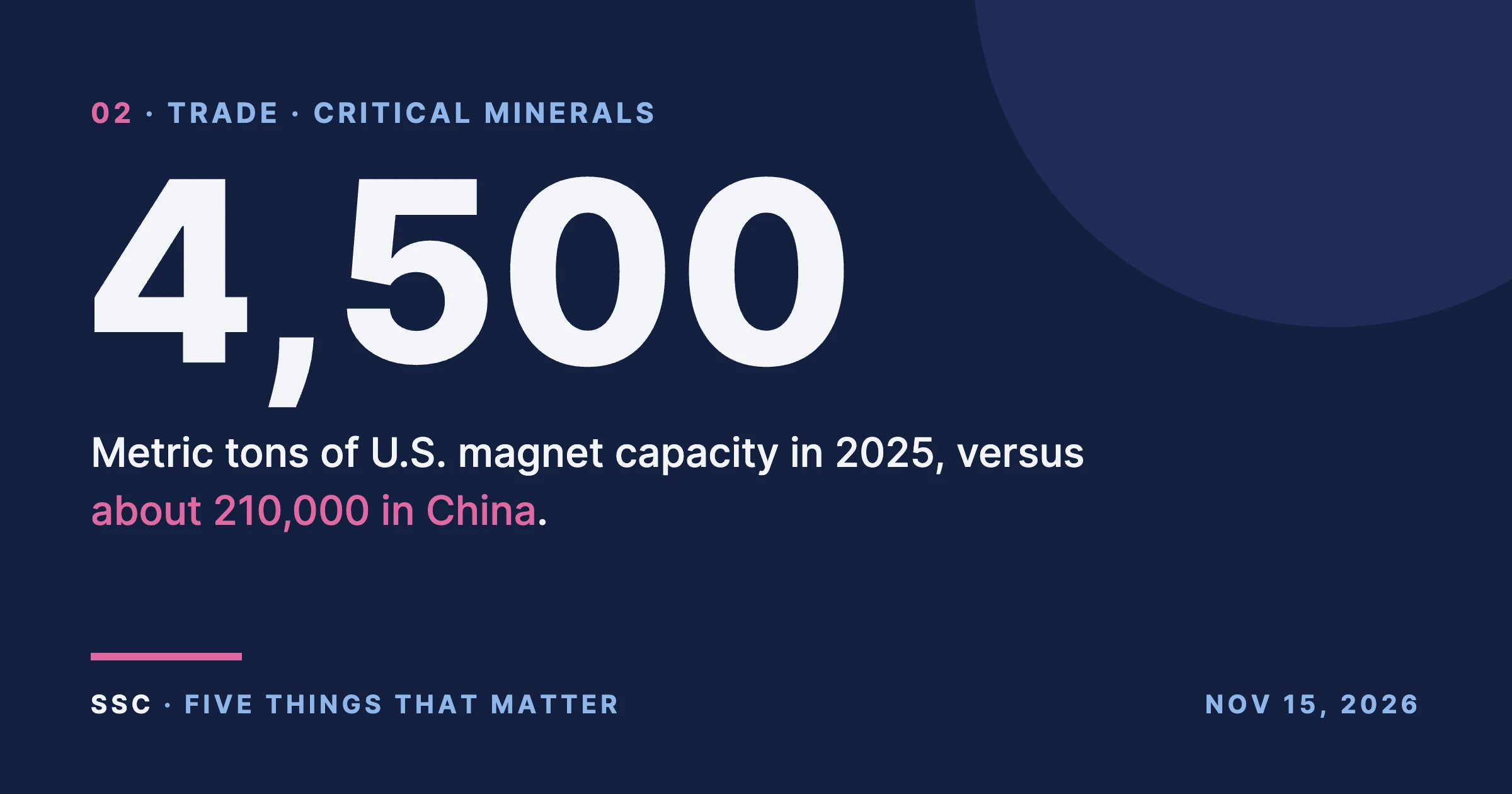
Donald Trump meets Chinese President Xi Jinping on Thursday with his effort to build a domestic critical minerals supply still unfinished. According to Reuters, many U.S. mining projects remain years from production despite billions in federal investment, leaving American manufacturers dependent on Chinese materials essential to semiconductors, robotics, weapons systems and the AI boom. The gap is enormous: U.S. capacity to make neodymium-iron-boron magnets was roughly 4,500 metric tons in 2025, compared with about 210,000 metric tons in China, according to the International Energy Agency.
Some new supply is coming online, slowly. Lithium Americas expects to begin producing at Nevada’s Thacker Pass mine in 2028, and Perpetua Resources plans to produce antimony in Idaho by 2029. Vulcan Elements has begun making rare earth magnets in North Carolina, although its customers have not yet approved them for use. In the meantime, the two leaders may agree to extend their existing trade truce, which expires in January and includes export-control waivers for certain critical minerals.
Why it matters: Controlling minerals isn’t only about owning mines. The country that processes the material and makes the components can set costs, slow rivals’ technology and pressure other governments. For now, Trump can only push Xi so far before risking the magnets that U.S. factories and weapons programs depend on.
What to watch: Whether Thursday’s meeting extends the truce by a few months or produces supply guarantees that last beyond the next deadline.
3. Cabo Verde Has Its First Woman on the Presidential Ballot. Voters Want Jobs First.
Cabo Verde votes for president Sunday, and for the first time a woman is a major contender. Joana Rosa, a former justice minister backed by the opposition Movement for Democracy, is the first woman to appear on the country’s presidential ballot. She is challenging incumbent José Maria Neves, who is seeking a second term with the support of the PAICV, the party that won this year’s parliamentary elections and now leads the government. Four other candidates are also on the ballot, and Neves is widely seen as the favorite. The outcome may matter less to voters than the economy. Youth unemployment, a shortage of good jobs, housing costs and emigration dominate the campaign in a country of roughly half a million people, whose diaspora is large enough that tens of thousands of voters are registered abroad.
Why it matters: Migration sends money home to families, but it also drains small economies of their young workers and rising professionals. The real question for Cabo Verde isn’t only who leads the country but what it would take for more young people to build their lives there.
What to watch: A candidate needs more than half of the valid votes to win outright, under the country’s electoral rules. If no one gets there, the top two go to a runoff.
4. COP31 Wants More Electricity, Without Saying Where the Power Comes From
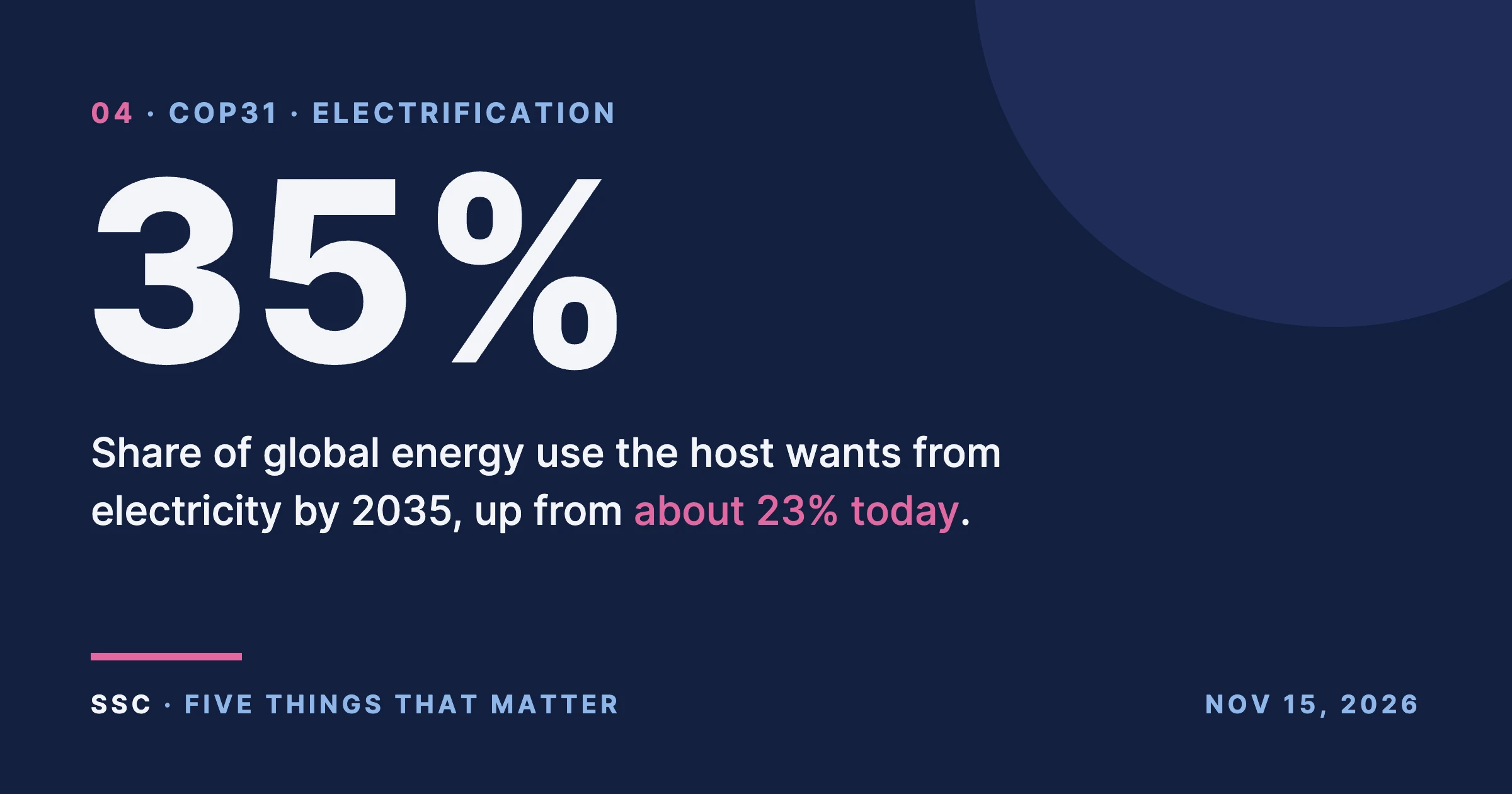
The COP31 climate summit in Antalya, Türkiye, enters its final week with governments still divided over whether the agreement should explicitly speed up the move away from fossil fuels. UN climate chief Simon Stiell urged negotiators Saturday to take on the hardest issues instead of delaying them, while major fossil-fuel producers keep resisting firmer language. The United States did not send an official delegation. The host country’s signature proposal, known as “35 by 35,” would lift electricity’s share of global final energy consumption to 35% by 2035, from about 23% now. Critics point out that the target doesn’t require the extra electricity to be clean. Portugal’s environment minister has argued that “our proposal is not simply electrification, but clean electrification.” The host’s own grid shows why that matters: Türkiye’s Energy Ministry said coal was the country’s largest electricity source in 2025, at 33% of generation.
Why it matters: Electrification on its own isn’t a climate strategy if the power plants behind it still burn coal and gas. Whatever deal comes out of Antalya will influence investment in grids, transportation, manufacturing and household utility bills worldwide.
What to watch: Whether the final text pairs the electricity target with measurable fossil-fuel commitments and climate financing before talks close on Friday.
5. SpaceX Caught a Spaceship From Orbit, and Lost the Booster That Launched It
SpaceX reached a milestone it has been working toward for years. On Saturday, the company caught a Starship upper stage with its launch tower for the first time, about 22.5 hours after Flight 15 lifted off from Starbase. Ship 42 flew 14 orbits and deployed 26 Starlink V3 satellites before the tower’s arms closed around it, according to CNBC. The booster didn’t make it back. SpaceX said the booster’s guidance system automatically canceled its catch after detecting a problem, and the Super Heavy came down and exploded in the Gulf of Mexico, UPI reported. SpaceX has now caught both stages on separate flights, but never both on the same mission, which is what full reusability requires.
Why it matters: A rocket that can be caught and reflown in days instead of rebuilt over months could sharply cut the cost of launching satellites and cargo. It also matters for NASA, which is counting on Starship to return astronauts to the lunar surface in 2028.
What to watch: What SpaceX finds about the booster’s failed return, and whether the next flight catches both stages.
The Bottom Line
Across transportation, trade, politics and climate, Sunday’s news shows that progress doesn’t automatically end vulnerability. The FAA can restore service without reimbursing every stranded traveler. Washington can fund new mines without escaping China’s supply chains for years. Cabo Verde can make electoral history without slowing the departure of its young people, and SpaceX can catch a spaceship while still losing the rocket underneath it.
The people in charge will measure progress through negotiations, investments, election results and engineering milestones. Everyone else will measure it by whether they can afford to travel, find opportunity at home, pay their energy bills and rely on the systems that run their lives. Context matters.
Five Things That Matter is produced by the Social Storytellers Collective News Desk. Get the End of Day Closing Note free in your inbox.