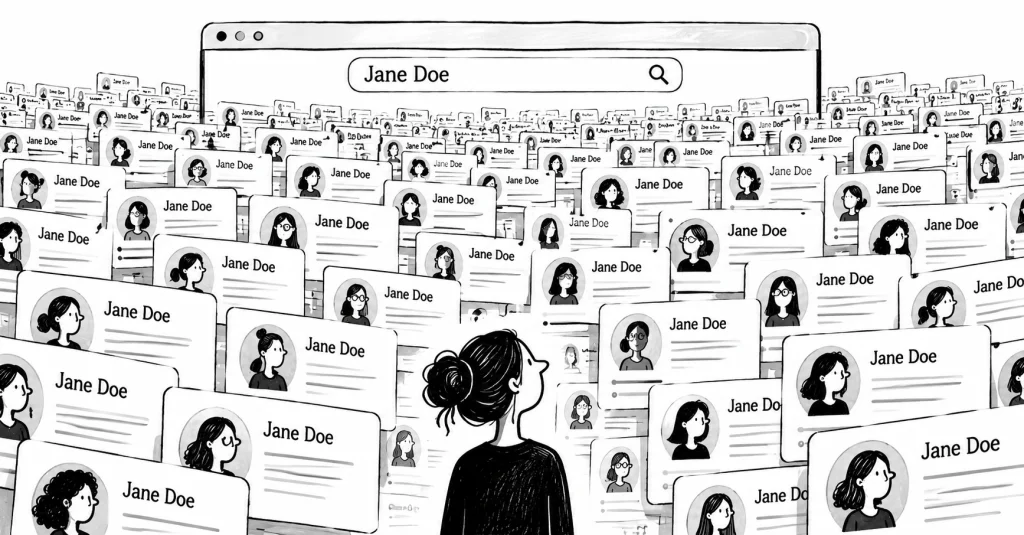
The same social platforms that can expose someone are being flooded with false identities to protect her. Days after the Nolan Wells blackout, another digital campaign is testing what collective visibility can actually do.
Associated Press reporter Deepti Hajela reported Sunday that women and some men are flooding social media with posts declaring “I am Jane Doe” after people online began trying to identify the woman suing Cornell University and seven fraternity members she accuses of raping her. Some participants are sharing their own experiences with sexual violence. Others have a more specific goal: create enough competing information around the name Jane Doe that search engines, social platforms and AI systems have a harder time determining who the Cornell plaintiff actually is.
Online identification works by connecting fragments. A university, an age, a date, a social circle, a photograph or an old post can become useful once enough pieces point toward the same person. The #IAmJaneDoe campaign is deliberately adding bad pieces to that process. Photographer Kelsey Combe told Hajela that she joined partly “to confuse the AI models.” The strategy worked imperfectly: an AI system later identified Combe herself as the Cornell plaintiff before she had the claim removed.
The Crowd Is Changing What Search Can Tell You
Reuters reporters Donna Bryson and Jonathan Allen documented why participants felt the intervention was necessary. The plaintiff’s attorney said attempts to discover and publish her identity had left her “under siege on social media.” Commentator Michael Tracey had publicly solicited help identifying her and later posted what he believed was her name before deleting it. Reuters could not verify the identification. The plaintiff filed her lawsuit on September 16; prosecutors have since reopened the criminal investigation, and New York Gov. Kathy Hochul appointed Attorney General Letitia James as special prosecutor.
The online response transfers some control over identity away from the people trying to expose Jane Doe and toward the crowd trying to protect her. A pseudonym once depended heavily on courts and news organizations agreeing not to publish a name. Digital platforms weakened that protection because anyone with enough fragments could attempt the identification independently. The campaign is responding inside the same system. Participants cannot remove information from the internet, so they are reducing its reliability by multiplying the number of people attached to the same name.
That makes this an interesting companion to Social Storytellers Collective’s recent piece, A Black Square Is Easy. Staying With Nolan Wells Is the Hard Part. The Nolan Wells blackout used repetition to prevent an unresolved death from disappearing into the news cycle. People replaced profile pictures with black squares and repeated Wells’ name because visibility was scarce. Jane Doe faces the opposite problem. Her protection depends on making one identity less searchable. The campaigns move in different directions, but both depend on ordinary users temporarily changing how information moves through a platform.
Visibility Can Protect and Expose
The Nolan Wells piece also documented the limit of the tactic. During Blackout Tuesday in 2020, millions of black squares made solidarity highly visible while simultaneously burying some of the organizing information activists were trying to circulate. A platform built to reward volume does not distinguish automatically between useful attention and harmful attention.
Jane Doe is demonstrating the same problem from another direction. Flooding platforms with false associations may make identification harder, but it can also create collateral damage. Combe was falsely linked to the lawsuit. Other women have already been incorrectly identified as the Cornell plaintiff, according to her attorney. The crowd can disrupt the search process without controlling where the confusion lands.
The stakes extend beyond one lawsuit. Reuters reported that 21% of U.S. women say they have experienced completed or attempted rape. At Cornell, 35% of undergraduate women reported nonconsensual sexual contact involving force or incapacitation in a 2025 university survey, up from 20% in 2021. Those numbers are part of why “I am Jane Doe” has spread beyond a privacy campaign. Women are attaching themselves to the name because the experience represented by it is familiar to far more people than the lawsuit alone would suggest.
Digital Solidarity Is Becoming More Tactical
The black square and #IAmJaneDoe show two uses of the same digital power. One concentrates attention. The other contaminates a search result. Neither requires an institution to grant access, approve the message or organize the participants. A large enough group can temporarily alter what a feed emphasizes and what a search appears to know.
That power remains temporary. The Nolan Wells blackout could not compel investigators to reopen a case. #IAmJaneDoe cannot guarantee anonymity if identifying information becomes independently verifiable. Social media can alter the information environment around an institution without acquiring the authority to make the institution act.
But these campaigns are getting better at understanding the systems they are using. The next generation of digital protest may look less like people simply posting the same message and more like people deliberately manipulating the conditions under which information becomes visible, searchable or credible. Nolan Wells showed what a crowd can do when it refuses to let a name disappear. Jane Doe is showing what the same crowd can do when it decides one name should no longer point cleanly to anyone.