
Google’s Gemini AI platform is rolling out expanded capabilities that allow users to generate personalized AI images using photos stored in their personal libraries — including images of family members, vacations, and everyday life. The feature is being positioned as opt-in personalization. The structural shift underneath it is something more consequential.
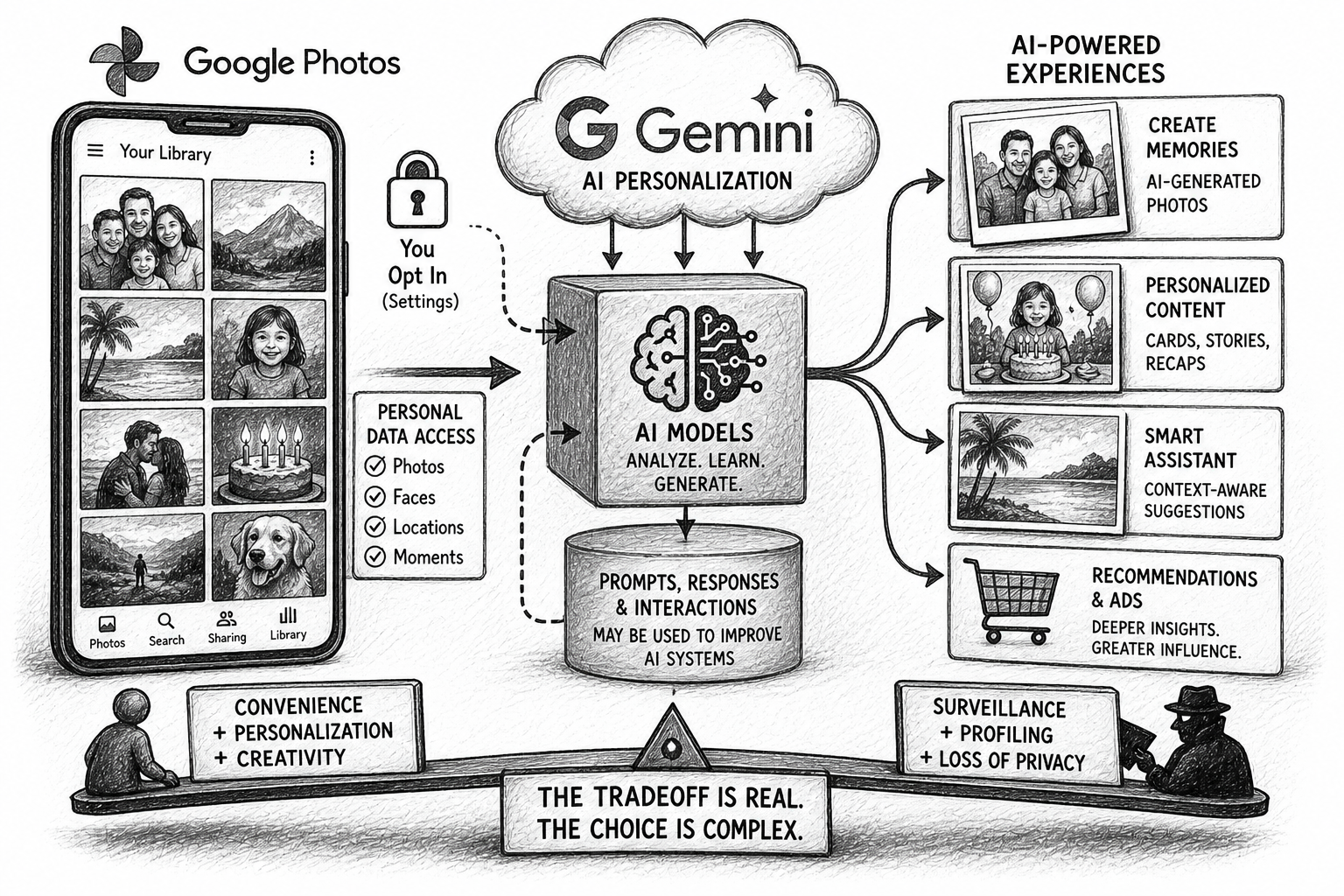
The concern extends beyond image generation. Google has acknowledged that prompts, responses, and interactions tied to user data may be used to improve AI systems — reinforcing growing public anxiety around how consumer behavior is being converted into long-term machine learning assets. While the company maintains that users control participation settings, modern tech platforms increasingly rely on layered consent systems that most users never fully read or understand. In practice, personalization becomes the mechanism through which platforms normalize deeper access to intimate behavioral data. The opt-in is real. So is the architecture it opens the door to.
What makes this shift significant is not simply that AI can now access photos. Cloud ecosystems already organize, categorize, and recognize faces, locations, and objects automatically. The structural change is that generative AI transforms those archives from passive storage into active production systems. Personal images are no longer memories sitting in a gallery — they become raw material for synthetic content generation, recommendation systems, emotional engagement tools, and future commercial AI products. The photo library evolves from documentation into infrastructure.
This is the same logic SSC examined in Instagram’s Encryption Rollback Is Reframing What “Private” Means Online — platforms quietly redefining the boundary between what feels personally private and what is technically accessible to the company operating the system. Meta removed the encryption layer that prevented it from reading DM content. Google is extending AI reach into photo archives. The mechanisms are different. The direction is the same: the intimate data users generate inside platform ecosystems is becoming more legible to the institutions that host it, and each expansion is framed as a feature rather than a policy shift.
The timing reflects competitive pressure inside the AI industry. Google, OpenAI, Meta, and Apple are racing to make AI assistants more personalized, context-aware, and continuously integrated into daily life. The companies that gain the deepest behavioral understanding of users gain the strongest long-term advantage in advertising, commerce, recommendation systems, and platform retention. Personalization is both a product feature and a competitive moat — which means the incentive to deepen access is structural, not incidental.
For users, the practical reality is more complicated than simple acceptance or rejection. AI-enhanced personalization can create genuinely useful experiences — automated memory creation, faster content editing, accessibility improvements. But the tradeoff increasingly centers on how much of daily life people are willing to convert into machine-readable systems in exchange for convenience. The deeper AI embeds itself into communication, photos, calendars, purchases, and search behavior, the more difficult it becomes to distinguish between a digital assistant and a continuously learning behavioral mirror. That distinction is not a technical question. It is a governance one — and the platforms expanding their access are not the ones being asked to answer it.