THE COST OF WORK
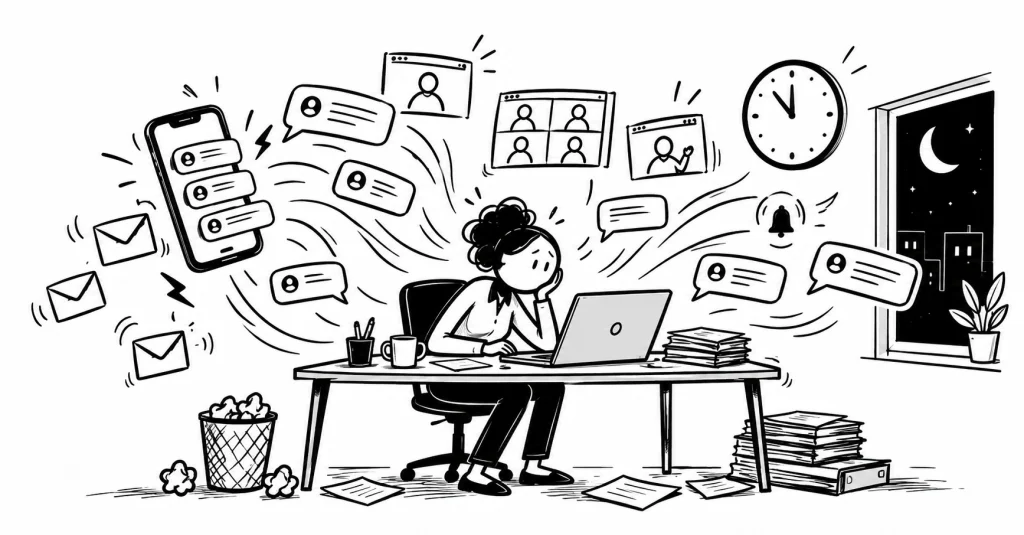
Digital coordination can consume the hours meant for concentrated work, pushing unfinished tasks into evenings and weekends.
Analysis | Social Storytellers Collective
Part of SSC’s reporting series examining labor pressure, workplace rules and who absorbs the cost.
Microsoft’s 2025 research on the expanding workday found that 48% of employees and 52% of leaders surveyed described their work as chaotic and fragmented. Its Microsoft 365 telemetry also showed meetings after 8 p.m. increasing 16% year over year. Those findings concern the populations and digital activity studied; they are not a census of all workers or evidence of a new change this week. They offer a useful explanation for a familiar problem: the scheduled workday can fill with coordination while the work requiring concentration waits until later. The cost appears when employees use personal time to close that gap.
Coordination Can Crowd Out Completion.
An employee can spend the morning answering requests, the afternoon attending meetings and the evening writing the report those conversations were intended to support. Every individual request may be reasonable. Their combined demand may exceed the hours available. The resulting problem is easy to misread as weak time management because the unfinished task belongs to an individual, while the interruptions come from across an organization. A manager who sees only the missed deadline may never see the competing obligations that made it difficult to meet. Understanding the workload requires looking at both assignments and the time consumed by maintaining communication around them.
The widely circulated Microsoft figure of 275 daily interruptions also needs care. The underlying measure counts pings across a 24-hour day among the highest-volume 20% of users. It should not be described as what every employee experiences during an eight-hour shift. Even with that qualification, the broader issue is worth examining: tools designed to make contact easier also make demands on attention easier to generate. Sending a message costs the sender little time, but responding can require the recipient to stop, reconstruct context and return to another task. That accumulated burden deserves a place in workload planning.
Availability Becomes an Unwritten Requirement.
After-hours activity does not always signal coercion. Some people prefer an early start, split their day around family commitments or choose a quiet evening for focused work. The problem arises when personal choice becomes an expectation that everyone must remain reachable. An evening message may be harmless if the recipient knows it can wait until morning. The same message can interrupt a household when response expectations are unclear or when quick replies appear to influence judgments of commitment. A workplace can therefore create pressure without issuing an explicit instruction to work late. Employees read the behavior managers reward, not just the boundaries managers announce.
Gallup’s research on burnout identifies unmanageable workloads, unclear expectations, insufficient manager support, unfair treatment and unreasonable time pressure among its principal drivers. That shifts attention toward the conditions under which people work. It is difficult to solve a structural shortage of focused time by asking individuals to become better at protecting it while maintaining every existing obligation. Boundaries have to be supported by decisions about priorities. Otherwise, declining a meeting, postponing a reply or asking which assignment should wait can look like a personal failure rather than responsible management of limited capacity.
Give Focused Work a Place in the Plan.
Organizations can clarify which channels signal urgency, specify normal response windows and reduce meetings that do not require live discussion. Managers can protect blocks for concentrated work and make explicit what should be delayed when an urgent assignment arrives. These changes need to match the work: a global team will face different coordination needs from a local one, and customer-facing roles may have different constraints from internal project roles. The useful test is whether employees have enough paid time to complete the responsibilities assigned to them. Calendar availability alone cannot answer that question if every open hour is treated as space for another demand.
The cost of an extended workday is partly financial, but it also concerns recovery, family attention and the ability to stop anticipating the next request. Efficiency should make a task easier to finish within an agreed period. If easier communication instead produces more obligations and fewer uninterrupted hours, organizations need to reconsider how they use that convenience. Workers should not have to prove commitment by staying continuously reachable. A healthier measure is whether the work gets done well within conditions people can sustain, with clear expectations about when responsibility ends and personal time begins.