
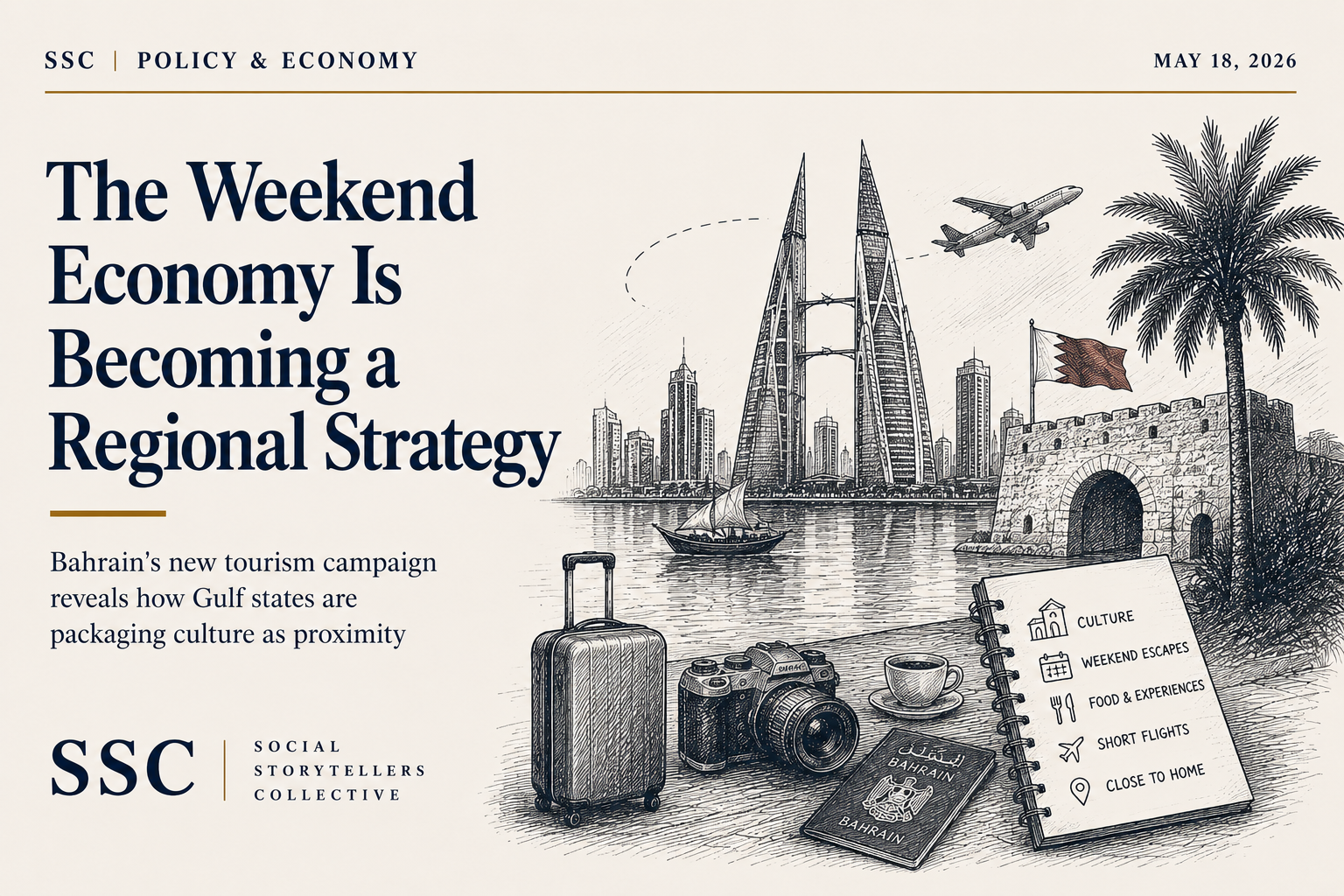
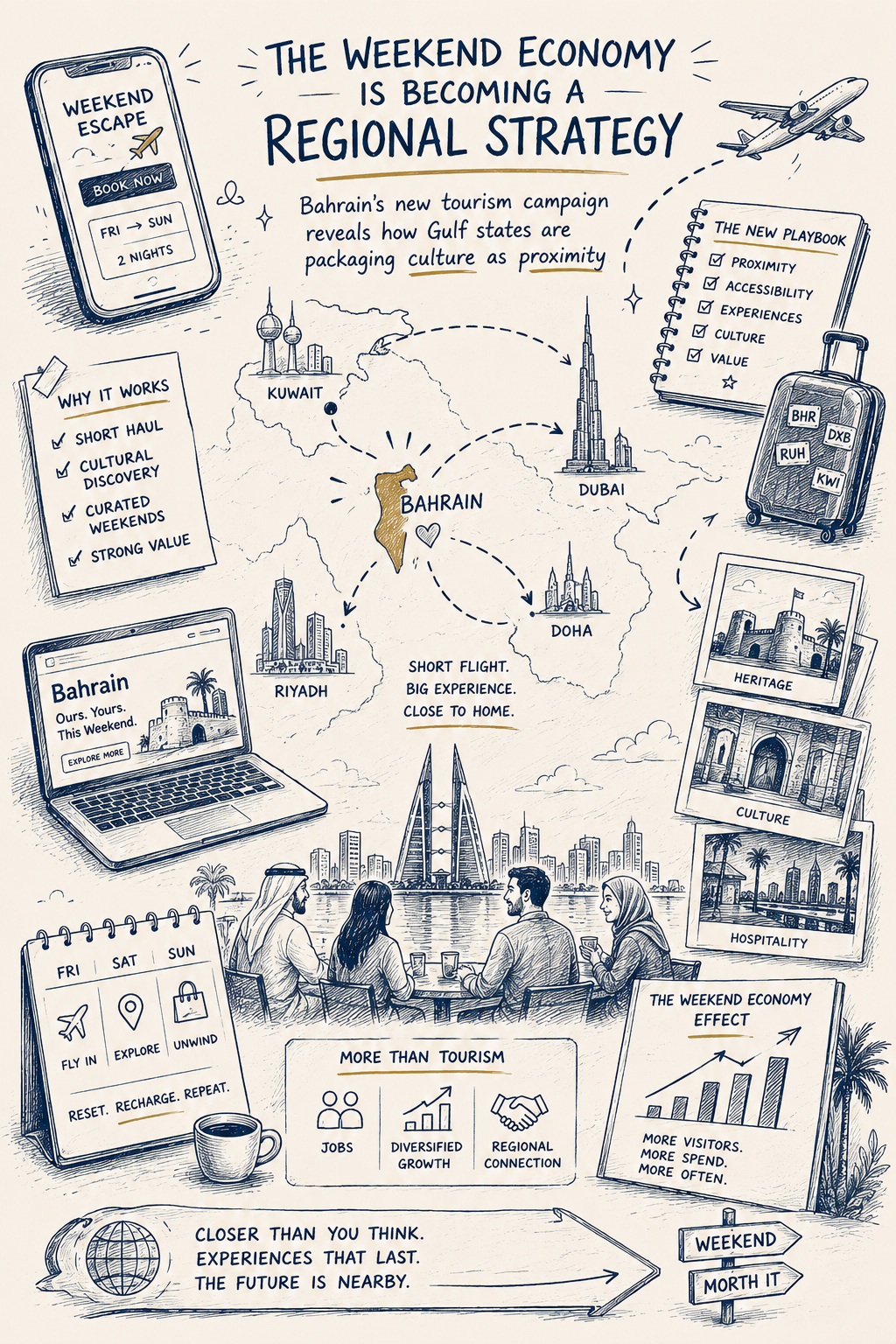
Bahrain launched a new GCC-focused tourism campaign this week built around concerts, festivals, shopping, family entertainment, sports events, dining, and hospitality packages aimed at short regional getaways. The campaign promotes Bahrain as an accessible weekend destination for Gulf travelers seeking condensed luxury and cultural experience without long-haul international travel. Traditional tourism campaigns lead with scenery or heritage. Bahrain’s strategy leads with something more specific: the rise of the experience-density economy, where cities compete by maximizing how much curated lifestyle activity can fit into a short window of time.
The Gulf tourism market has transformed rapidly over the last decade as Saudi Arabia, the UAE, Qatar, and Bahrain invested heavily in entertainment infrastructure, airline expansion, hospitality development, and event programming. Saudi Arabia alone is targeting 150 million annual tourists by 2030 under Vision 2030. Dubai International Airport handled more than 86 million passengers in 2023. Bahrain’s positioning acknowledges a regional audience with higher disposable income, stronger connectivity, and growing demand for short-form luxury experiences that feel efficient rather than expansive — travel that fits around modern schedules rather than requiring departure from them.
The important shift is that tourism increasingly functions as emotional logistics. Travelers are no longer simply purchasing flights and hotel rooms. They are purchasing compressed identity experiences: wellness weekends, food districts, concert series, motorsports events, shopping corridors, and branded hospitality environments designed to feel culturally elevated within limited timeframes. The modern traveler optimizes around convenience, visibility, and social shareability. Gulf tourism campaigns are adapting to that behavioral reality by marketing proximity as luxury itself. Bahrain is positioning itself as a high-access regional reset — not a once-a-year destination, but a recurring option.
That logic mirrors broader economic behavior across industries. Streaming platforms optimize for frictionless engagement. Food delivery apps optimize for immediate availability. Remote work normalized shorter, more flexible travel patterns for hybrid professionals. Experience economies are adapting to the same behavioral shifts — and the Gulf is investing to capture that demand before it consolidates elsewhere. The campaign is not selling Bahrain as a place worth traveling to. It is selling Bahrain as a place worth returning to, repeatedly, without planning far in advance.
There is a labor dimension beneath the polished campaign imagery that rarely surfaces in coverage. Experience economies require large operational workforces across hospitality, transportation, entertainment, security, logistics, retail, and food service. Gulf states continue balancing aggressive tourism expansion with deep dependency on migrant labor systems that sustain most of the region’s service infrastructure. The faster experience economies grow, the more invisible that labor becomes — necessary to maintain the appearance of seamless convenience while remaining structurally excluded from its rewards.
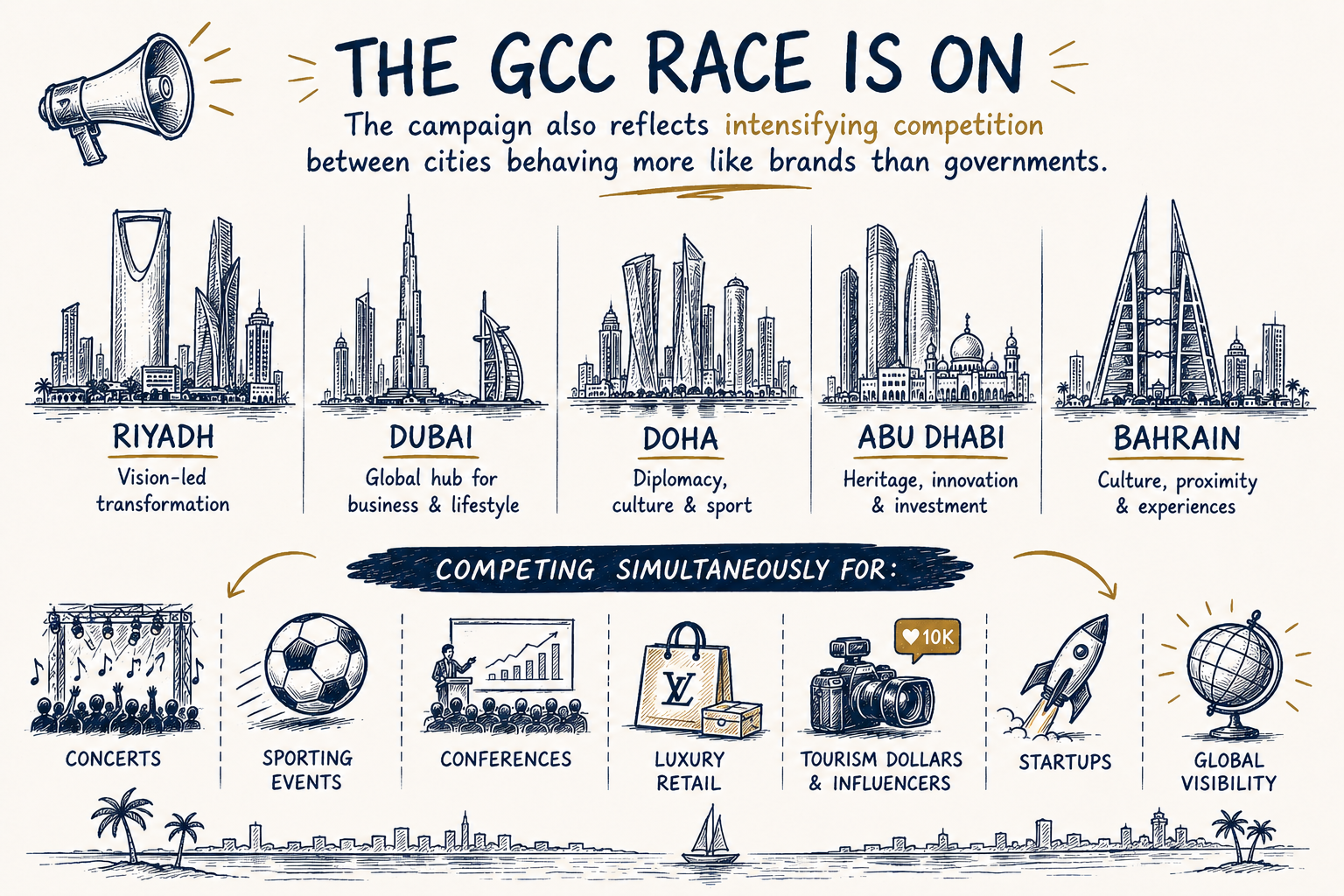
The campaign also reflects intensifying competition between cities behaving more like brands than governments. Riyadh, Dubai, Doha, Abu Dhabi, and Bahrain are now competing simultaneously for concerts, sporting events, conferences, luxury retail, tourism dollars, influencers, startups, and global visibility. Culture becomes a development strategy because economic diversification increasingly requires attracting attention before attracting capital. Visibility itself becomes a precursor to investment, and investment follows the perception of momentum.
Bahrain’s campaign is not selling vacations. It is selling efficient access to curated lifestyle participation — and that framing increasingly defines how modern consumers measure value in both travel and daily life. The weekend economy is becoming a permanent infrastructure category. Gulf states are building for it deliberately. The cities that move fastest will not simply capture more tourists. They will capture the definition of what a modern short-form experience is supposed to feel like — and that definition, once established, is difficult to displace.
SSC | Culture & Society — May 18, 2026 — Social Storytellers Collective News Desk