
The number that anchors the story is $5.86. That is the average price of a gallon of gas in California, nearly two dollars higher than the national average, and it is being driven in part by disruptions thousands of miles away in the Strait of Hormuz. On the surface, this is a familiar story about global supply chains and regional constraints. But what the number obscures is how unevenly that cost is distributed once it arrives. A price increase does not land on a neutral population. It moves through a state where geography, race, and income are already structured in ways that determine who has flexibility and who does not. The result is not just higher costs. It is a quiet reordering of who can afford to move through daily life without strain.
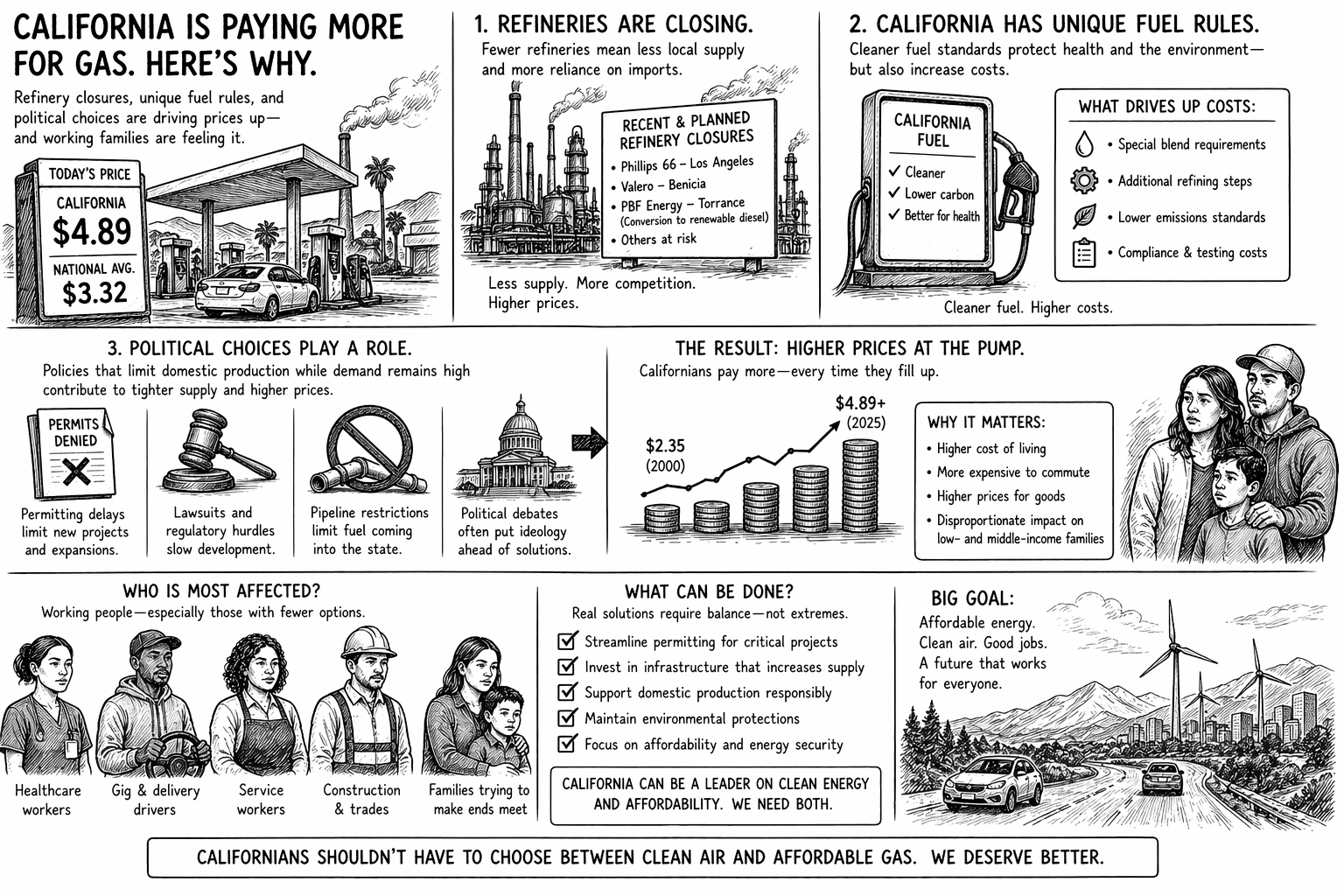
The geography of California is central to how this cost is distributed. Over the past two decades, rising housing prices have pushed many Black and Latino residents farther from job centers into inland and outer-ring communities where housing is marginally more affordable but transportation options are significantly more limited. These shifts were not random. They reflect patterns of development that concentrate opportunity in certain areas while pushing others outward. In those outer regions, commuting is not optional. It is the condition of employment. When gas prices rise, the cost of that distance becomes immediately visible. A worker driving 40 miles each way does not experience a price increase the same way someone living near a transit hub does. The same gallon of gas carries different weight depending on where you are positioned within the state’s geography.
That difference becomes sharper when layered onto income. Lower-income households already spend a larger share of their earnings on transportation, and in California, that baseline is higher to begin with. For Black and Brown families disproportionately represented in lower-wage sectors, fuel is not discretionary. It is tied directly to the ability to maintain employment, manage childcare, and access essential services. When prices rise, the adjustment does not come from convenience spending. It comes from compression elsewhere in the household budget. Groceries, savings, healthcare, and debt absorb the pressure. Gas prices do not operate in isolation. They redistribute strain across every other category of life.
The labor structure reinforces that imbalance. Many of the workers most exposed to rising fuel costs are in roles that cannot be performed remotely—hospitality staff, warehouse workers, home health aides, delivery drivers, construction crews. These sectors keep regional economies functioning, and they are also where Black and Latino workers are overrepresented. For these workers, rising gas prices function as an immediate reduction in effective wages. The paycheck remains the same, but the cost of earning it increases. Over time, that gap compounds, turning a macroeconomic shift into a daily calculation about whether getting to work is worth the cost.
The absence of viable alternatives is what transforms this from a cost story into an access story. Regions with strong public transit systems can absorb fuel shocks by shifting how people move. Much of California cannot. Transit coverage is uneven, and in many of the communities most affected, it is not a realistic substitute for driving. Households are forced to absorb the increase rather than adapt around it. That lack of flexibility is not incidental. It reflects long-term infrastructure decisions that have left certain populations more dependent on a single mode of transportation—and more vulnerable when that mode becomes more expensive.
What this moment reveals is not simply that energy prices are volatile. It is that volatility interacts with existing inequalities in ways that make some populations absorb more of the shock than others. Higher-income households can adjust. They can absorb the cost, reduce travel, or switch modes. Lower-income households, disproportionately Black and Brown, have fewer options. Their mobility is already constrained by where they live, what jobs they hold, and what infrastructure is available to them. When gas prices rise, those constraints tighten.
This is not just a story about fuel. It is a story about how systems translate global instability into local experience. Energy markets operate at a global scale, but their consequences are felt at the level of the commute, the grocery bill, and the monthly budget. In that space—where policy, geography, and lived experience intersect—the burden is not shared equally. It is concentrated, predictably, among the people who were already carrying the most..