
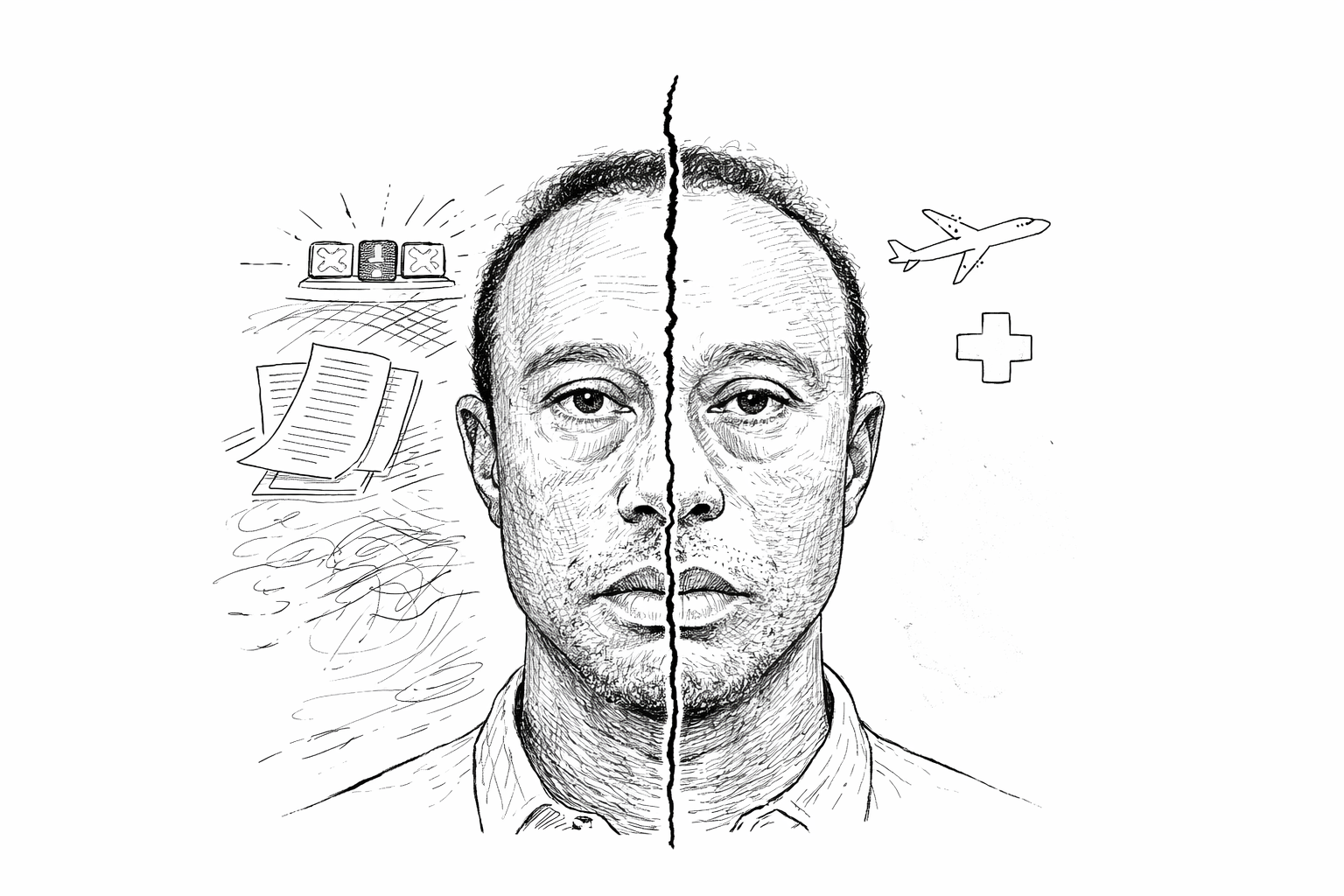
Part of Culture in Motion — examining who defines culture, how it moves, and what it reveals about the moment.
NEWS DESK | SOCIAL STORYTELLERS COLLECTIVE
In our initial reporting — When Old Images Tell New Stories: The Tiger Woods Timeline Problem — the focus was on distortion. Platforms collapsed nearly a decade of events into a single visual narrative, allowing a 2017 mugshot to circulate alongside a 2026 arrest as if they were the same moment. When timelines compress, context disappears, and perception begins doing the work that facts are supposed to carry.
But what that distortion also did — more quietly — was blur accountability.
The release of a second mugshot appears to correct the record. This image is current. It restores sequence. It reanchors the moment in time. But accuracy in image does not guarantee accuracy in consequence. Because even when the timeline is clarified, accountability is not applied evenly.
The facts, as documented in the bodycam footage and arrest affidavit released this week, are not ambiguous. On March 27, 2026, Tiger Woods was traveling at high speed on a two-lane road on Jupiter Island, Florida when his Range Rover clipped a truck hauling a pressure-cleaner trailer and rolled onto its side. Officers who responded found him appearing lethargic and exhibiting signs of impairment. Bodycam footage shows him failing field sobriety tests — tightly shutting his eyes while attempting to stack his fists, clap, and count — and intermittently closing his eyes while seated in the back of a patrol car. He told officers he had taken his prescription medication earlier that day, and two hydrocodone pills were found in his pocket during booking.He blew triple zeroes on the breathalyzer — no alcohol — and then refused a urine test, the refusal becoming one of the charges against him.
He was charged with misdemeanor DUI with property damage and refusal to submit to a lawful test. This is his second DUI arrest and fourth high-profile crash. The 2017 arrest — which ended with a guilty plea to reckless driving — involved being found asleep behind the wheel with a mixture of prescription medications in his system, in an almost identical location.
For most people, that combination — high speed, signs of impairment, a controlled substance in the pocket, refusal of a test, a prior DUI on record — triggers a predictable and often unforgiving chain of consequences: legal exposure, financial strain, restricted movement, and a public record that is difficult to move beyond. Accountability, in those cases, is not just immediate. It is durable.
Here, the sequence begins to diverge in ways worth examining carefully. Four days after the crash, Woods released a public statement announcing his decision to “step away for a period of time to seek treatment and focus on my health,” and arrived shortly after in Zurich, Switzerland to begin treatment. The charges are misdemeanors. The framing shifted almost immediately from legal consequence to personal recovery — from system involvement to treatment, from public accountability to private resolution. Not the absence of accountability, but a transformation of it into something more contained, more controlled, and ultimately more navigable.
This is what structural privilege does. It does not erase consequence. It reshapes it. And that reshaping is not random. Access to resources creates options. Status creates time. Familiarity with institutions creates flexibility. A person of means facing misdemeanor charges with a treatment program in Switzerland already underway arrives at a courthouse in a categorically different position than someone without those options.
Donald Trump, asked about his “very close friend” on the tarmac next to Air Force One, said: “He’s got some difficulty … I don’t want to talk about it.”
The relationship between Woods and the sitting president of the United States is not incidental context. It is part of the institutional landscape that shapes how a case moves through a system that theoretically treats everyone equally.
There is also an identity layer here that complicates the picture in ways that deserve direct naming. Years ago, Tiger Woods described himself as “Cablinasian” — a term he coined to reflect a multiracial identity spanning Caucasian, Black, American Indian, and Asian heritage. It was positioned as specificity. It has also been read, by many, as a deliberate distancing from Blackness. That history matters in a moment like this because accountability in America has never been applied in a vacuum. It is filtered through perception — of race, of belonging, of proximity to power. The question of who gets the treatment narrative and who gets the incarceration narrative is not answered by the facts of the case alone. It is answered by the full picture of who the person is, what relationships they hold, what resources they can access, and how the institutions processing them have historically responded to people who look like them.
Woods is not simply a wealthy celebrity. He is a wealthy, light-skinned multiracial celebrity with a personal relationship with the president, a globally recognized brand, and the institutional access that comes with decades at the top of the world’s most expensive sport. That combination does not make accountability disappear. It makes it negotiable — not in whether it exists, but in how it is experienced, how quickly it is reframed, and how completely it recedes from public memory before the legal process has run its course.
As SSC covered in Everyone Profits From the Narrative — Except the People Living It , the infrastructure of celebrity consequence is not the same infrastructure that everyone else navigates. The same act — impaired driving, a crashed car, a refusal to submit to testing, a prior DUI on record — produces different outcomes depending on what kind of person is sitting in the back of the patrol car. The mugshot suggests equality before the law. The system that follows reveals something closer to hierarchy.
Why This Matters
The first story showed how platforms collapse time, distorting how events are understood. This moment reveals what that distortion can conceal: not just confusion about sequence, but unequal accountability operating underneath the sequence. When timelines blur, it becomes harder to track not only what happened, but what followed — and what following looked like for this person versus what it would have looked like for someone without the same access, the same relationships, the same resources, and the same proximity to power. The image is now current. The timeline is now clear. But accountability remains conditional — and the conditions are not equally distributed.