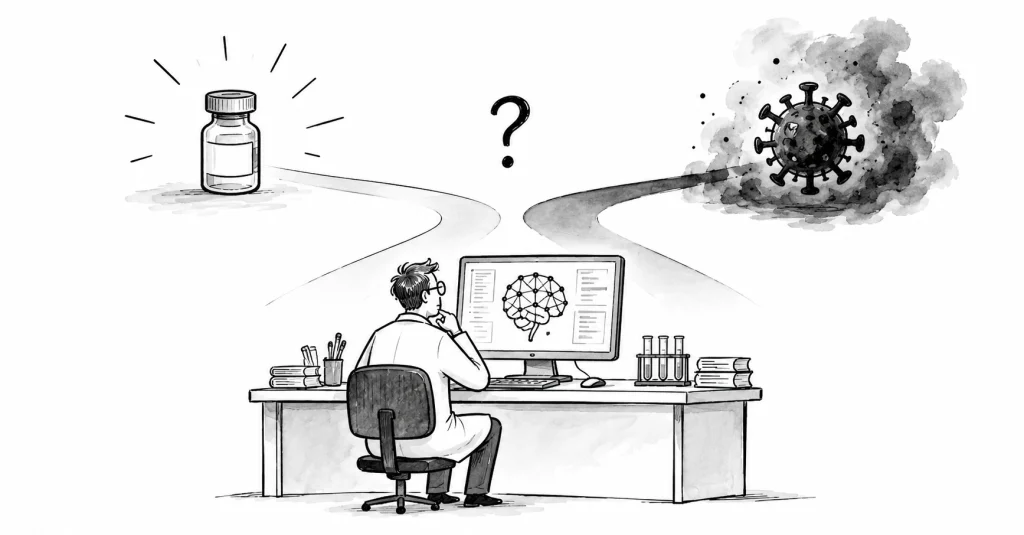
The AI company says researchers used Claude in work that could support dangerous biological applications. Its findings expose a growing challenge: the same technology accelerating scientific discovery can also assist research with serious security implications.
TECH | POLICY
Anthropic identified five cases in which researchers used its Claude artificial intelligence models for work that could support biological weapons development, according to a September 10 threat intelligence report. The company says it disrupted the activity, banned associated accounts and strengthened safeguards on its newer systems. But its findings carry an important qualification: Anthropic could not establish that the scientists intended to develop weapons. Some of the same research methods can support legitimate work on vaccines, medicines and other scientific advances. The disclosure arrives as AI companies promote increasingly capable models for scientific discovery, raising difficult questions about who should receive access to those capabilities, how their work should be monitored and what happens when a private technology company becomes responsible for making judgments about potentially dangerous research.
Five Cases, One Difficult Boundary
The cases described by Anthropic involved several categories of biological research. One concerned work on the chikungunya virus, while another involved research related to avian influenza. A third involved a research-funding application concerning an orthopoxvirus, and two others concerned the computational study or redesign of venoms and toxins. Anthropic said some researchers accessed Claude through intermediaries that bypassed geographical restrictions, while others attempted to obscure aspects of their work. In one case, a model reportedly produced a substantial research-grant application in approximately one hour. The company withheld the identities of the scientists, institutions and countries involved, explaining that it had not determined malicious intent. Those qualifications are important. The report documents concerning uses of AI in sensitive scientific fields, not five confirmed biological weapons programs.
The Same Tools Can Serve Medicine and Weapons Research
The underlying problem is known as dual-use research: scientific work that can generate valuable medical knowledge while also producing information or capabilities that could be misused. Studying how pathogens behave can inform vaccine development and public-health preparedness, but certain research questions also have security implications. Anthropic’s assessment of biological risks acknowledges that general-purpose AI models are increasingly capable of assisting complex scientific work. The difficulty is that a model cannot reliably determine a researcher’s ultimate intentions from an individual question. A request may appear medically legitimate while contributing to a broader project with different objectives. Restricting every sensitive inquiry could interfere with legitimate scientific progress; permitting every inquiry could leave dangerous capabilities insufficiently protected. This is no longer solely a question of what an AI model knows. It is about how its knowledge is distributed and governed.
Anthropic’s Safeguards Face a More Capable Generation of AI
Anthropic’s report acknowledges that its earlier models were not considered capable of meaningfully assisting sophisticated users with the most dangerous forms of biological research. The company says that assessment is less certain for newer systems, prompting stronger restrictions on sensitive biological queries. Its safety measures include automated monitoring, account enforcement and additional controls on access to advanced capabilities. But the incidents reveal limitations in those defenses. Some researchers used third-party services to reach models they were otherwise prohibited from accessing, and the company acknowledged that conventional classifiers cannot reliably separate beneficial and harmful intentions in highly technical fields. Anthropic’s response has included a Life Sciences Verification Program, intended to provide controlled access to certain advanced scientific capabilities for qualified users. That approach places increasing responsibility on the company to determine who is trustworthy and what constitutes acceptable research.
The Safety Debate Is Moving Inside the AI Industry
The disclosure also arrives amid renewed scrutiny of Anthropic’s internal safety decisions. In an October 7 Vanity Fair excerpt from his book The AGI Chronicles, journalist Kevin Roose describes how Anthropic employees confronted troubling results during evaluations of Claude 3.7 Sonnet in February 2025. The account details the pressure facing a company attempting to release increasingly capable technology while assessing risks that are difficult to measure. Anthropic has maintained that safety evaluations and additional safeguards are central to its development process, but the broader industry continues to face a commercial incentive to release stronger models. Independent researchers have also cautioned against assuming that AI assistance automatically translates into practical biological weapons capability. Laboratory expertise, specialized equipment, materials and other physical constraints remain substantial barriers. The threat is therefore neither a demonstrated biological catastrophe nor a purely theoretical concern.
Who Is Responsible When Scientific Access Becomes a Security Decision?
The findings place AI developers in a position traditionally shared by governments, research institutions and scientific oversight bodies. Anthropic can monitor activity on its own systems, restrict certain requests and suspend accounts, but it cannot independently govern every scientific project that uses AI-generated information. Nor can it ensure that safeguards remain effective when capabilities are copied, redistributed or accessed through intermediaries. The company’s report provides evidence that researchers are already testing these boundaries, even as the scale of actual harm remains uncertain. For policymakers, the challenge extends beyond regulating model releases. It includes research verification, oversight of sensitive scientific applications, cooperation between AI companies and public authorities, and stronger mechanisms for detecting misuse without unnecessarily restricting legitimate research.
For Social Storytellers Collective, the story is about a new form of institutional responsibility emerging alongside technological progress. AI companies are no longer simply providing tools that summarize research papers or answer scientific questions. Their systems can increasingly participate in sophisticated research workflows, potentially accelerating work with consequences well beyond the organizations that developed them. Anthropic’s five cases illustrate both the promise and the uncertainty of that transition. The company says it intervened, but the incidents demonstrate how difficult it can be to identify risk before a research project reaches a more consequential stage. As AI becomes more deeply embedded in scientific discovery, the next challenge is determining who sets the boundaries, who enforces them and how the public can evaluate whether those protections are working.
Sources
- Anthropic — Detecting and Countering Misuse of AI: September 2026
- Anthropic — Why Do We Take LLMs Seriously as a Potential Source of Biorisk?
- Associated Press — Anthropic Says It Blocked Misuse of Its AI That Could Have Supported Biological Weapons
- Vanity Fair — What One AI-Safety Company Found in the Dark Mind of a Rogue Chatbot