
Part of The Access Shift — examining how access is being quietly reshaped across American life.
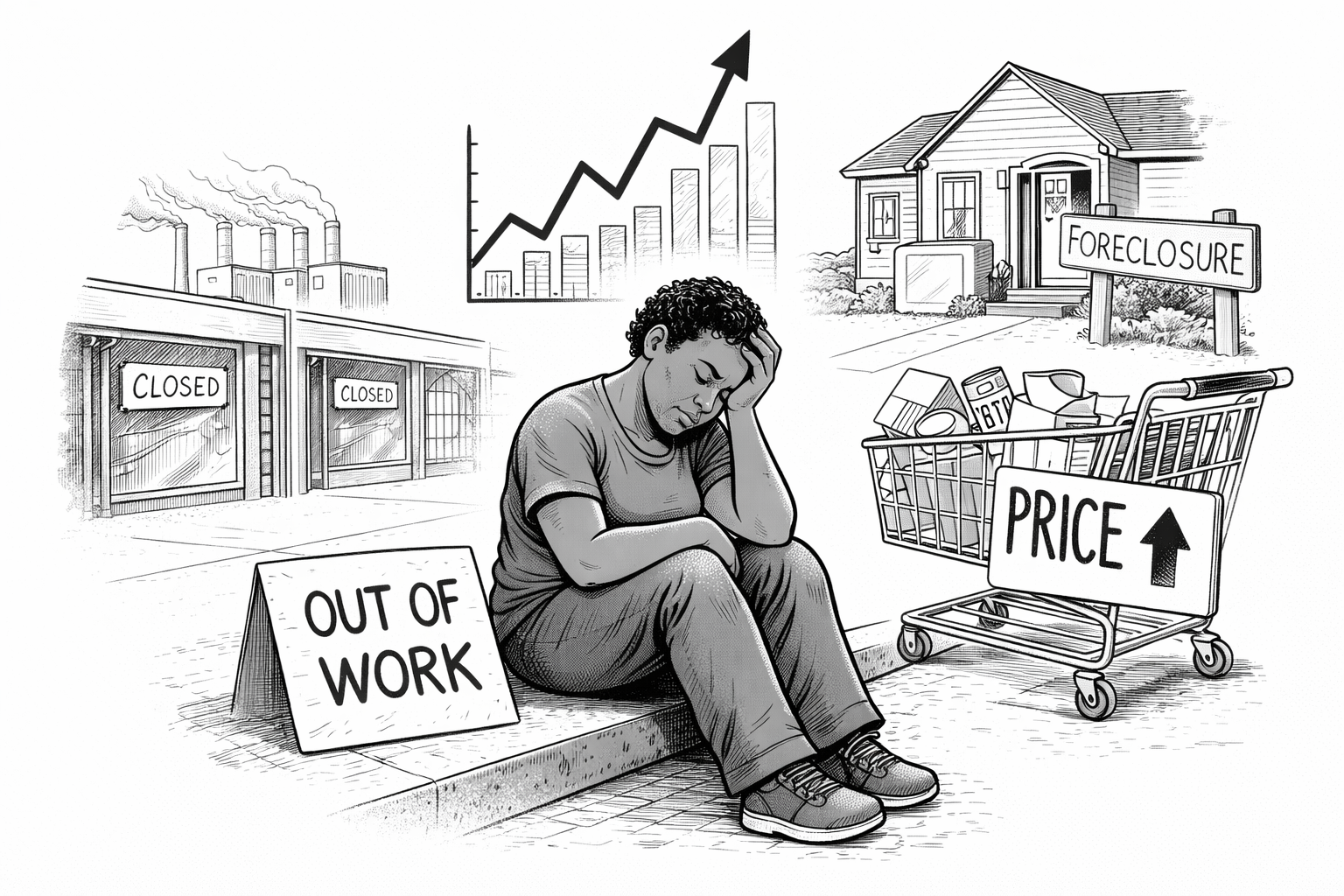
Liberation Day — the April 2, 2025 announcement of sweeping reciprocal tariffs — was framed as an economic reset. One year later, the Joint Center for Political and Economic Studies’ State of the Dream 2026 report documents what that reset has produced for Black communities: 300,000 Black women newly unemployed, Black workers disproportionately concentrated in the manufacturing, retail, and service sectors absorbing the highest tariff exposure, and a recession that was already underway in Black communities before the broader economy registered it.
The mechanism is direct. Tariffs raise prices on imported goods. Those price increases land hardest on households spending the highest share of their income on consumer staples — food, clothing, electronics, household goods. Black households, disproportionately represented in lower-income brackets as a result of the same structural wealth gaps SSC has documented all year, have the least cushion to absorb those increases. At the same time, the domestic manufacturing revival the tariffs were supposed to catalyze has not materialized at the pace or in the communities the policy promised. The jobs that were supposed to replace the ones displaced by trade are not arriving in the neighborhoods that lost them.
The tariff recession is being covered as an American story. As SSC documented in The Black Recession Is Already Here, the economic pressure now accelerating is not arriving on neutral ground — it is compounding a recession in Black communities that was already underway before the first announcement. And as SSC covered in The Iran War Is a Gas Pump Problem, the energy shock hitting Black families at the pump is the same shock hitting Lagos and Accra, connecting the domestic economic story to the West Africa fuel shock in ways that are rarely framed together. The structural exposure is the same on both sides of the Atlantic. The policy producing it is being decided in Washington.
Why This Matters
The one-year anniversary of Liberation Day is a moment to measure what it produced. For Black communities, the answer is a concentrated economic impact that was predictable, predicted, and largely absent from the policy debate that preceded it. The tariff recession is not a recession that affects everyone equally. It is a recession that arrived in Black communities first and will take the longest to leave.