
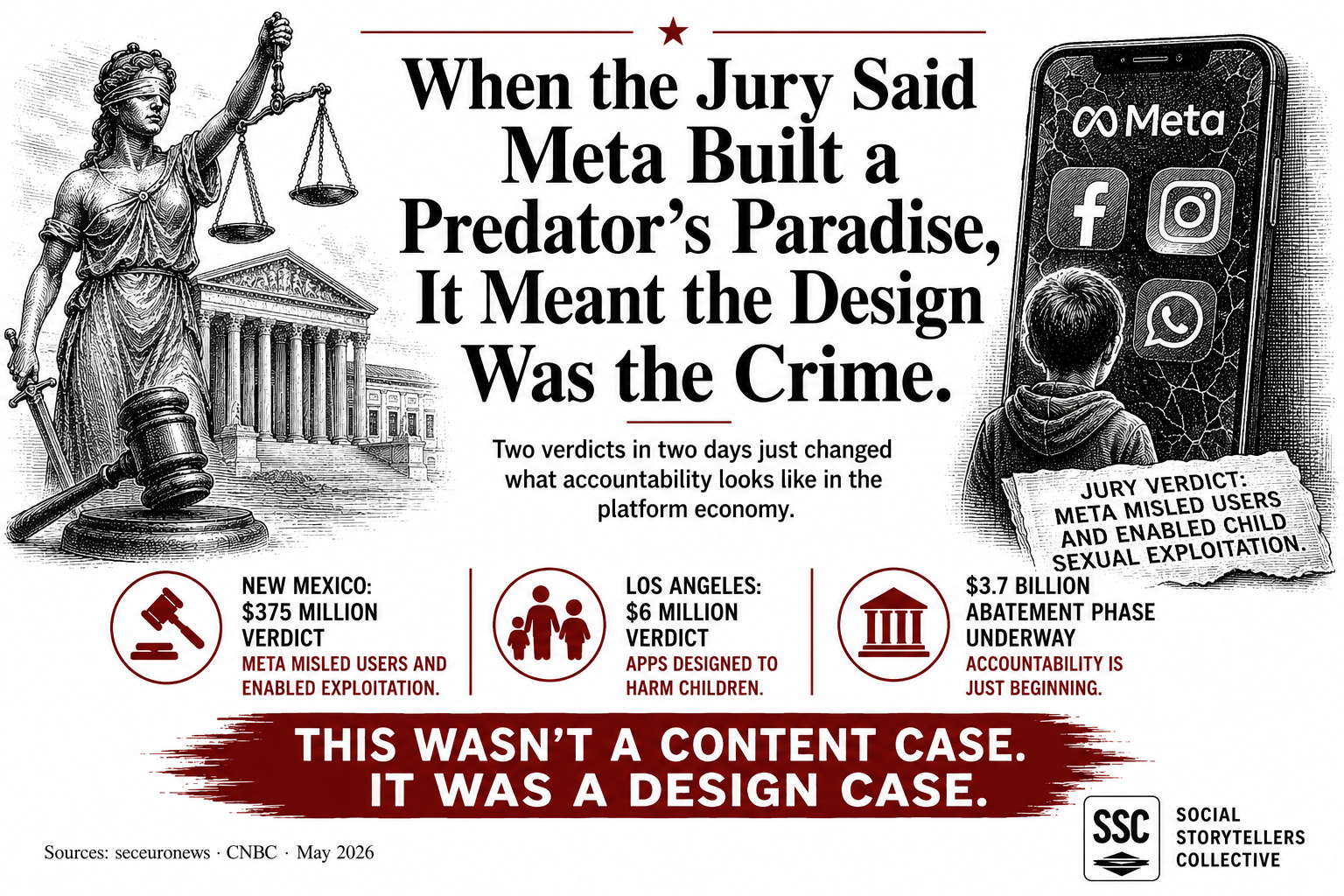
A New Mexico jury deliberated less than a day before ordering Meta to pay $375 million in civil penalties — finding the company misled users about the safety of Facebook, Instagram, and WhatsApp while enabling child sexual exploitation on its platforms. The verdict landed on March 24, 2026. Twenty-four hours later, a Los Angeles jury found Meta and YouTube negligent for designing apps that harmed children and teens, awarding $6 million in combined compensatory and punitive damages. Two jurisdictions, two juries, two verdicts in consecutive days — and the legal exposure hasn’t peaked. A bench trial phase seeking an additional $3.7 billion in abatement costs began May 4, with New MexicoAttorney General Raúl Torrez demanding mandatory age verification, predator removal, and restrictions on encrypted messaging for minors.
The New Mexico case was six weeks in the making, but the underlying lawsuit was filed in 2023. It alleged that Meta didn’t just fail to stop predators — it created conditions that made predation easier. That distinction is the legal and moral center of what just happened. Consumer protection law, not tech regulation, is what cracked the case open. State attorneys general, not Congress, are the ones forcing the confrontation. Meta‘s own insurers refuse to cover these claims, meaning the financial responsibility for the $375 million verdict, the pending $3.7 billion abatement phase, and more than 2,400active lawsuits from children, families, school districts, and 42 state attorneys general falls directly on the company. Experts have already compared the back-to-back verdicts to Big Tobacco’s turning point — the moment when “we didn’t know” stopped being a viable defense.
What mainstream coverage keeps treating as a child safety story is actually a platform architecture story — and it’s a distinction SSC has been pressing since we first covered platform design as infrastructure earlier this year. The jury wasn’t asked whether Meta knew bad things happened on its platforms. It was asked whether Meta designed systems that made those things more likely — and then told users the opposite. That is a product liability argument applied to software, and it is a significantly more dangerous legal theory for the tech industry than content moderation disputes have ever been. Meta‘s $375 million penalty is a fraction of its $201 billion in 2025 revenue, but the verdict’s significance isn’t in the dollar amount — it’s in the legal precedent that platform design choices can now be held accountable under state consumer protection law. The Los Angeles verdict reinforced the same logic from a different angle: addiction by design is now a cognizable harm.
The question Meta and every other major platform has to answer is not whether they’ll appeal — they will — but whether the legal architecture is now permanently altered. Before these verdicts, platform companies could point to Section 230 protections and content moderation policies as evidence of good faith. The New Mexico case explicitly sidestepped that framework by arguing the issue was product design, not content. That move changes the litigation map. It means platforms can be sued not for what users post, but for how the product was engineered to keep them engaged — and what that engineering made possible. The families who brought these cases weren’t asking for content removal. They were asking the court to recognize that the machine was built to do this.