
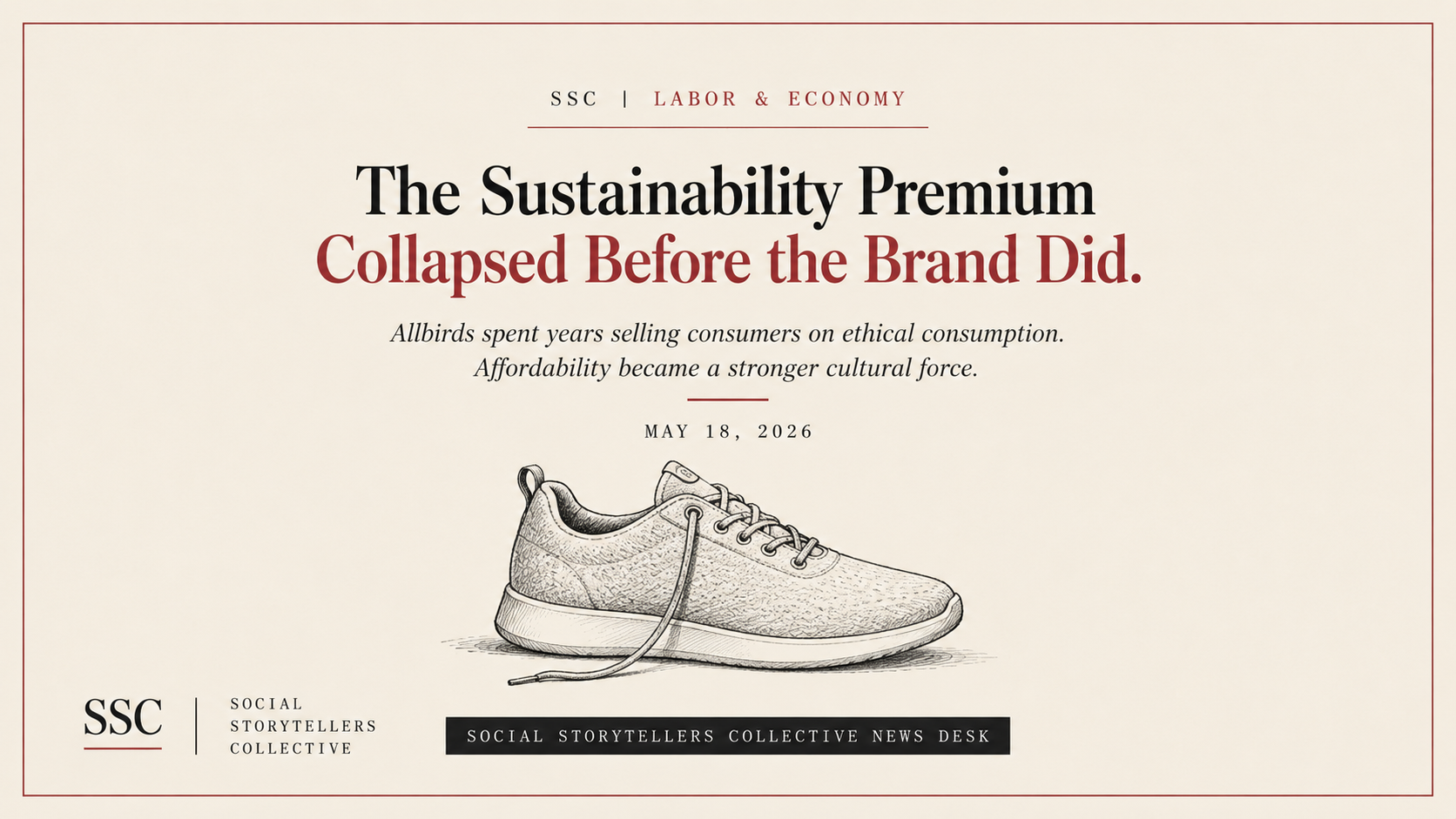
When Allbirds announced plans to close additional stores and continue restructuring operations this year, the decision landed as another quiet marker in a much larger retail correction already unfolding across consumer culture. The company that once reached a market valuation near $4 billion after its 2021 IPO has spent the last several years shrinking instead of scaling, cutting corporate staff, reducing physical retail exposure, and trying to stabilize demand after revenue growth stalled. Quarterly sales have continued trending downward, and the brand’s stock price now trades at a fraction of its public debut. Allbirds became one of the clearest symbols of an era where consumers — particularly affluent urban professionals — treated purchasing decisions as moral identity statements. The collapse of that momentum says something larger about what kinds of values people can afford to maintain when economic pressure intensifies.
Allbirds emerged during a decade when venture-backed consumer brands believed ethics could function as premium positioning. The company built its reputation around wool sneakers, carbon footprint disclosures, minimalist aesthetics, and language centered on sustainability rather than performance or status. At its peak, the strategy worked extraordinarily well. Revenue climbed from roughly $102 million in 2018 to more than $277 million by 2021 as direct-to-consumer retail exploded and ESG-oriented branding became attractive to investors and consumers alike. Celebrities, tech workers, and startup founders helped transform the brand into a kind of professional-class uniform, particularly in cities like San Francisco, New York, Seattle, and Austin. But the same environment that allowed Allbirds to flourish also depended heavily on low interest rates, abundant venture capital, and a consumer economy where upper-middle-class buyers still had room to spend aspirationally on lifestyle signaling. That environment is gone. And it is not coming back on the timeline anyone in sustainable consumer branding was counting on.
Sustainability branding became easier to admire than sustain financially. Allbirds was asking consumers to consistently pay premium prices for products whose primary value proposition was ethical alignment rather than obvious functional superiority. That becomes much harder during periods where inflation reshapes purchasing behavior. By 2024 and 2025, American consumers had already begun moving aggressively toward discount retailers, resale platforms, dupes, and value-oriented shopping patterns across multiple sectors. Footwear and apparel companies that depended on emotional branding suddenly faced customers recalculating household budgets in real time. Nike, Adidas, and even luxury brands encountered slowing discretionary spending, but companies like Allbirds faced an even sharper contradiction: their target audience still believed in sustainability rhetorically while increasingly shopping pragmatically. Consumers didn’t stop caring about climate-conscious consumption. Many simply could no longer afford to prioritize it.
That tension reflects a broader shift happening inside professional-class consumer identity itself. During the late 2010s, consumption increasingly became a form of personal ethics communication. Buying oat milk, carrying reusable water bottles, wearing sustainable sneakers, and participating in “responsible consumption” culture allowed people to publicly perform values through ordinary purchasing behavior. But economic tightening has exposed how dependent many of those behaviors were on financial flexibility. The sustainability economy often assumed consumers would permanently absorb higher prices in exchange for moral coherence. Instead, the market is revealing that ethical consumption frequently operates like a luxury category — available in full only to those whose budgets were never really in question. When housing costs rise, student loan payments resume, layoffs spread through white-collar sectors, and everyday essentials become more expensive, consumers begin distinguishing between values they support philosophically and values they can afford transactionally. That gap is widening. And the brands caught inside it are the ones that never built a bridge across it.
Mainstream coverage often frames Allbirds as a simple case of brand fatigue or failed execution, but that interpretation understates the structural change underneath the decline. The company is colliding with the same reality reshaping much of the wellness, organic food, boutique fitness, and premium self-care economy: aspirational ethics struggle during affordability crises. Consumers are still highly responsive to identity-driven branding, but they increasingly expect lower-cost access points. The result is a market where major corporations with scale advantages can absorb sustainability language into mass retail while smaller mission-driven brands struggle to compete on price. In practice, sustainability stops functioning as a disruptive advantage and starts becoming another marketing layer attached to conventional consumer capitalism. Once that happens, the premium attached to “doing good” begins eroding quickly — and no amount of carbon footprint disclosure language reverses it.
There is also a Silicon Valley dimension to the Allbirds story that deserves more attention. The company’s rise aligned almost perfectly with the peak cultural influence of the tech industry’s managerial class. Allbirds sneakers became associated with startup offices, founders, product managers, and venture-backed workplace culture in the same way Patagonia vests once symbolized finance culture. That association was an asset during the boom. It became a liability the moment the boom ended. The industries that made Allbirds a status object are now living through layoffs, hiring freezes, AI disruption anxiety, and shrinking professional certainty. When workers feel economically secure, identity purchases expand. When workers begin worrying about career durability, consumption becomes more defensive. The lifestyle brand and the labor market it depended on began contracting at almost exactly the same time. That is not a coincidence.
One sneaker company overexpanding is not the story. Retail brands fail constantly. The more revealing signal is that the consumer demographic Allbirds was built for — college-educated, urban, professionally mobile, values-forward — is itself under economic pressure it did not anticipate and has not fully absorbed. The sustainability economy is not disappearing. It is stratifying. Ethical consumption is drifting upward toward households wealthy enough to treat it as fixed spending rather than discretionary, while everyone else recalibrates toward price. Allbirds is not simply closing stores. It is marking the moment when a generation’s consumer optimism met a balance sheet and had to choose.