
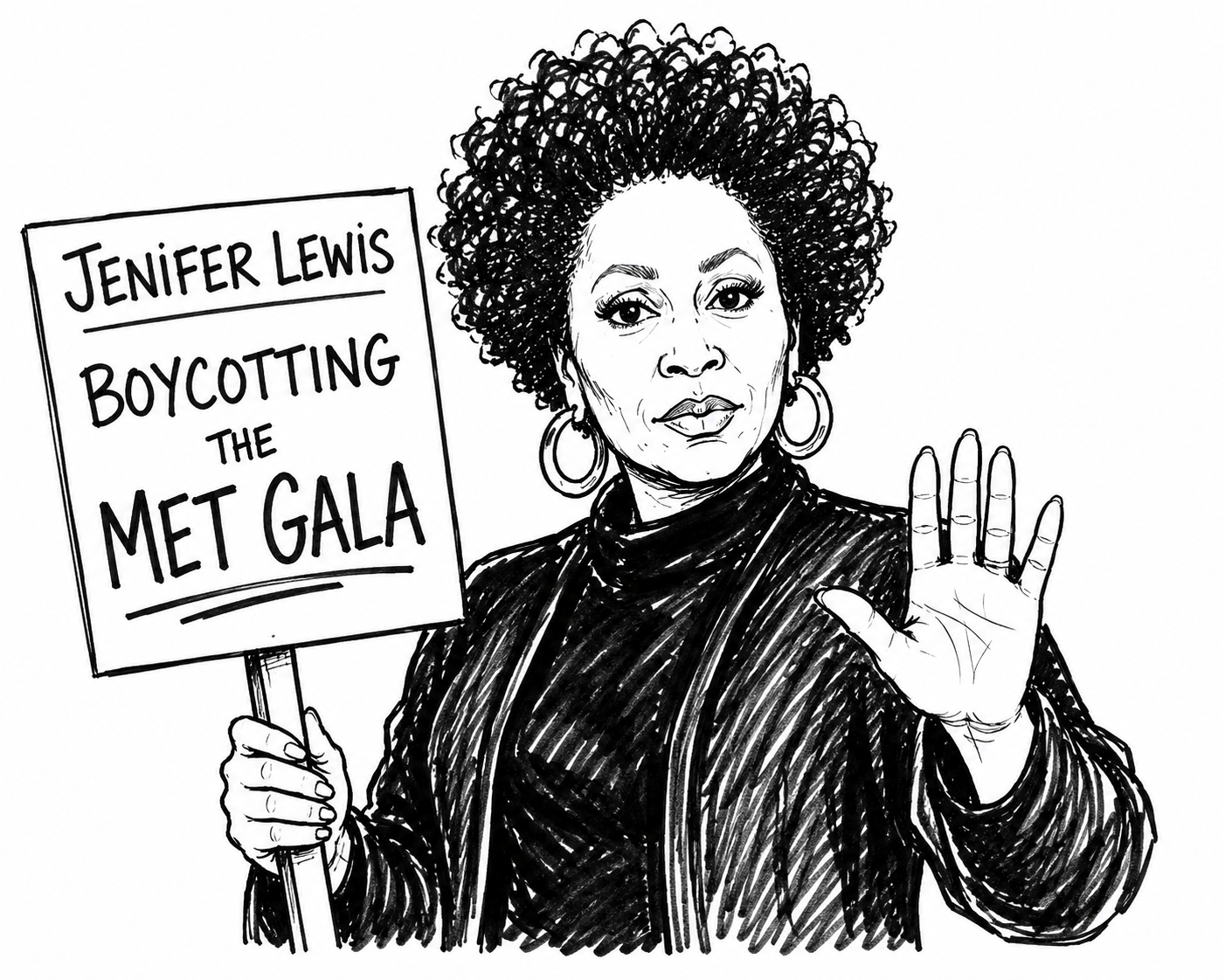
Actress and activist Jenifer Lewis did not mince words. In a viral video circulating across social platforms following the 2026 Met Gala, Lewis publicly questioned why celebrities continue showing up to elite cultural events while large-scale layoffs, political unrest, DEI rollbacks, and economic instability escalate around them. Her remarks were direct, emotionally charged, and immediately polarizing — which is precisely why they spread. But Lewis was not speaking into a vacuum. She was responding to a specific and visible provocation: Jeff Bezos and his wife Lauren Sánchez did not simply attend the 2026 Met Gala — they chaired it, serving as honorary co-chairs of one of the most watched cultural events in the country while Bezos’s empire remains at the center of ongoing debates about labor practices, wealth concentration, and corporate accountability.
That detail is not incidental. It is the entire frame.
That detail is not incidental. It is the entire frame.
The Met Gala has always existed at a complicated intersection — simultaneously a philanthropy mechanism, a luxury branding exercise, a media spectacle, and one of the most curated elite networking environments in the country. For decades, the politics of who was in the room were understood but rarely treated as disqualifying. Audiences consumed the event as aspirational entertainment and largely kept it separate from harder conversations about wealth, labor, and institutional accountability. That framework has shifted. Bezos’s presence at the 2026 Gala did not go unexamined the way similar moments might have a decade ago. It was immediately read as a statement — not just about his personal brand, but about what the event itself chooses to celebrate and whose participation it chooses to legitimize.
Bezos arrives at this cultural moment carrying significant institutional baggage that audiences have not forgotten. Amazon’s labor practices — warehouse working conditions, union suppression efforts, and the treatment of workers during periods of record corporate profit — have been among the most widely covered corporate accountability stories of the past several years. The Washington Post, which Bezos owns, has faced its own scrutiny over editorial decisions during politically sensitive periods. And Amazon’s broader corporate posture on DEI, worker organizing, and wealth concentration places Bezos squarely inside the set of institutional actors that critics argue are directly responsible for the conditions Lewis was describing. His presence at the Met Gala was not a neutral fashion choice. It was a visibility decision made in full awareness of what that visibility would communicate.
What Lewis’s criticism tapped into is the growing collapse of the traditional separation between cultural spectacle and political accountability. Social media has permanently altered how audiences evaluate public figures and the events they choose to attend. As SSC has reported, the celebrity endorsement gamble has already demonstrated how quickly public alignment with political and institutional power can erode audience trust when the gap between a celebrity’s stated values and their visible affiliations becomes too wide to ignore. Celebrities and executives are now expected to demonstrate some coherent relationship between their public positioning and their institutional behavior — and audiences can track brand partnerships, event attendance, public silences, and political donations with a specificity that was not possible even a decade ago. In that environment, showing up to one of the most photographed events in the world while your company faces active labor organizing campaigns and your personal wealth has grown exponentially during a period of mass economic anxiety is not a neutral act. It is a statement about priorities, whether intended as one or not.
The broader frustration Lewis articulated is one that extends beyond Bezos specifically. Audiences are increasingly unwilling to separate the cultural participation of powerful figures from the systems those figures actively maintain. The entertainment industry has been slow to reckon with this shift, in part because the incentive structures have not changed: celebrities and executives attend events like the Met Gala because participation sustains brand value, industry relationships, and the kind of cultural positioning that translates directly into leverage. Those incentives are real. But they are colliding with an audience that is navigating genuine economic strain — job losses, housing instability, eroding institutional protections — and looking at red carpets with a different kind of attention than they once did.
Lewis’s argument was not that powerful people cannot attend events or occupy elite spaces. It was that the gap between what those spaces signal and what the people standing inside them actually represent has become too wide to ignore. When the most photographed guest at a billion-dollar gala is also the owner of a company whose warehouse workers have organized for basic labor protections, the event stops being a fashion story. It becomes a priorities story.
Jenifer Lewis named that out loud. The room she was criticizing has not yet demonstrated that it heard her.