The U.S. Supreme Court is reviewing the Trump administration’s effort to terminate Temporary Protected Status (TPS) for hundreds of thousands of immigrants, including more than 350,000 Haitians and several thousand Syrians. As reported by Reuters, the case carries implications far beyond the groups directly affected, as it could shape how the federal government treats TPS designations across multiple countries. What is being evaluated is not only whether these protections can be withdrawn, but whether the government can reverse legal stability after it has been extended long enough to structure lives around it.
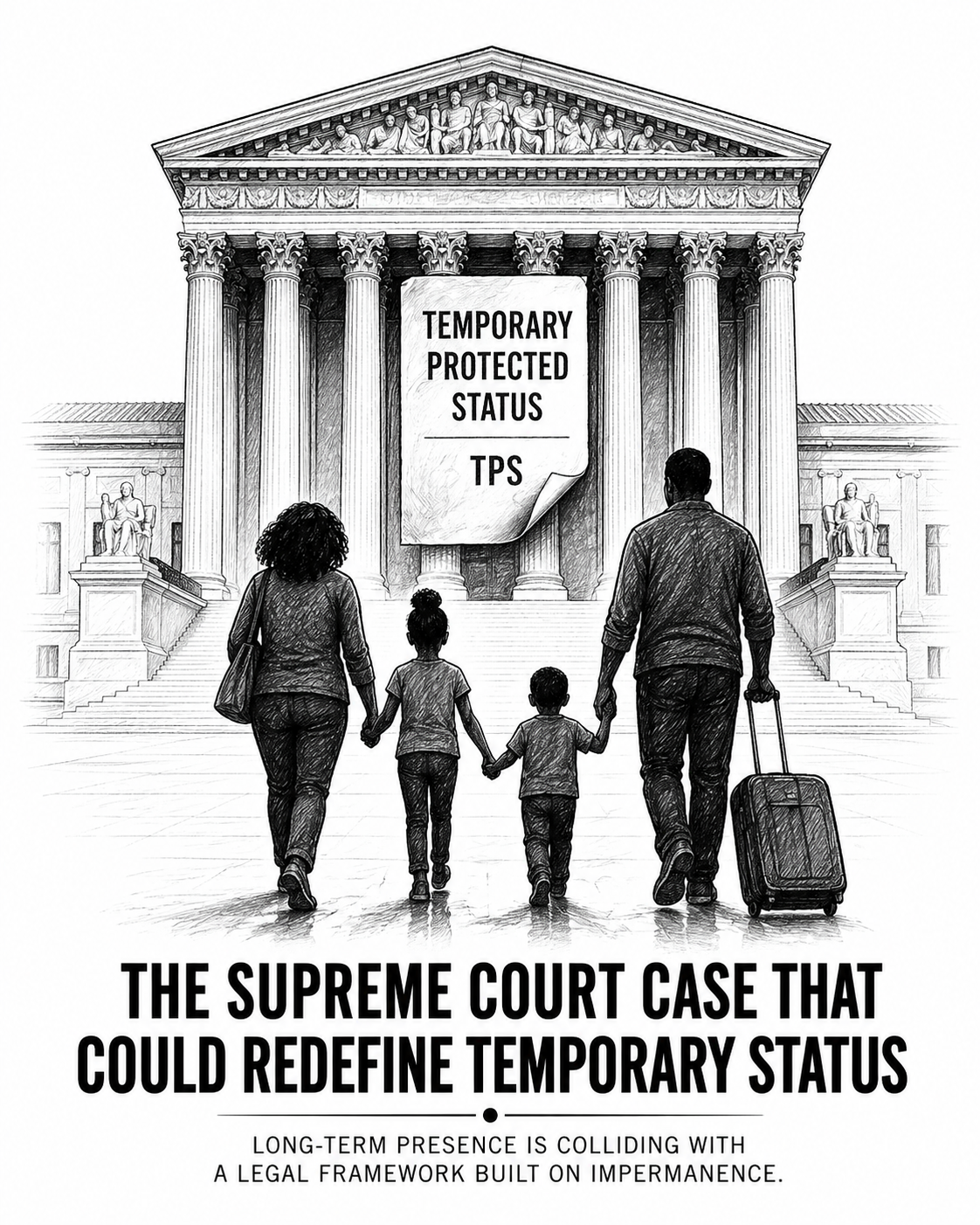
TPS was designed as a temporary safeguard for individuals from countries facing armed conflict, environmental disaster, or other extraordinary conditions. In practice, however, many recipients have lived in the United States for years or decades, building families, careers, and economic stability around a status that has been repeatedly renewed. The administration’s effort to end those protections introduces a different logic, one where duration does not produce permanence and where legal continuity can be withdrawn regardless of the systems it has already enabled.
The economic implications extend beyond immigration policy into the labor markets that depend on TPS holders. These workers are embedded in sectors ranging from construction to healthcare, contributing to workforce stability in regions already navigating labor shortages and long-term capacity constraints. Removing that population from legal status would not only disrupt individual lives but also create measurable gaps in industries that rely on their participation to function at scale.
What the Court is being asked to decide is not simply whether a program can end, but whether time itself carries legal weight. If temporary status can be revoked after decades of renewal, then stability becomes conditional in a way that reshapes how people engage with the system. The category of “temporary” begins to function less as a short-term designation and more as a permanent condition of uncertainty.
As covered in SSC’s recent analysis of Black immigrant population growth, the demographic reality inside the United States is already shifting in ways the legal framework has not caught up to. The Black immigrant population has more than doubled over the past two decades, reaching 5.6 million people and accounting for more than one in ten Black Americans today. That growth is concentrated in metropolitan areas like New York, Miami, Houston, and Atlanta, where Black immigrant communities are deeply embedded in local economies, cultural production, and workforce participation.
The tension emerges when legal status fails to reflect that reality. A population that has grown, integrated, and contributed at scale is still being governed through frameworks that treat its presence as provisional. TPS holders are not navigating entry into the United States. They are navigating whether the stability they have already built will be recognized as durable or treated as reversible.
What connects these dynamics is the widening gap between demographic permanence and legal conditionality. The systems of work, housing, and community life that have formed around TPS are not temporary in any meaningful sense, yet the legal framework governing them remains so. The outcome of this case will determine whether that mismatch continues to define the experience of millions of people or whether the law begins to account for the permanence it has already helped create.