
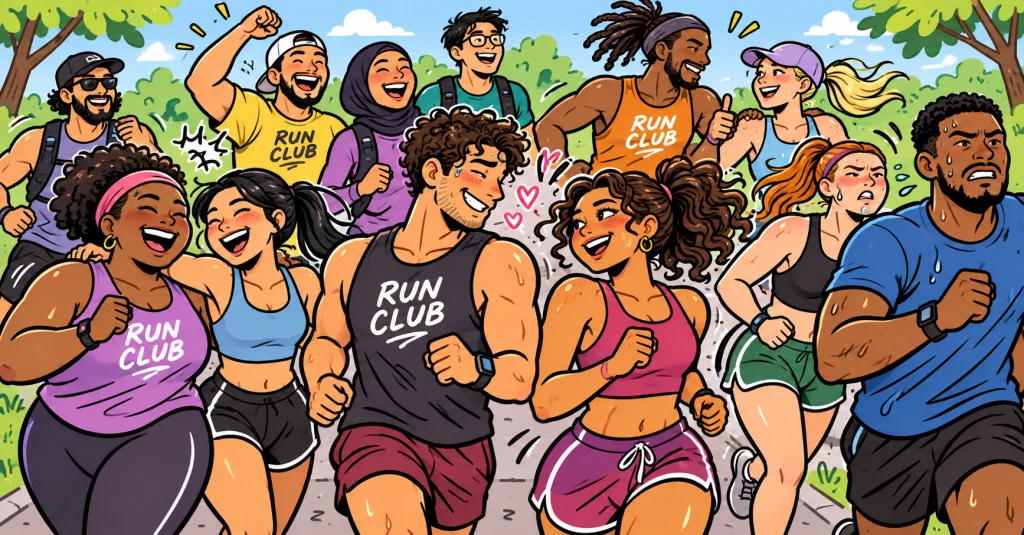
In Chicago, hundreds of runners in coordinated athletic sets show up by 8 a.m. to stretch, trade Instagram handles and, eventually, run. Chicago Run Collective drew close to 1,000 people to its lakefront runs within months of launching in May 2024, CBS News producer Analisa Novak reported. Co-founder Maya Carducci told CBS that she and co-founder Jordan Williams started it because most Chicago clubs were built around marathon training. They wanted one built around talking. The club gives single runners signs that read “I am single, run with me,” and Williams said anyone can grab one and carry it around. The run is still on the schedule, but for a growing share of the crowd it isn’t the main reason they came.
The data backs that up. Strava‘s 2025 Year in Sport report drew on billions of logged activities and a survey of more than 30,000 people. It found running clubs on the platform grew 3.5x year over year, and 37% of respondents called run clubs a good place to meet people. The appeal comes down to price. SSC has reported that Americans are skipping social events because they can’t afford them, and that the friendship recession is changing how adults spend their weekends. A bar tab, a concert ticket and a dinner out all cost money. A run club offers a standing time, a shared task and strangers who might remember your name next week, all for free. It fixes the cost problem that pushed people to stay home.
Why This Matters
- 3.5x: growth in running clubs on Strava in 2025, with club-organized events up 1.5x
- 64% of Gen Z respondents told Strava they’d rather spend money on fitness gear than on a date
- 46% of respondents said yes to a workout first date, while 31% called it a hard pass
- 27% of women and 20% of men surveyed see run clubs as spaces only for elite runners
A loneliness fix with a schedule
Timing explains why the boom hit now. In 2023, the U.S. Surgeon General issued an advisory calling loneliness and social isolation a public health crisis. Weill Cornell Medicine psychiatrist Dr. Daniel Knopfelmacher told Spectrum News that Americans’ social ties have been fraying since the mid-1970s, when people started moving farther from family. The pandemic stripped away the workplace friendships that had been filling the gap. Run clubs filled a hole that offices, churches and neighborhood bars used to cover, and they arrived with a feature those places lacked: a weekly time you can’t easily flake on, because the group leaves without you.
The format also lowers the stakes. Talking while side by side and slightly out of breath takes the pressure off eye contact and small talk. Strava found Gen Z is 39% more likely than Gen X to use fitness to meet people with shared interests. The same report found Gen Z is twice as likely to say starting a new sport feels intimidating. The generation leaning hardest on run clubs for connection is also the one most likely to feel shut out by the wrong first impression. That tension shapes everything that follows.
When the crowd becomes the product
A free gathering that draws 1,000 people every week becomes an audience, and audiences attract money. Shoe brands host demo runs, coffee shops sponsor the cooldown and apparel companies hand out gear. That money covers the club’s real costs, like permits, speakers and a place to hang out afterward. The catch is that sponsors pay for visibility, and visibility favors the photogenic, well-dressed crowd that looks good on a brand’s feed. A club that wants to keep its sponsors has every reason to keep looking that way.
Running needs almost no equipment, yet its most visible social scenes now signal status through clothing, neighborhood, pace and follower count. The matching sets in the group photo were never required, but they become expected once enough people show up in them. Strava’s finding that more than a quarter of women see run clubs as elite-only spaces shows the result. A caption that says “all paces welcome” does little for the runner falling behind at mile two, watching the pack disappear toward the coffee shop.
The dating app moved outside
Dating adds another layer. New York’s Lunge Run Club was started in May 2024 by Steven Cole, creator of the Lunge fitness dating app, NBC New York reported. It began with about 30 runners. Singles wear black and runners who are taken wear color, and within months about 1,000 people were filling Washington Square Park every Wednesday. Cole told CBS the runs were the “largest singles event New York has ever seen.”
By late summer, NBC News reporter Sakshi Venkatraman found regulars describing the same ghosting and lying about relationship status they had joined to escape. The setup is the point. A dating company moved courtship off the phone and onto the street and kept the business model, with the app still sitting behind the run. The runner who came for miles and friendship ends up on the market whether or not they signed up. Once a dress code signals who’s available, wearing the wrong color becomes a statement too.
The template was already here
Black Girls RUN! worked out a different model years before the trend. Toni Carey and Ashley Hicks, college friends from Middle Tennessee State University, started it in 2009 as a blog after they often found themselves among the only Black women at races, CBS Philadelphia reported. Within two years it had become a running group, and it eventually grew into dozens of chapters across more than 30 states. Their mantra was “Leave No Woman Behind.”
That approach treats belonging as something you design for: pace-inclusive routes, members recruiting other members, and health as the shared goal rather than a side effect. Their focus on chronic disease in their own community gave every run a purpose beyond being seen there. The current boom copied the format of community running, but the intent behind it is often missing. Clubs that grew on TikTok copied the meetup but skipped the slow work of making sure the last runner finishes with the group.
What the public health case needs
In a July 2025 American Journal of Public Health editorial, Northwestern Feinberg School of Medicine’s Lilian N. Bui argued that run clubs build social capital by inviting strangers to run together in public, regularly and at no cost. She also pointed out that run clubs tie people to the streets and parks they share, which gives them a stake in public space. Those three conditions carry the benefit. A club that sorts people by gear, follower count or relationship status keeps the “free” and drops the “strangers.”
The boom has shifted the work of building adult community away from neighborhoods and nonprofits and toward platforms and brands. Expect the scene to split in 2027. Sponsored mega-clubs will run more like content shoots and singles mixers, while smaller neighborhood clubs grow by staying deliberately low-key, with no dress code and no pace pressure. Health departments and city parks offices, already looking for low-cost answers to loneliness, have a reason to back the second kind with permits, routes and safe meeting spots. The clubs that are still around in five years will judge success by who comes back next Saturday, not by who posted from this one.