
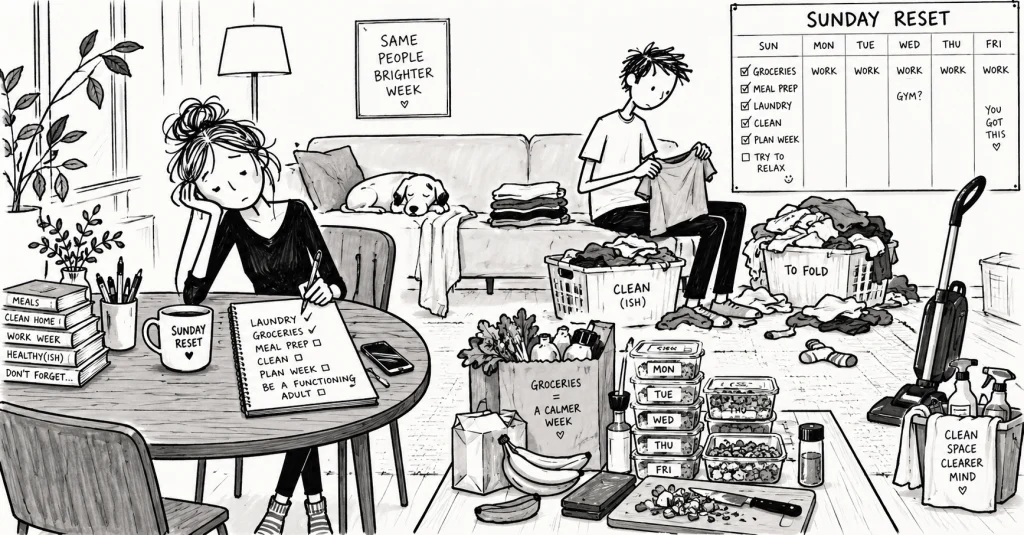
Laundry. Groceries. Meal prep. Cleaning. Calendars. The weekend was supposed to be the break. Somewhere along the way, it became the time we prepare to work again.
There is a particular kind of Sunday that barely qualifies as a day off. The laundry needs to be finished. Groceries have to be bought. Lunches need to be prepared. The apartment gets cleaned, the calendar checked, clothes selected and perhaps the inbox cleared before Monday morning. Social media gave the routine an appealing name—the Sunday reset—and transformed ordinary household maintenance into an aesthetic of organized refrigerators, fresh sheets, matching storage containers and perfectly prepared weeks.
There is nothing inherently wrong with getting organized. For plenty of people, a few hours of preparation makes Monday substantially easier. But the popularity of the reset also exposes something about modern weekends: a significant portion of them is not leisure at all. It is maintenance.
Saturday Has a Chore Problem
The Bureau of Labor Statistics provides a less glamorous version of the reset video. Its 2025 American Time Use Survey found 81% of Americans performed household activities on an average day, spending roughly two hours doing things such as cleaning, cooking, lawn care and household management. Housework itself was even more likely to happen on weekends: 40% of people did housework on an average weekend or holiday compared with 35% on a weekday.
Work does not necessarily disappear either. Among employed Americans, 30% worked on an average weekend day in 2025. Full-time employees who worked on those days averaged 5.5 hours of work. For some households, then, the two-day weekend is already being divided among paid work, household work and whatever time remains afterward.
That helps explain why the Sunday reset became so appealing. It gives maintenance a structure. Instead of feeling like you spent Sunday doing chores, you completed a ritual designed to make the coming week manageable. The language turns obligation into self-care.
When Rest Needs a Checklist
But there is a strange contradiction buried inside the idea. Rest itself has become increasingly optimized. There are morning routines, nighttime routines, cleaning routines, workout schedules, meal-prep systems and digital detoxes. Even leisure can arrive with instructions about how to do it better.
The time-use numbers suggest Americans do have leisure time, but how it is spent is revealing. People averaged 5.2 hours of leisure and sports activity per day in 2025, but television alone accounted for 2.6 hours—roughly half of it. Meanwhile, Americans were less likely to socialize on an average day than they were a decade earlier.
There is an economic component here too. Outsourcing the reset costs money. Someone with sufficient disposable income can pay for grocery delivery, prepared meals, housekeeping, laundry service or childcare. Someone without that cushion performs much more of the work personally. What looks online like a lifestyle choice can therefore also reflect the amount of unpaid labor required to keep a household functioning.
Maybe Saturday Doesn’t Need Improving
The alternative does not have to be abandoning the laundry until Tuesday. It may simply mean resisting the idea that every free hour needs to produce something useful.
A Saturday afternoon spent wandering through a bookstore does not prepare you for Monday. Neither does sitting in a coffee shop, taking a long walk, watching a movie in the middle of the day or meeting someone without scheduling an activity around it. That is precisely what makes those hours different from work.
The Sunday reset helped people impose order on increasingly crowded lives. Its success makes sense. But perhaps the next weekend trend will be simpler: leaving part of the weekend alone.
Not everything needs a reset. Sometimes the point of Saturday is that nothing needs to happen next.