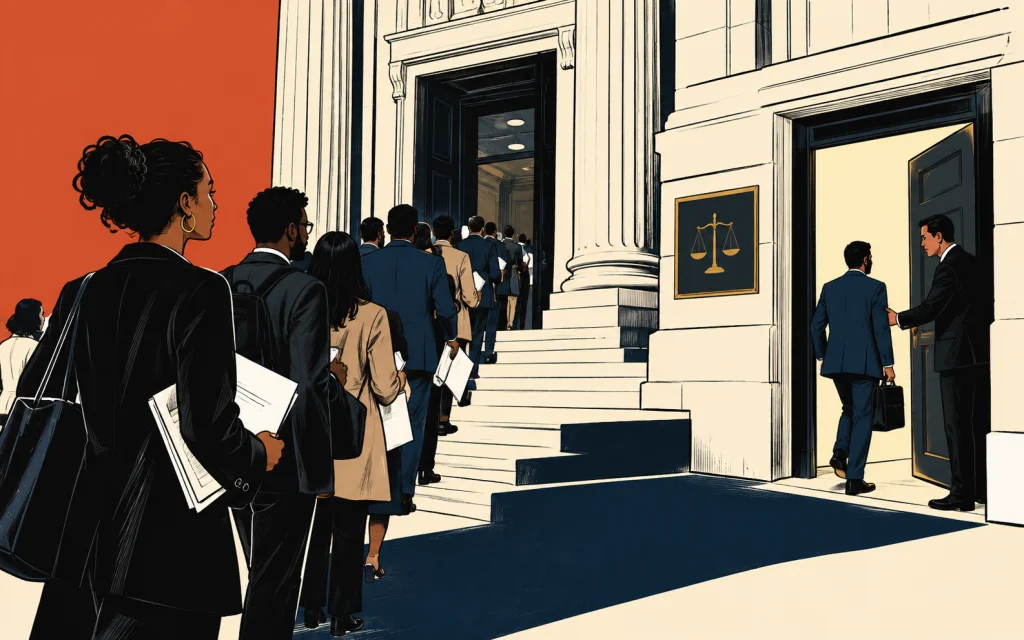
Four months after USCIS made it harder for immigrants already living in the United States to adjust to permanent residency, the policy is now facing a federal lawsuit — and the broader crackdown on legal immigration is spreading into the technology workforce.
A policy that looked technical in May has become a much larger fight over the future of legal immigration. Earlier this year, U.S. Citizenship and Immigration Services instructed officers to treat adjustment of status — the process that allows eligible immigrants already living in the United States to apply for a green card without leaving the country — as an extraordinary discretionary benefit rather than a routine pathway. The practical effect was potentially enormous. Pew Research Center found that 58% of the 1.36 million green cards issued in fiscal 2024 went to people already living in the United States, including large shares of employment-based immigrants and immediate relatives of U.S. citizens. Now, immigrant families, labor unions, university faculty groups and advocacy organizations have taken the administration to federal court, arguing that the government is rewriting a pathway Congress deliberately created.
The lawsuit, filed October 5 in federal court in Massachusetts, challenges two USCIS policies. The first is the May adjustment-of-status memo, which tells officers that choosing to seek permanent residency from inside the United States rather than through a consulate abroad can count as a negative discretionary factor. Applicants may have to demonstrate what USCIS described as “unusual or even outstanding” considerations to overcome that factor. The second policy, issued in August, gives officers broader authority to deny applications without first requesting additional evidence, including in some cases applications filed before the policy existed. The plaintiffs argue that together the rules expose immigrants who have followed legal procedures to denials, family separation and the loss of jobs or educational opportunities. Both policies remain in effect while the litigation proceeds.
This Is Not Primarily About Undocumented Immigration
That distinction is central to understanding the policy. Adjustment of status is used by immigrants who already have a legal pathway toward permanent residency. In 2024, 69% of employment-based green cards were issued through adjustment of status, as were 60% of green cards for immediate relatives of U.S. citizens. Virtually all refugees and asylees who became permanent residents did so through adjustment. Many employment-based applicants first arrived legally on temporary visas such as H-1Bs, built careers and families in the United States, and then applied for permanent residency without having to interrupt those lives to complete processing abroad.
Requiring more applicants to use consular processing changes that calculus substantially. Leaving the United States is not necessarily a short administrative trip. Immigration attorneys warn that consular processing can take months or longer depending on the country, visa availability and backlogs. Applicants can also encounter legal barriers triggered by departure, lose employment authorization or find themselves separated from spouses and children while a case remains unresolved. The administration says the policy restores consular processing to its proper role and closes perceived loopholes. Critics argue it turns a lawful immigration pathway into a test of whether applicants are willing to risk leaving the lives they have already established in the United States.
The scale explains why the litigation matters. Pew found that 782,770 people adjusted status from inside the United States in fiscal 2024, compared with 573,990 new permanent residents who completed the process from abroad. Cuba, Mexico, China and India were among the largest sources of adjustment cases. About 87% of Cuban immigrants who received green cards in 2024 adjusted status inside the United States, as did 65% of Mexican immigrants, 66% of Chinese immigrants and 61% of Indian immigrants. A policy that makes adjustment harder therefore does not operate at the margins of legal immigration. It reaches one of the principal ways immigrants become permanent residents.
The Crackdown Has Expanded Into the Workplace
The October lawsuit is also arriving as the administration broadens its restrictions on employment-based immigration. On October 8, the Department of Labor suspended Microsoft, Adobe, Cognizant, Infosys, Tata Consultancy Services, Wipro, HCL Technologies and Capgemini from parts of the PERM labor-certification process used to sponsor foreign workers for employment-based green cards. Officials say the companies abused immigration programs while laying off American workers. The affected employers dispute or question those allegations, and analysts say the immediate operational effect on some firms may be limited because several have reduced their reliance on PERM filings.
But the broader direction is difficult to miss. The administration is simultaneously narrowing the pathway for people who want to adjust their status inside the country and challenging the employer-sponsored system through which many high-skilled workers reach permanent residency. It has also pursued new restrictions and fees around H-1B and other temporary-worker programs. Taken together, these are not simply enforcement measures aimed at unauthorized immigration. They represent a more fundamental reassessment of how easily legally present immigrants should be able to transition into permanent members of the American workforce and society.
That distinction has economic consequences. High-skilled immigrants frequently spend years in temporary status while employers sponsor them for green cards. If permanent residency becomes harder to obtain, workers remain more dependent on individual employers and less able to change jobs, launch companies or make long-term decisions about where to build their lives. Critics of the administration’s approach argue that countries including Canada, Australia and the United Kingdom could become relatively more attractive to international talent if the American system becomes less predictable. The administration’s answer is that U.S. immigration programs should prioritize American workers and prevent employers from using foreign labor to suppress wages.
The Courts Are Starting to Define the Limits
The new Massachusetts case is not occurring in isolation. Courts have already intervened in other 2026 disputes over USCIS restrictions. In September, a federal judge in Maryland partially sided with Diversity Visa applicants challenging a USCIS processing hold and ordered the agency to resume ordinary adjudication of affected applications. Other courts have also confronted immigration policies introduced through agency memoranda rather than traditional rulemaking. Those decisions do not resolve the broader adjustment-of-status fight, but they show that courts are increasingly being asked to decide how much immigration policy an administration can remake through executive discretion.
That is now the central legal question surrounding the May policy. Congress created adjustment of status precisely so some immigrants already in the United States would not have to leave to complete permanent-residency processing. USCIS argues that Congress also left final approval discretionary and that officers are entitled to weigh an applicant’s decision not to use the consular system. The plaintiffs argue that the administration is using that discretion to effectively punish people for choosing a process Congress explicitly authorized.
Four months ago, Pew’s numbers showed how many people could be affected. The October litigation shows what the policy has become: a test of whether an administration can make legal immigration harder without Congress changing the underlying immigration law.
That makes this larger than one green-card form. The United States is debating unauthorized immigration aggressively, but a quieter transformation is happening alongside it. The pathways for people who entered legally, worked legally, studied legally, married U.S. citizens or qualified through humanitarian programs are becoming more conditional too.
The fight is no longer simply about who can enter the country. It is increasingly about who is allowed to stay permanently after following the legal path in.