
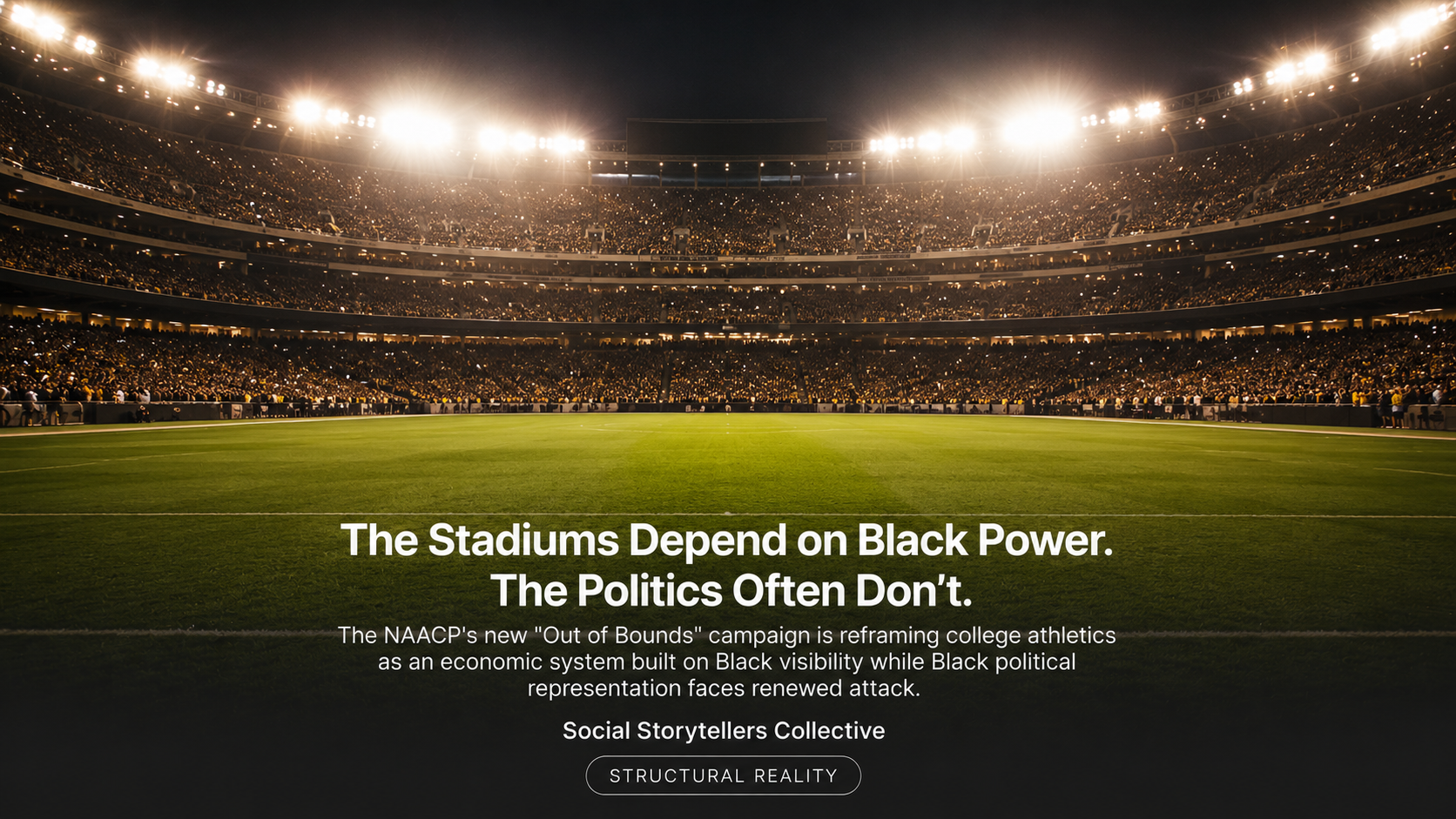
The NAACP has launched one of the most economically confrontational civil rights campaigns directed at college athletics in years. Under a new initiative called “Out of Bounds,” the organization is calling on Black athletes, families, alumni, fans, and consumers to withhold athletic and financial support from flagship public universities located in states accused of weakening Black voting rights following the Supreme Court’s 6–3 ruling in Louisiana v. Callais — a decision that gutted what remained of the Voting Rights Act. The campaign targets eight states — Tennessee, Louisiana, Alabama, Florida, Mississippi, South Carolina, Texas, and Georgia — all home to universities whose athletic programs collectively generate billions in annual revenue while relying heavily on Black athletic labor and cultural influence. Each of the targeted programs generates more than $100 million in annual athletic revenue.
NAACP President and CEO Derrick Johnson did not soften the language. “What these states have done is not a policy disagreement. It is a sprint to erase Black political power. These actions happened in days, in some cases in hours, of a Supreme Court ruling that gives extremist lawmakers a playbook to erode Black representation. The NAACP will not watch the same institutions that depend on Black athletic prowess to fill their stadiums and their bank accounts remain silent while their states strip Black communities of their voice. Out of Bounds is our answer: we are naming the contradiction, and we are calling on Black athletes, families, fans, and consumers to act on it. The same power that built these programs can be redirected. And it will be.”
The campaign’s framing is intentionally direct. The organization’s message is designed to collapse the artificial separation between sports, economics, and governance. College football and basketball have long been treated as culturally adjacent to politics rather than structurally embedded within it. The NAACP is arguing the opposite: that the financial ecosystems surrounding these institutions cannot be separated from the states that regulate voting access, representation, and political participation.
The timing matters because college athletics is now operating at a scale and visibility that resembles a full entertainment industry. NIL compensation, conference realignment, expanded playoffs, streaming rights, sports gambling integration, and transfer portal volatility have transformed flagship athletic departments into billion-dollar branding machines. Universities increasingly operate as media properties competing for attention, sponsorships, and national relevance. That visibility creates vulnerability. A protest directed at ticket sales, fan engagement, recruitment pipelines, and alumni donations carries a different kind of pressure than symbolic statements alone. The NAACP appears to understand that institutional behavior often changes faster when reputational risk intersects with revenue dependency.
What makes the campaign especially potent is the contradiction at its center. Many of the universities being targeted aggressively market diversity in recruiting materials, rely disproportionately on Black athletes in revenue-generating sports, and use athletic success to strengthen school identity, donor engagement, and statewide prestige. Black athletes remain central to the spectacle, branding, and emotional economy of college sports. Yet the organization argues that Black political representation in several of these same states is simultaneously being weakened through redistricting fights, voting access disputes, and broader legislative battles over representation.
The campaign is therefore not simply asking whether schools support diversity rhetorically. It is asking whether institutions that materially benefit from Black participation can remain publicly silent while political systems around them are accused of restricting Black political influence. The stadiums are full. The voter rolls are being thinned. The NAACP is arguing those two facts belong in the same sentence.
The economic implications extend well beyond athletes alone. Entire ecosystems exist around these programs: apparel sales, sponsorships, alumni travel, tailgating economies, local hospitality industries, television ratings, licensing deals, and social media amplification. The NAACP’s language about redirecting power is rooted in the idea that Black consumers are not merely participants in the culture of college sports but foundational economic drivers within it. That reframes fandom itself as leverage. Economic participation has political value whether institutions acknowledge it or not.
The campaign introduces real complexity for many Black athletes and families navigating higher education and professional opportunity. For countless students, these universities still represent pathways to scholarships, national exposure, social mobility, and professional careers. Some of the targeted programs remain among the most competitive athletic and academic environments available. That tension is part of what makes this moment larger than a traditional boycott campaign. It forces a broader public confrontation over how Black labor, Black visibility, Black aspiration, and Black political power intersect inside institutions that often celebrate one while distancing themselves from the others.
Civil rights advocacy is entering a more economically strategic phase. Increasingly, activist organizations are focusing less on symbolic inclusion alone and more on identifying the systems that quietly depend on Black participation every day. The NAACP’s campaign suggests that the future battleground over representation may not exist only in courts and legislatures. It may also unfold inside stadiums, television contracts, donor networks, and the billion-dollar institutions that have long benefited from Black cultural and athletic power while insisting sports remain separate from politics.
The contradiction Out of Bounds is naming has always been there. The campaign is simply making it impossible to ignore.