
I was watching a YouTube documentary produced by Cultured Elegance about John F. Kennedy Jr. and Carolyn Bessette-Kennedy’s Tribeca loft when they paused on the wall. Not the architecture, not the furniture, not anything connected to his name or his lineage. Just one image — a single photograph, and nothing else. The documentary noted it and moved on. I didn’t. I went looking for what it was, and what I found changed how I understood the room entirely.
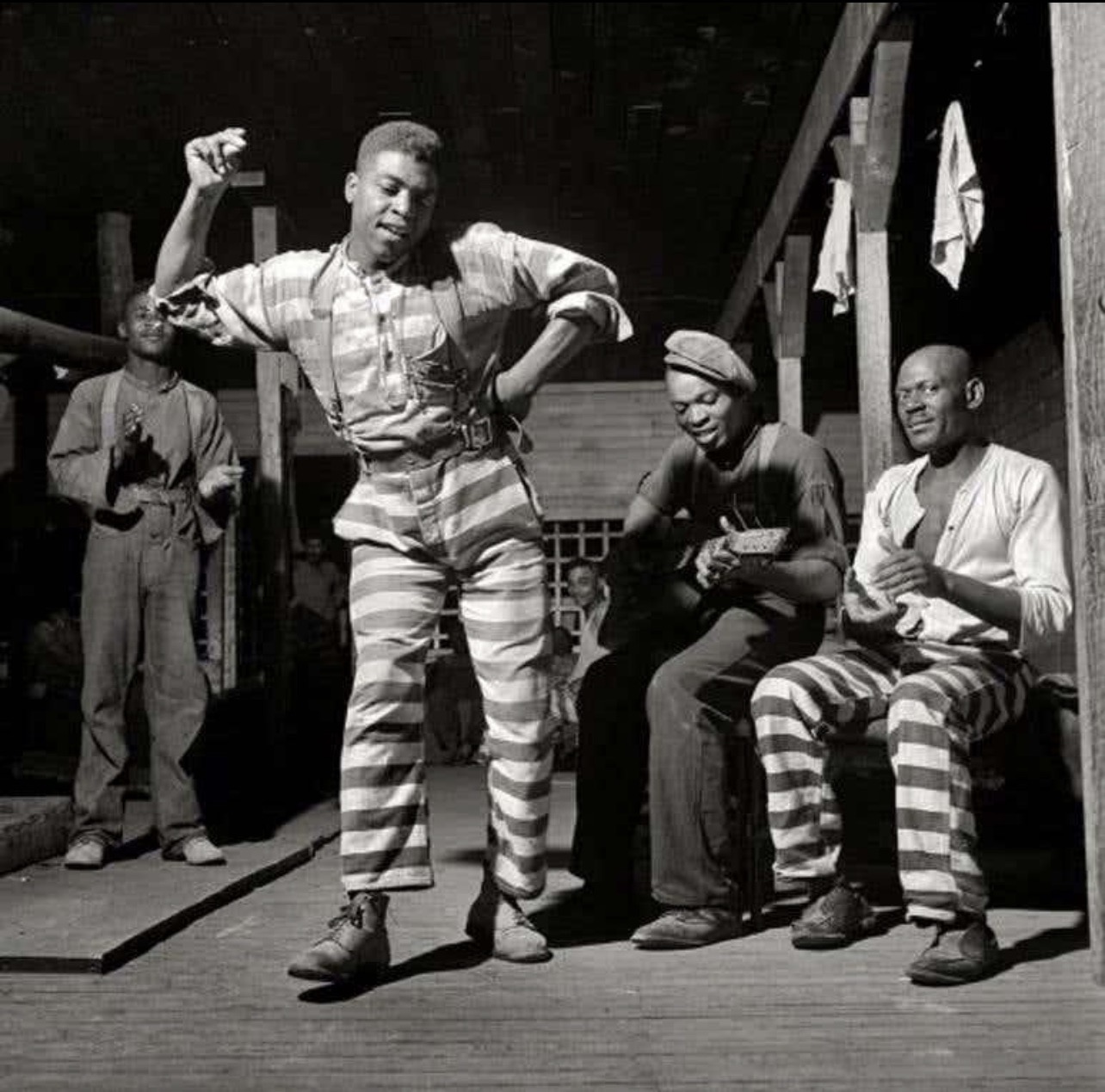
The photograph is attributed to Jack Delano, taken in 1941 at a convict labor camp in Greene County, Georgia. Part of the Farm Security Administration’s broader documentation of American life, the image captures a moment that resists the conditions surrounding it. The men are confined, but not still. The striped uniforms signal control, but the posture, the rhythm, the interaction between them introduce something else — movement, expression, joy. As a Black man, I recognized that immediately. Not as performance and not as denial, but as something my people have always known how to do: find fullness inside conditions designed to produce emptiness. That capacity — to be jovial, to be present, to create culture from the scrappings of a system that was never built for you — is not incidental to Black American life. It is the through line. It is how soul food got made from what was left behind, how music got built from borrowed instruments, how a culture that reverberates around the world was assembled from what privilege threw away.
What stopped me was the resilience in that image. What made me keep thinking was the question I couldn’t answer: why did it stop Kennedy too? That question is the real subject of this piece.
Placed inside a Manhattan loft tied to one of America’s most recognizable political legacies, the photograph shifts meaning. It is no longer just documentation. It becomes contrast. On one side: inherited proximity to power, mobility, and access — a life defined by abundance, by choice, by the assumption that the world will accommodate you. On the other: confinement, surveillance, and a system historically shaped by race and labor extraction, where the only thing that could not be fully controlled was the spirit of the people inside it. The photograph collapses that distance into a single visual field, and the room — stripped of everything else — offers nothing to soften that collision.
That choice matters more than the image itself. Minimalist spaces are about control — what is allowed in, what is kept out, what is deemed essential. To include only one image is to assign it weight. To choose this image is to introduce a narrative that the rest of the room does not naturally support. It suggests that even within environments of access and insulation, there is an awareness — however quiet — of the systems operating outside those walls. But awareness is not proximity, and the loft makes no claim beyond the fact of the photograph’s presence. Kennedy grew up inside one of the most powerful families in American political history. The men in that photograph grew up inside a system that treated Black life as a labor resource. That he chose to live with their image — and only their image — is a fact that does not come with an explanation attached.
What Delano captured was not intended as metaphor. It was documentation of a system that extended beyond prison walls into labor, land, and race relations in the American South. Convict leasing and forced labor did not simply disappear after slavery — they reappeared through structures like the camps Delano photographed, operating legally, systematically, and largely without consequence for decades. The image holds that history without explaining it. It does not instruct the viewer how to feel. It presents a moment that carries more weight than it appears to, and leaves the rest to whoever is standing in the room.
In a cultural moment where incarceration is discussed through data, policy, and abstraction, the photograph does something harder. It restores scale. It brings the conversation back to bodies, to relationships, to moments that exist even inside systems designed to eliminate them. For me, it connected to something longer than the image itself — a lineage of Black Americans who have always done more with less, who have always found a way to build something lasting from what the system discarded. The men in that photograph are part of that lineage. So am I. That recognition is immediate and it is not intellectual. It lands before the analysis begins.
What I keep returning to is the question of how it landed on Kennedy — a man whose life was defined by abundance, legacy, and a proximity to power that most people never experience. What did he see when he looked at that image? What did it give him that the rest of the room, deliberately emptied of everything else, could not? I don’t have that answer. The documentary didn’t offer it and Kennedy never gave it publicly. But the fact that he kept the image — that in a space stripped of his family’s history, his father’s legacy, and the visual weight of everything his name carried — he chose to live with this particular witness says something that I find impossible to look away from. Whether that was conscience, aesthetics, inheritance, or something he couldn’t fully name himself — the photograph outlasted the explanation. It stayed. And the fact that it stayed, in that room, on that wall, with nothing else around it, is the only answer we have.