Spirit Airlines is reportedly preparing to cease operations as early as 3 a.m. Saturday after failing to secure a critical $500 million financial lifeline. The breakdown stems from insufficient backing from bondholders and federal support channels, leaving the ultra-low-cost carrier without the liquidity needed to continue flying. The immediate impact is operational — passengers stranded nationwide, more than 14,000 jobs in the balance, and a travel system absorbing a disruption it was not designed to cushion. But the more important story is structural, and it was visible long before this weekend.
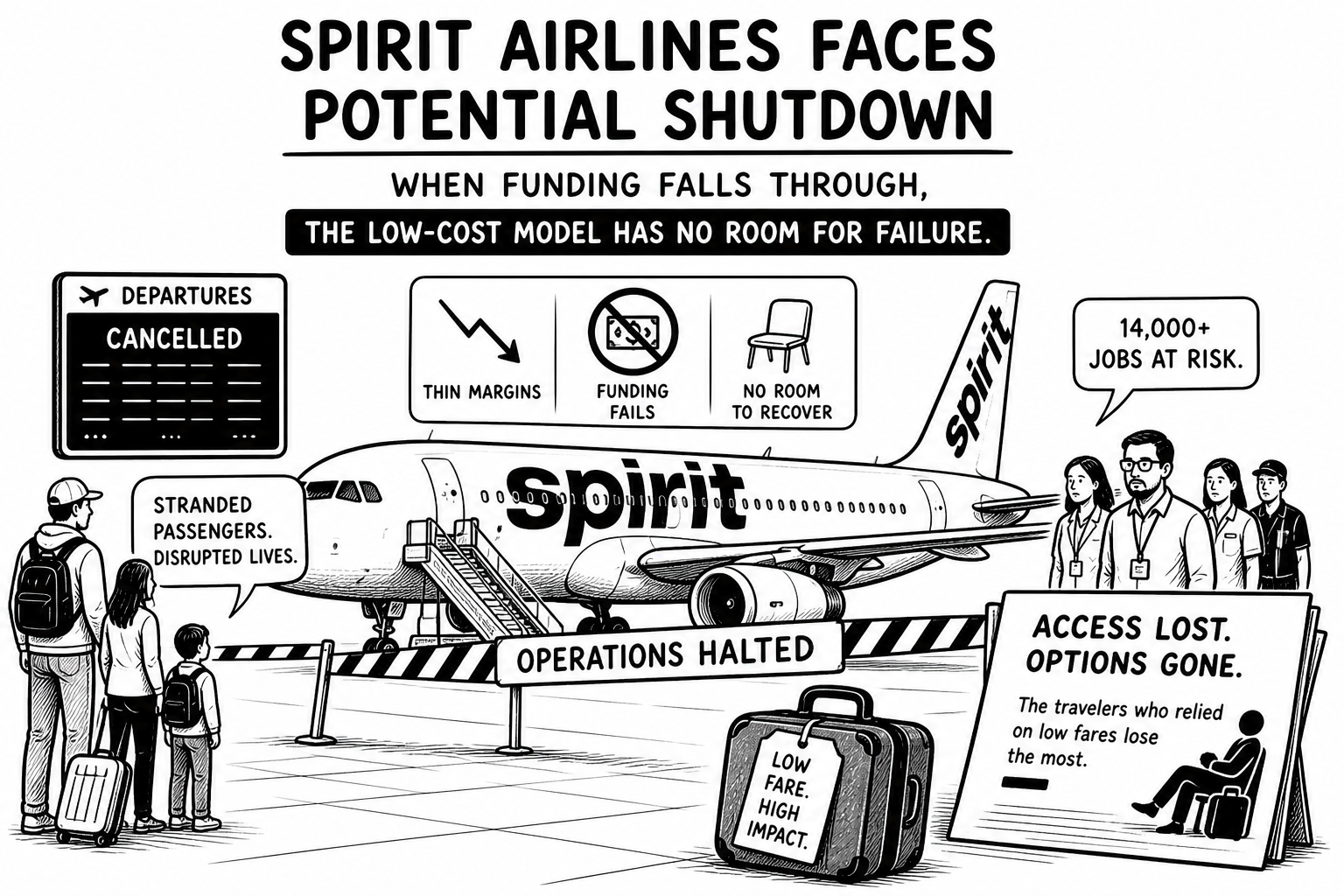
Budget airlines do not fail suddenly. They fail at the moment when the variables holding a thin-margin model together — volume, cost discipline, and stable consumer demand — break in the same direction at the same time. Spirit’s model was never built for shock absorption. It was built for volume. Seats filled at low prices, fees layered on top, and operational costs kept tight enough that the math worked as long as people kept booking. When confidence tightens and capital follows, there is nothing underneath to catch it. As budget carriers began turning to Washington for support, the signal was already there — a sector whose margins leave no room for the kind of sustained pressure that federal intervention becomes necessary to absorb.
What makes this moment worth examining beyond the operational disruption is what it reveals about how the system continued to function even as the underlying operation deteriorated. Bookings reportedly remained open even as shutdown loomed — passengers purchasing tickets on an airline that may not have had a viable path to completing their trips. That is not an anomaly. It is a feature of platform-era commerce, where the transaction layer operates independently of the operational reality beneath it. The system is designed to keep moving. It is not designed to stop and signal when the ground has shifted.
The access dimension here is direct. Spirit served a specific traveler — one for whom the price difference between a budget carrier and a legacy airline is not a preference but a constraint. The routes Spirit flew, the markets it served, and the passengers it carried were not incidental to its business model. They were the business model. When a carrier built around cost access collapses, the people who lose are not the ones who can rebook on Delta. They are the ones for whom Spirit was the only viable option in the first place.
That is what gets lost in coverage that frames this as a corporate failure or a market correction. It is both of those things. It is also the removal of a travel option from people who had few to begin with — and a reminder that in a system with no structural floor, the cost of collapse does not distribute evenly.
Why It Matters
The low-cost carrier model was never just a business strategy. It was an access strategy — one that brought air travel within reach of travelers the legacy carriers were not designed to serve. Spirit’s potential shutdown does not just remove an airline. It removes a price point. And in a travel market where consolidation has already narrowed options significantly, the gap it leaves will not be filled by the market on its own. What looks like one company’s failure is, in practice, a contraction in who gets to move.