
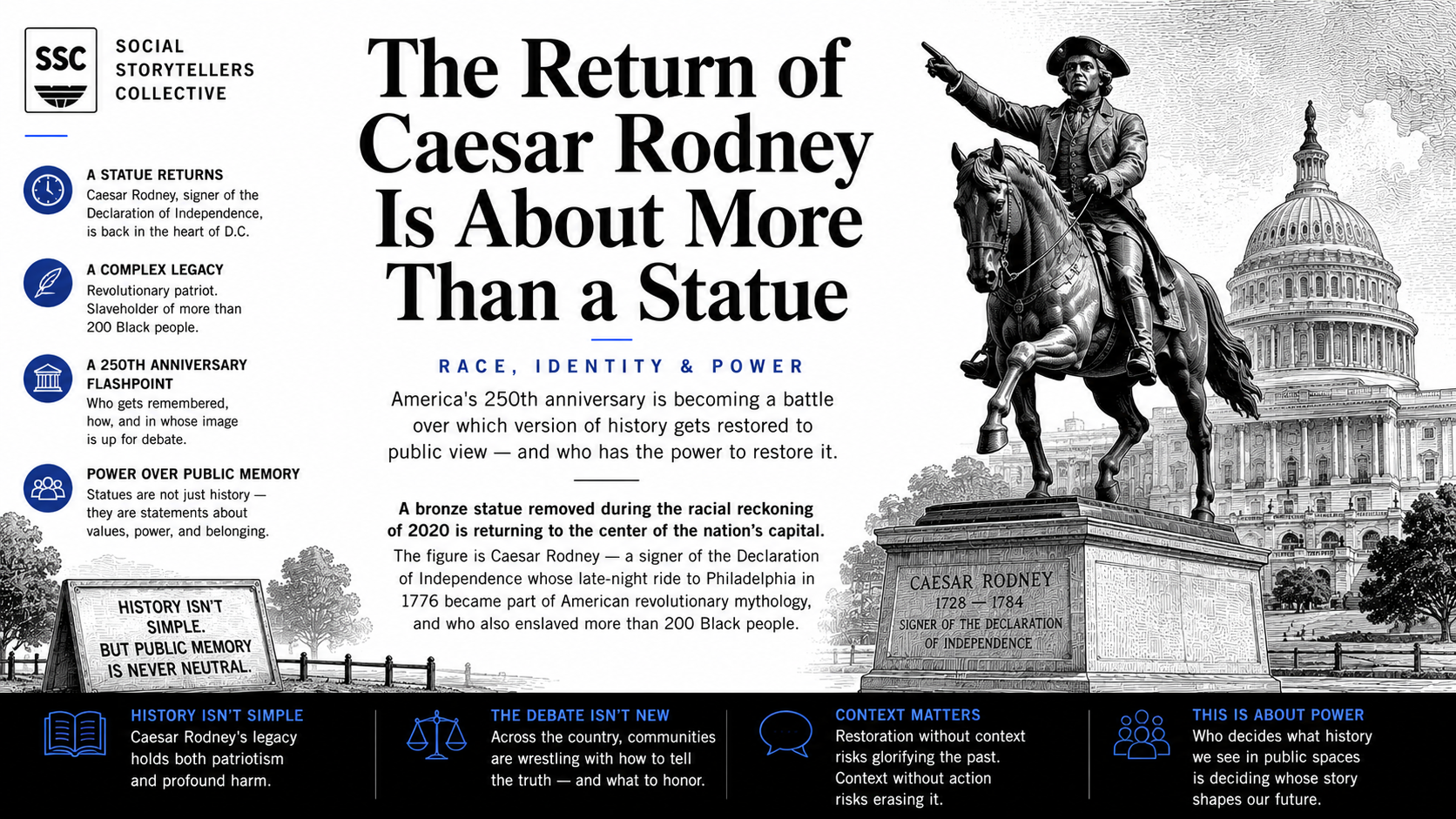
A bronze statue of Caesar Rodney — signer of the Declaration of Independence and enslaver of more than 200 people — is being temporarily installed in Washington, D.C.’s Freedom Plaza as part of America’s 250th anniversary celebration. The statue was removed from Wilmington, Delaware in the days after George Floyd’s murder in 2020 and spent nearly six years in storage. Freedom Plaza is named in honor of Martin Luther King Jr. That last detail is not incidental. It is the whole argument.
This is not a statue being quietly returned to its original location after years of community conversation. It is a monument being repositioned through federal power — timed to the country’s most prominent moment of national self-definition in a generation. The Interior Department framed the decision as honoring “the full breadth” of American history. Federal descriptions of Rodney emphasize courage and revolutionary sacrifice. The 200-plus enslaved people whose labor underwrote his political standing are barely mentioned. That imbalance is not an oversight. It is a choice.
After 2020, institutions across the country — cities, universities, sports leagues, corporations — publicly acknowledged that many American monuments reflected who held power when they were built, not neutral history. Hundreds were removed or reconsidered. What is happening now is not a simple reversal of that moment. It is more precise than that: the reassertion that those removals were overcorrections rather than reckonings. The Caesar Rodney statue is one expression of that reassertion. The rollback of DEI programs, the curriculum fights over how American history is taught, the disappearance of racial equity language from institutional communications — it is all part of the same shift. Public memory has become political terrain, and the federal government is now actively deciding what gets restored.
America is telling itself a story about its 250th year. Freedom Plaza — named for a man who was surveilled, harassed, and ultimately killed for insisting that American freedom apply to everyone — will temporarily hold a monument to a man whose freedom was built on the unfreedom of others. The debate over who deserves elevation in shared civic space never ended. The statue coming back just makes that plain.
SSC covers race, identity, power, and the structural forces shaping American public life.