
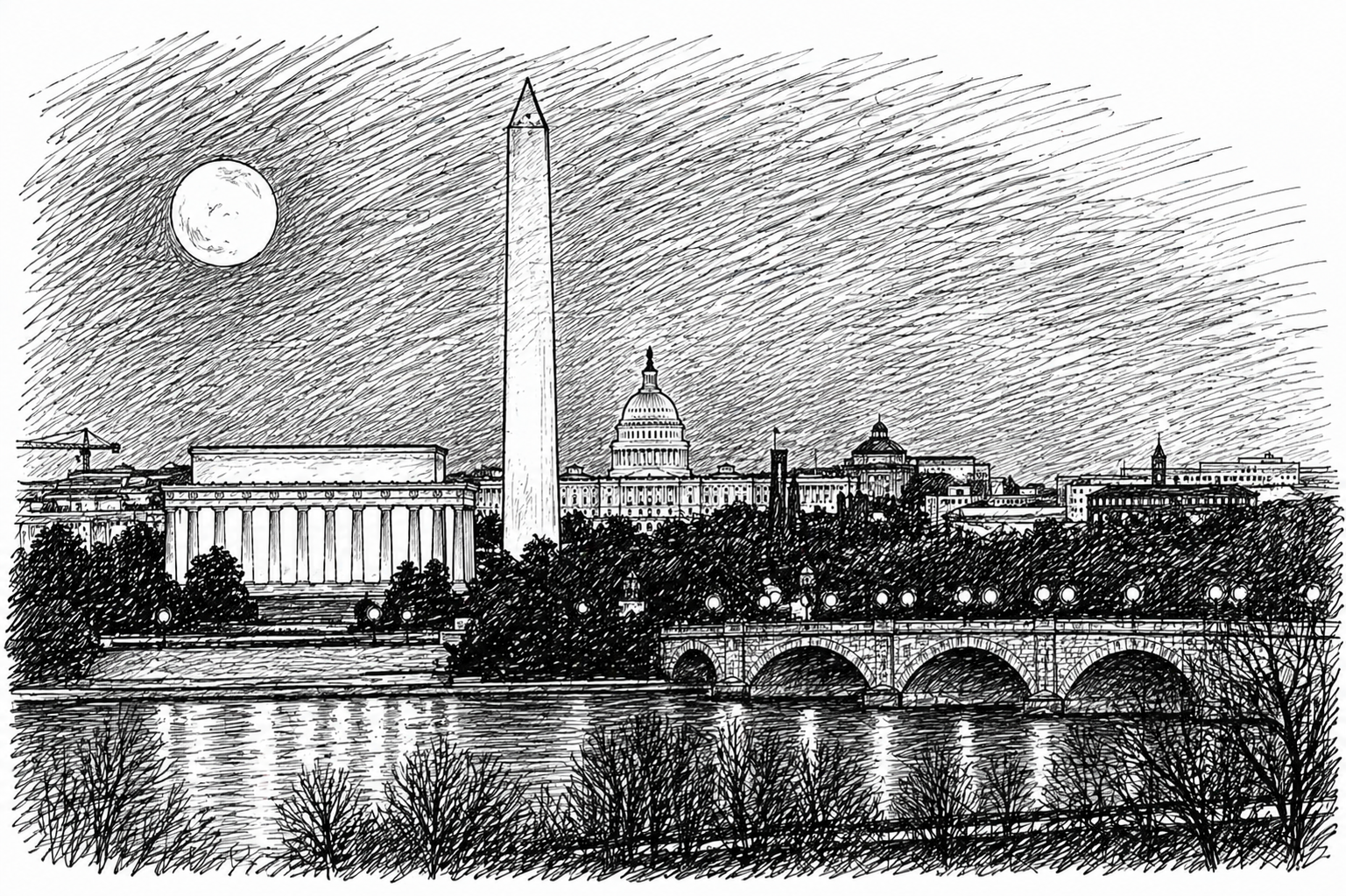
Washington D.C. has a specific economic story that no other city in the series shares. It is the seat of federal power, home to the highest concentration of government employment in the country, and the city where federal jobs have functioned for generations as the single most reliable pathway into the Black middle class. That context makes the wealth data here more than a local story. It is a national one — and the policy decisions being made right now are directly restructuring the economic foundation that produced whatever stability Black D.C. households have managed to build.
The Color of Wealth in the Nation’s Capital found that white households in D.C. have a net worth 81 times greater than Black households. In the survey years covered, the typical white household in D.C. had a net worth of $284,000. The typical Black household had a net worth of $3,500. That 81-to-1 ratio is the starkest in the series. It is produced by a city whose history of wealth extraction from Black residents is as deliberate and as documented as any in the country.
The Color of Wealth report traces that history with precision. In the 1840s, Black Codes prohibited Black residents from owning and operating businesses. When emancipation came to the District in 1862, white enslavers were compensated for their “financial loss.” Black people were not compensated at all. In the 1960s and 70s, urban renewal swept through D.C.’s largely Black southwest neighborhoods — more than 500 acres bulldozed, along with 1,500 businesses including many Black-owned ones, and 6,000 homes. Approximately 23,000 residents, predominantly Black, were displaced with little compensation. The 5,800 new homes built on that land were designed for middle- and upper-middle-class residents. The clearance was not incidental. It was the policy.
Federal employment filled some of that gap. For decades, the federal government was one of the few large employers that applied civil service rules uniformly enough to create genuine pathways for Black workers who were barred from comparable private sector advancement. That pipeline produced D.C.’s Black middle class — not wealth in the Color of Wealth sense, but income stability, benefits, and the possibility of homeownership in neighborhoods where Black families could actually buy. As recently as 2024, nearly 29 percent of D.C.’s federal workforce was Black.
That pipeline is now being dismantled. Economic Policy Institute research shows that Black workers make up a disproportionate share of all federal workers and a particularly large share at agencies targeted for mass layoffs. At the Department of Veterans Affairs alone — expected to face 80,000 job cuts — Black workers represent more than a quarter of employees. The federal workforce reduction is being described in efficiency terms, in terms of cost savings and organizational streamlining. What it is doing in structural terms is removing the single most reliable mechanism through which Black D.C. households have converted income into something approaching stability — not wealth, but the income floor that makes wealth-building theoretically possible.
The labor market picture reinforces how little margin exists. Black unemployment in D.C. stood significantly above white unemployment as of 2024, with white residents facing a rate of just 3.6% while Black residents faced unemployment at more than double that rate — placing the District among the jurisdictions with the largest racial unemployment gaps in the country. Underemployment reveals another layer: 14.4% of Black workers in D.C. were underemployed, compared to 3.7% of white workers. Researchers conclude that these disparities cannot be explained by education or job training levels alone. They are rooted in a long history of racism in policies and systems that denied Black D.C. residents equal access to quality education, jobs, and wealth-building opportunities.
The gentrification pressure completing this picture is acute. The white population of D.C., which had fallen to 28% of the city’s total at its lowest point, has climbed back toward nearly half the city’s population as affluent families have returned to the urban core. That demographic shift has driven property values in historically Black neighborhoods beyond the reach of long-term residents — including the federal workers whose stable income had made homeownership there possible in the first place. The same neighborhoods that were bulldozed in the 1960s to make room for middle-class development are now being priced out from the other direction — not through eminent domain this time, but through market forces that produce the same displacement at a slower pace.
D.C. closes the Local Ledger series with the most concentrated version of the argument the series has been making city by city. The wealth gap is not a product of individual circumstance. It is a product of policy — historical policy that built it, and current policy that is actively preventing the conditions under which it could narrow. The federal workforce reduction is not a side effect of administrative efficiency. It is a direct intervention in the economic infrastructure that Black D.C. households depend on, arriving at the moment when the wealth gap it is widening was already 81 to 1.
The ledger does not close here. It compounds.
Part of The Local Ledger — an ongoing SSC series. Read the series framing piece here: [The Local Ledger: What Your City’s Wealth Gap Actually Looks Like]. Previous installments: [The Local Ledger: Baltimore] | [The Local Ledger: Boston] | [The Local Ledger: Chicago]| [The Local Ledger: Los Angeles].