
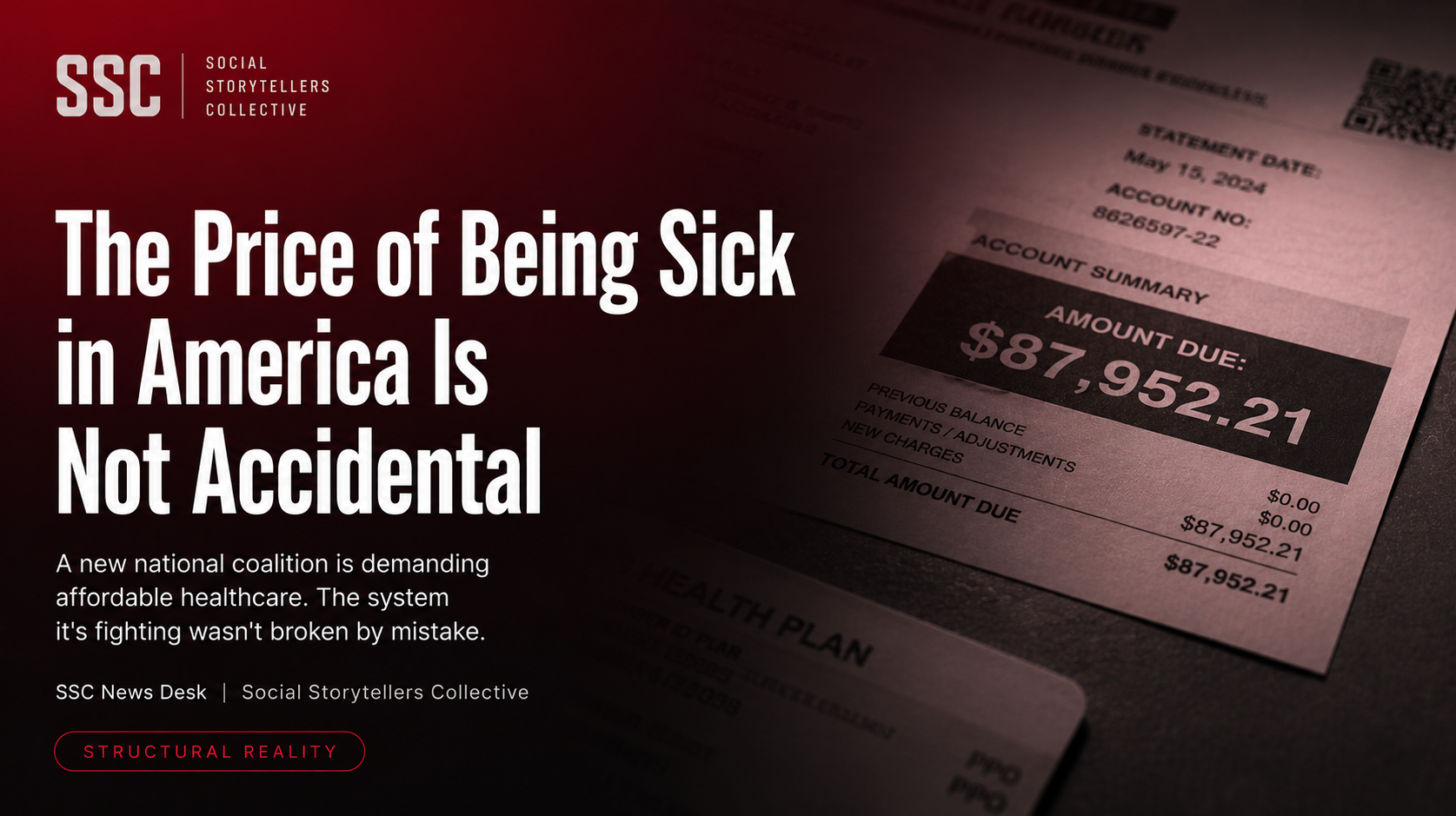
Before One Nation, Overcharged launched its national campaign this week, the numbers were already telling the story that the healthcare industry would prefer not to discuss in the same sentence.
The seven largest for-profit health insurance companies took in nearly $1.7 trillion from their customers in 2025 — $175 billion more than in 2024 — and booked more than $54 billion in profits. In that same year, just under half of all U.S. adults reported difficulty affording healthcare costs. Those two facts do not exist in separate economies. They are the same economy, operating exactly as designed.
The coalition — backed by the Robert Wood Johnson Foundation and anchored by the NAACP, National Urban League, Black Women’s Health Imperative, UnidosUS, Black Voters Matter, and more than 130 partner organizations — is making a demand that sounds simple: a healthcare system that puts people over profits. The structural argument behind that demand is that profits and people are not simply in tension. For the communities bearing the highest cost of American healthcare, the profit motive has been extractive — and the extraction has been precise.
Black Americans carry significant medical debt at a rate of 13 percent, compared to 8 percent of white Americans. Black Americans are 1.5 times more likely to have medical debt than white Americans. Medical debt is the leading cause of personal bankruptcy in the United States, responsible for 66.5 percent of all filings. These are not the statistics of a system that failed to reach everyone equally. They are the statistics of a system that reached some people harder than others, and did so consistently enough that the pattern cannot be explained by anything other than structure.
The cost burden compounds at every level. A slight majority of Hispanic adults and half of Black adults report difficulty affording care, compared to about four in ten white adults. Over half of Black adults say they have delayed or skipped prescribed medication due to cost — compared to about a third of men and four in ten white adults overall. Delayed medication does not stay in the category of financial hardship. It migrates into the chronic disease statistics that then get cited as evidence of poor health behaviors in communities that were, in fact, being priced out of staying well.
The coalition’s launch lands inside a specific legislative moment. Congress is currently advancing what would represent the largest Medicaid cuts in American history. The House-passed budget resolution framework would place at risk the health and financial security of more than 70 million children, seniors, people with disabilities, and working families. Nearly 42 million people — approximately a third of all people of color in the United States — rely on Medicaid and would be placed in harm’s way if the cuts become law. Those cuts are not being proposed in a vacuum. They are being proposed to fund tax relief that flows predominantly to the wealthiest households in the country — a transfer of resources from the most medically vulnerable to the most financially secure, laundered through the language of fiscal responsibility.
A Public Citizen analysis found 446 hospitals are at high risk of closing or cutting services due to planned Medicaid cuts, with experts saying the impact would fall hardest on Black and Latino communities. Hospital closures in communities already navigating healthcare deserts are not service reductions. They are the elimination of the last available option, and they arrive in the same neighborhoods that already absorbed the closure of grocery stores, the withdrawal of bank branches, and the defunding of public transit. The geography of disinvestment does not change by sector. It accumulates.
The seven largest insurers paid their CEOs a combined $146.1 million in compensation in 2024. The industry’s preferred explanation for rising consumer costs — that paying more claims is itself a crisis, an event it describes internally as “medical loss” — tells you everything about the values being optimized for. Loss, in this framing, is what happens when sick people receive care. Profit is what happens when they don’t.
One Nation, Overcharged is making a moral argument. But the data makes a structural one, and the structural argument is harder to dismiss. The system is not overcharging people because it lacks the resources to do otherwise. It is overcharging people because overcharging is the mechanism by which it generates returns for shareholders — and the people with the least leverage to resist that mechanism are the people who have historically had the least political power to change it.
That is not a healthcare problem. It is an accountability problem. And accountability, unlike charity, requires that someone be responsible for the outcome.
Social Storytellers Collective covers race, identity, access, and structural inequality. Read more at socialstorytellerscollective.substack.com