
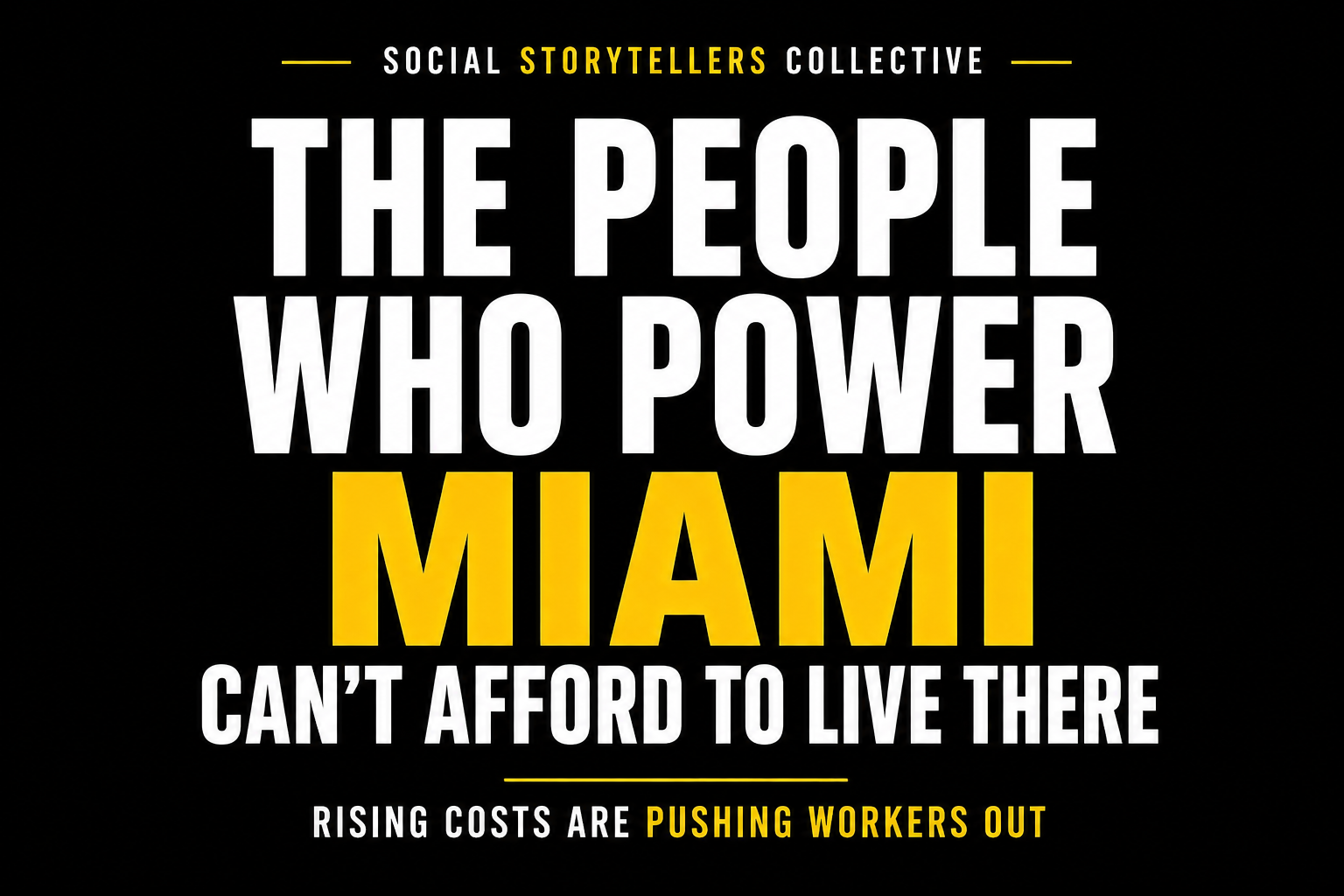
Miami’s housing market crossed a threshold when prices rose more than 80 percent in the years following the pandemic, outpacing local income growth by a wide margin. The average Miami home now sells for $672,000 — up 2.6 percent in the past year alone — while the luxury condo market has effectively redefined its own floor, with $1 million now considered a fairly average price tag and the true luxury segment starting around $2.5 million. What had long been an expensive coastal city became something else entirely: a market where ownership and rental levels are increasingly set by buyers and investors whose financial realities are not tied to local wages. The result is not just higher costs. It is a shift in how the city functions — and for whom.
The demand driving that shift is not local. In 2024, Miami ranked as the number one destination city in the country for individuals with $100 million or more in investable assets (Miami’s Housing Market Isn’t Cooling. It’s Splitting in Two.) — hedge fund managers, billionaires, and international capital operating entirely outside the mortgage rate constraints that govern everyone else’s purchasing decisions. Luxury condo prices per square foot have risen 30 percent in five years, reaching nearly $1,000 per square foot in prime neighborhoods. When that segment dominates new development activity, it doesn’t just set a ceiling on the luxury tier. It presses down on everything below it, compressing the market categories that working and middle-income households depend on.
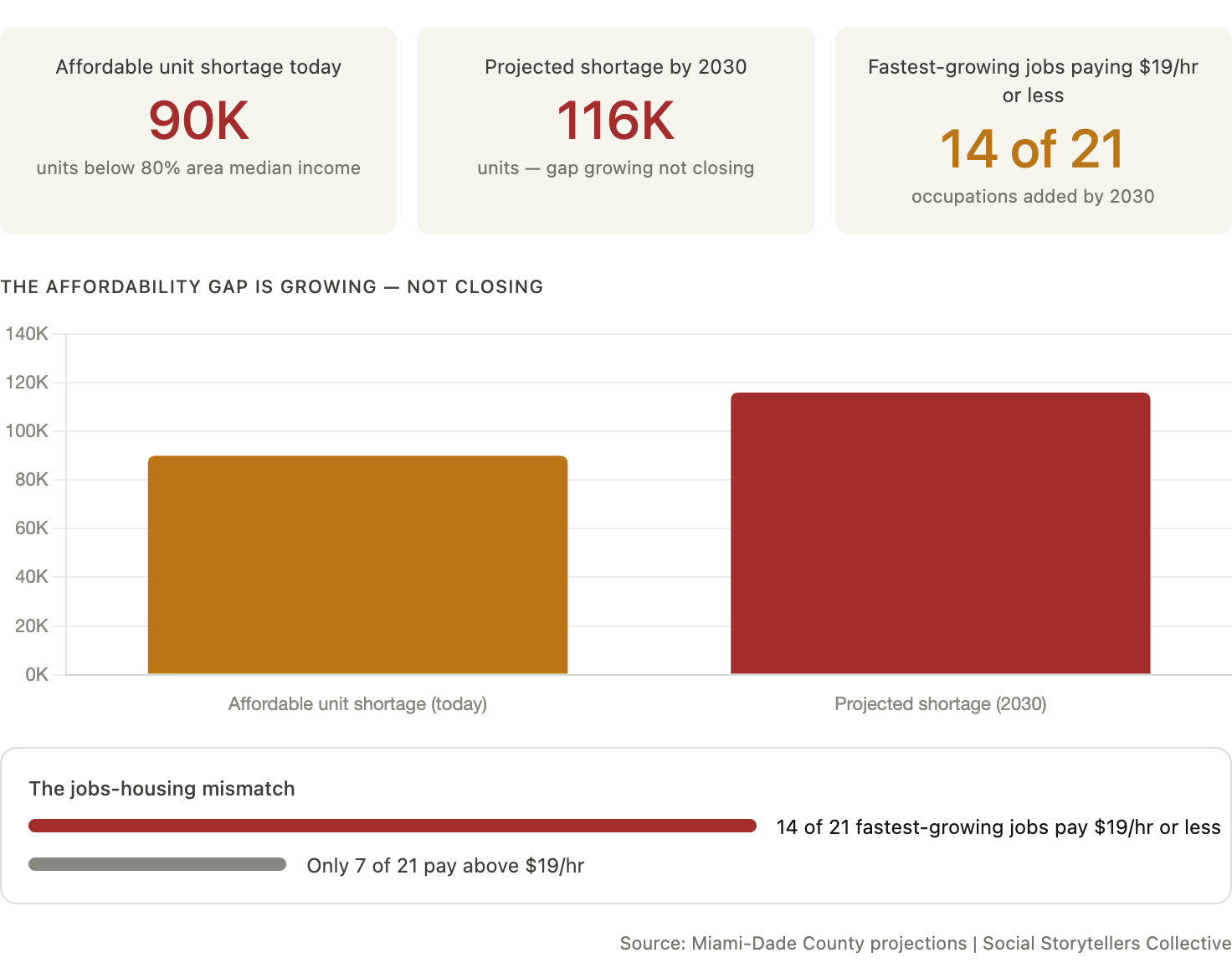
That compression has a measurable human cost. Half of all households in Miami-Dade County are cost-burdened — spending more than 30 percent of their income on housing — including three-quarters of households earning below $75,000 per year. Of the 21 occupations projected to add the most workers in Miami-Dade by 2030, 14 have a median hourly wage of $19 or less. The jobs the city is creating cannot support the housing the city is building. The county has a gap of more than 90,000 affordable and available rental units for households earning below 80 percent of the area median income — a gap projected to grow to nearly 116,000 units by 2030. Miamians on average spend 56 percent of their combined income on housing and transportation costs together. That is not a budget constraint. It is a structural trap.
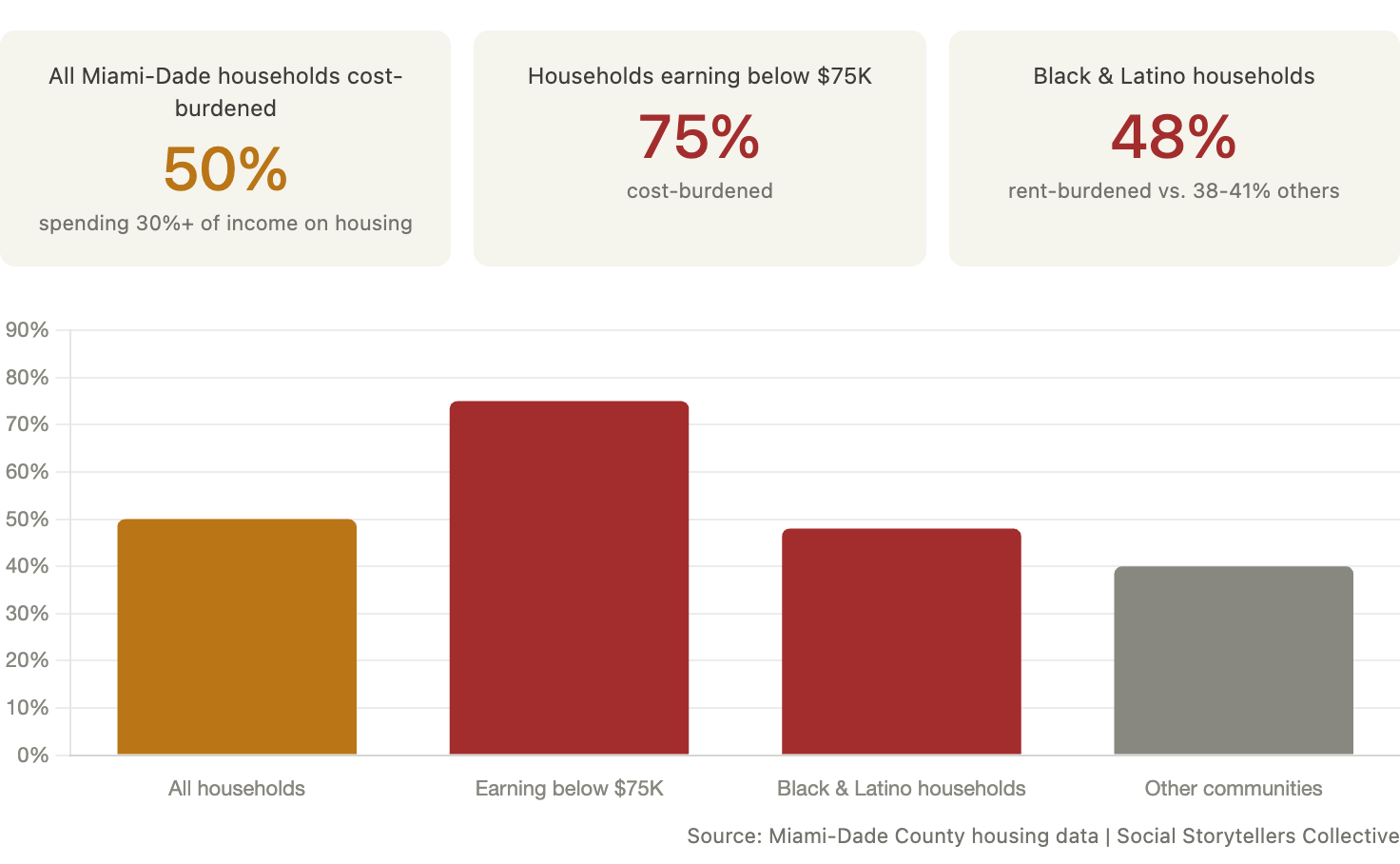
The burden is not evenly distributed. Black and Latino households absorb the sharpest pressure — 48 percent are rent-burdened compared to 38 to 41 percent of other communities. Miami has always been a majority-minority city, built substantially on Caribbean and Central and South American migration, with communities like Little Haiti, Liberty City, and Overtown carrying decades of cultural and economic history alongside decades of targeted disinvestment. Those communities are not encountering the luxury market’s expansion as an abstraction. They are encountering it as eviction pressure, as property tax increases that follow rising assessed values, as the gradual replacement of the neighborhoods they built with condominiums priced for buyers whose primary residence is somewhere else entirely (Miami’s Luxury Rebuild Is Moving Fast. The Question Is Who It’s Being Built For.) — a dynamic SSC has been tracking across the Brickell corridor and into the surrounding neighborhoods absorbing its overflow.
What makes Miami’s situation structurally distinct from other expensive coastal markets is the mechanism driving it. This is not simply a supply problem — though the county’s shortage of 90,000 affordable units makes it that too. It is a participation problem. As SSC has documented in its broader housing coverage (Stability, Pending Approval.), the architecture of affordability in American cities has been quietly restructured so that the people who need it most are the least likely to access it. In Miami, that restructuring has been accelerated by a specific force: the arrival of global capital that doesn’t need the city to be affordable because affordability was never a constraint it faced. The market recalibrated around people who arrived already wealthy — and the communities that were already there have been absorbing the cost of that recalibration ever since.
The share of single-family listings priced under $350,000 has dropped from 24 percent in 2020 to just 3.5 percent in 2026. What disappears with that inventory is not just a price tier. It is the mechanism through which working-class and first-generation homeownership has historically been possible in this city. That disappearance connects directly to a pattern SSC has documented nationally (The Black Homeownership Gap Is Now Wider Than When the Fair Housing Act Was Signed.) — the Black homeownership gap is now wider than it was the day the Fair Housing Act was signed. In Miami, that gap isn’t just a national statistic. It is being actively produced, neighborhood by neighborhood, by a market whose logic excludes the communities that built the city’s cultural identity and economic foundation.
The effects are visible in who is leaving. As costs rise, long-time residents and middle-income households are relocating — either within Florida or beyond it. At the same time, new arrivals continue to enter at higher price points, sustaining upward pressure on costs. This creates a cycle where displacement and demand operate simultaneously — a city that grows while also pushing people out. Over time, that cycle produces a two-market structure: one defined by high-value transactions, luxury development, and capital preservation; the other defined by constraint, rising rents, longer commutes, and fewer options for stability. The divide is not just economic. It reshapes neighborhoods, local businesses, and the types of services that can survive within the city at all.
Miami is not alone in experiencing these pressures — but the scale, speed, and specificity of what is happening here make it the clearest current example of a broader national shift. Housing markets are no longer shaped solely by local conditions. They are increasingly influenced by global flows of money that can enter and exit quickly, leaving lasting effects on pricing and access for the communities that cannot move with the same speed or capital. In that environment, affordability becomes less a question of supply and more a question of participation — and the question of who gets to participate has already been answered by the market, even if the policy conversation hasn’t caught up yet.
Miami is no longer just becoming more expensive. It is becoming more selective — with access determined less by local income and more by proximity to wealth. The cost of staying is not just rising. It is redefining who the city is for.
Miami is part of City Signals, SSC’s ongoing series on what cities reveal about who they’re built for. Read the New York City, Boston, and Houston installments now at socialstorytellers.substack.com. Future cities in the series include Washington D.C., Los Angeles, Dallas, Austin, and San Francisco.