
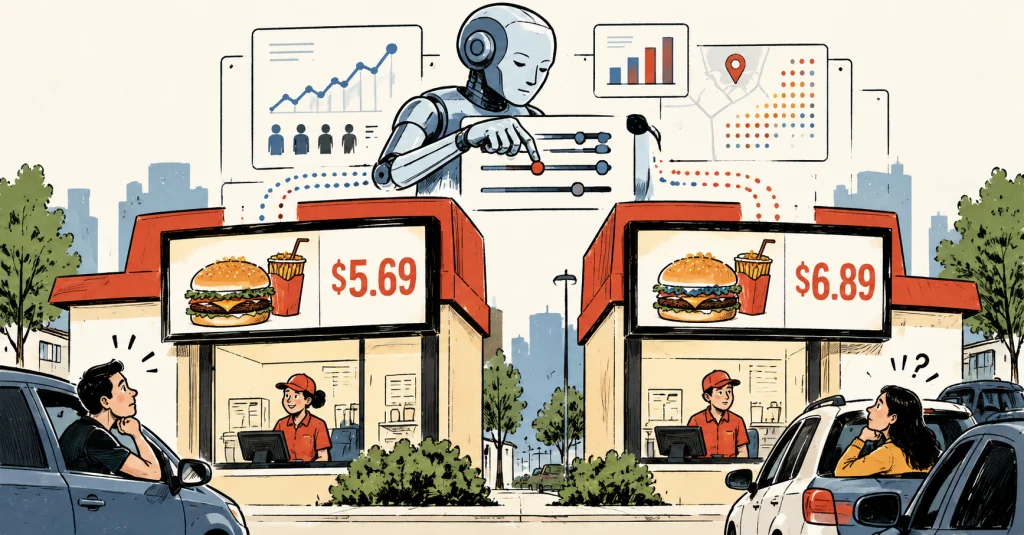
Reuters reports that McDonald’s is using machine learning to recommend menu prices across nearly 14,000 U.S. restaurants, offering a look at how AI is moving from back-end operations into the everyday prices consumers see at the counter.
Two McDonald’s restaurants in Fresno, California, about two miles apart, were selling a Big Mac for $5.69 and $6.89, according to a new ReutersThe Price of a Big Mac May Depend on What the Algorithm Thinks You’ll Pay
Reuters reports that McDonald’s is using machine learning to recommend menu prices across nearly 14,000 U.S. restaurants, offering another example of how businesses are using price not simply to reflect costs, but to measure and respond to consumer behavior.
Two McDonald’s restaurants in Fresno, California, about two miles apart, were selling a Big Mac for $5.69 and $6.89, according to a new Reuters investigation. The 21% difference does not prove that artificial intelligence caused the gap, and restaurant prices have never been identical everywhere. But Reuters found that McDonald’s is increasingly using machine learning to recommend prices across its nearly 14,000 U.S. restaurants, analyzing millions of transactions and estimating what customers in individual markets may be willing to pay. The pricing engine generates what McDonald’s calls an “optimal price” for individual menu items at individual restaurants. That puts one of the country’s most familiar fast-food chains inside a pattern SSC examined just yesterday: companies and governments are getting increasingly precise about how price influences behavior.
From Changing Behavior to Predicting It
Yesterday, SSC examined New York City’s congestion-pricing system and found that even a substantial price difference did not consistently cause people to change when they traveled. Drivers entering Manhattan faced a $9 peak toll compared with $2.25 overnight, yet researchers found measurable shifts around only two of four pricing transitions they studied. Visits increased 5.9% before the weekday 5 a.m. cutoff and 9.2% after the weekend 9 p.m. cutoff, while behavior barely moved at the other transition times. The findings suggested that price has limits: people can respond only when work schedules, family obligations and other constraints give them room to move. McDonald’s is approaching the same relationship from the other direction. Rather than setting a price and measuring who changes behavior, its pricing system analyzes past behavior to recommend what a particular market may be willing to absorb.
That puts more weight on the data behind the price. Reuters reports that McDonald’s pricing engine analyzes millions of daily transactions, local market conditions and competitor pricing, while its interface assesses factors including a restaurant’s sensitivity to price and “customer willingness to pay in your area.” Restaurant operators still formally control their own prices, according to McDonald’s, which describes the system as a recommendation tool rather than a mandate. But five franchisees told Reuters they felt pressure to follow its recommendations, and internal documents showed that deviations are tracked. The software does not need to set the final price automatically to influence the number customers see on the menu board. Once a recommendation arrives backed by transaction data and corporate analytics, it becomes part of how operators decide what counts as a reasonable price.
A More Precise Version of Local Pricing
Local pricing itself is not new. Rent, wages, taxes, competition and transportation costs have always helped explain why the same restaurant chain may charge different prices in different cities or neighborhoods. What machine learning changes is the precision of the process. Instead of making broad adjustments based mainly on costs, a company can continuously analyze demand and identify where higher or lower prices may produce the outcome it wants. Reuters reports that McDonald’s works with Tiger Analytics on the pricing platform and can give the system goals ranging from attracting more customers to increasing profits. Those recommendations can also become surprisingly specific: company parameters have included avoiding summer price increases on ice cream and drinks and focusing increases on items that have not changed price recently.
That creates an important difference between traditional local pricing and algorithm-assisted pricing. One explains why doing business costs more in one location than another. The other can also ask how much more customers in that location will tolerate. In Fresno, Reuters found one company-owned McDonald’s selling a Big Mac for $5.69 while another company-owned restaurant two miles away charged $6.89. Reuters could not determine whether the pricing engine produced that particular difference, but three franchisees told the outlet that the system has widened some existing price gaps between nearby restaurants. McDonald’s says restaurants separated by only a few miles can operate in distinct markets and that its tool helps franchisees make informed business decisions.
When Price Becomes a Behavioral Signal
The connection to congestion pricing is useful because both stories show price increasingly being treated as information. New York changes the toll and researchers can observe when people change their schedules. McDonald’s observes customer purchases and uses those patterns to help determine which prices might work next. In one case, behavior follows the price. In the other, behavior helps produce the price.
That approach has already spread well beyond restaurants. Airlines and hotels have long used yield management to adjust prices as demand changes, and ride-hailing companies made real-time surge pricing familiar to millions of consumers. Fast food brings the practice into a more routine part of household spending. McDonald’s serves customers across income levels, including people who may choose it precisely because they expect a relatively predictable and inexpensive meal. When the tools behind pricing become more sophisticated, the customer does not necessarily know which factors contributed to the amount shown on the screen. The calculation happens upstream; the receipt is where the consumer encounters it.
The Price Consumers Cannot See Being Set
Reuters also found that McDonald’s is navigating competing incentives inside its franchise system. Corporate headquarters earns much of its money from a percentage of franchisee revenue, giving it an incentive to increase traffic and sales volume. Franchisees face their own pressure from wages, rent and other restaurant costs, which the National Restaurant Association estimates have risen 36% since 2019. That can leave corporate headquarters recommending lower prices to attract customers while some restaurant operators would prefer higher prices to protect individual-store margins. Reuters reports that McDonald’s now sends pricing guidance to franchisees at least three times a year and has incorporated engagement with approved pricing tools into its business standards.
The consumer sees none of those negotiations. What appears on the menu looks like a single number, even when that number sits at the end of a chain involving local costs, corporate targets, competitor prices, transaction history and estimates of willingness to pay. Artificial intelligence is not only being introduced to make restaurants faster or more efficient. It is becoming part of the commercial machinery that helps decide how much ordinary transactions should cost.
Yesterday’s SSC congestion-pricing report showed that consumers do not always have the flexibility to reorganize their lives around a cheaper price. Today’s McDonald’s report shows businesses becoming increasingly capable of studying those same behavioral limits. Put together, the two stories point toward a pricing environment increasingly shaped not only by what something costs to provide, but by what data says people are able — or willing — to pay.