
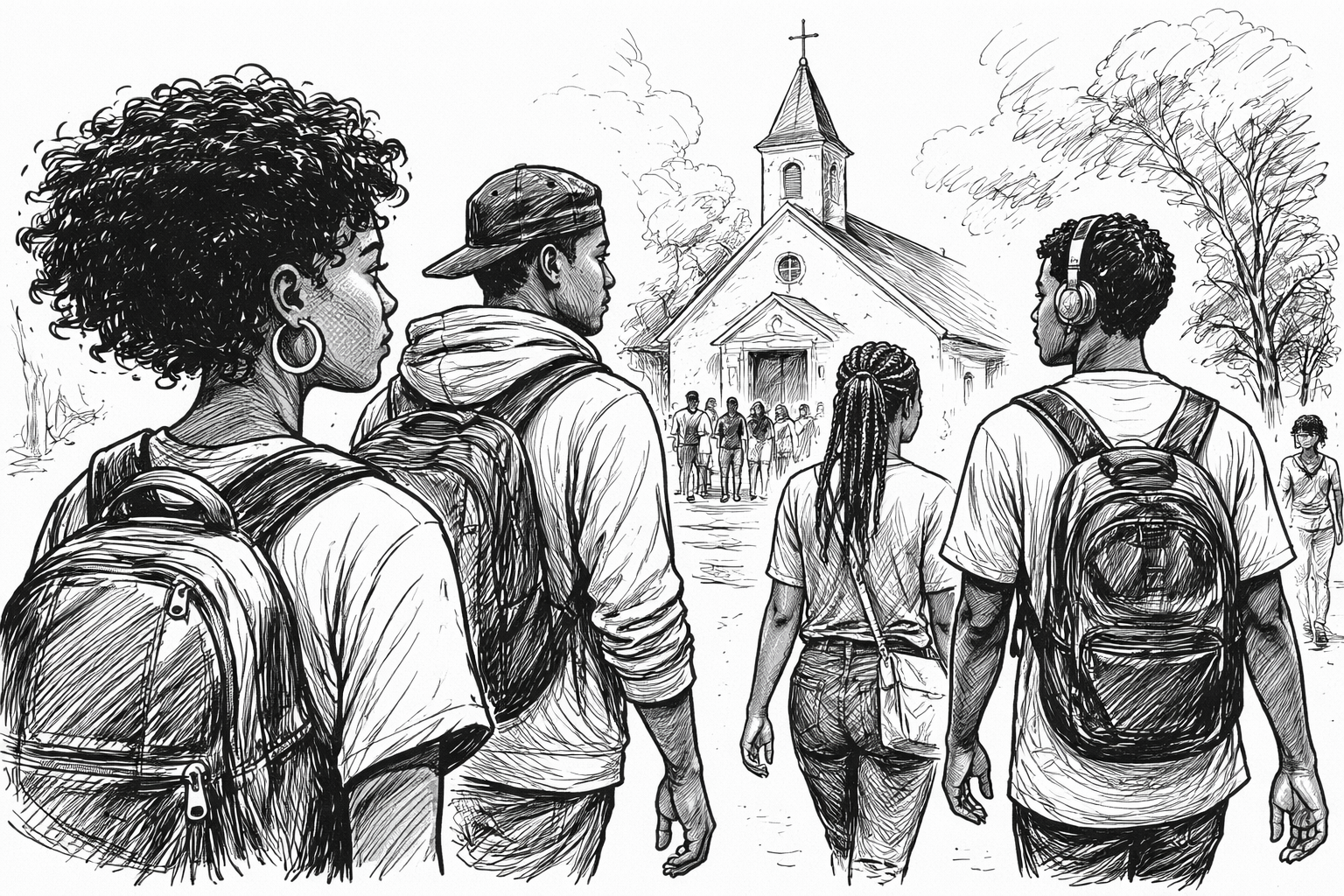
Part of Faith & Inner Life — an ongoing series exploring belief, identity, and the quiet work of becoming
The headlines want this to be a revival story. A viral claim circulated earlier this year suggesting Gen Z’s belief in God has tripled — a dramatic reversal, the framing implied, of everything we thought we knew about the most secular generation in American history. The data doesn’t back it up. But the impulse to tell that story reveals something real: people are watching young Black and Brown Americans closely right now, trying to determine what they believe, where they’re going, and whether the institutions that shaped their parents and grandparents will hold.
The honest answer is more complicated — and more interesting — than a revival.
Church membership among Black adults has dropped nearly 20 percentage points over the past two decades. Among Black Millennials and Gen Z who do attend religious services, only about half go to predominantly Black churches, compared to two-thirds of Black baby boomers. That shift is not a rejection of belief. It is a rejection of a specific institutional relationship — one that, for many young Black Americans, stopped feeling like safety and started feeling like obligation, performance, or harm.
What is being called a departure is often actually a renegotiation — and what young FBA Gen Z is renegotiating looks different from what the broader conversation assumes. For most, the move is not toward a recovered ancestral tradition. It is toward something more personal and portable — private prayer that doesn’t require a pew, spirituality assembled from individual experience rather than inherited doctrine, a belief system that belongs to the person holding it rather than the institution authorizing it. The language has shifted from salvation and denomination to alignment, healing, and the universe — but the underlying need is the same one the church was built to meet. For West African immigrant communities and their American-born children, the movement looks different. The growing presence of Nigerian, Ghanaian, and Senegalese families in American cities is introducing practices like Yoruba and Ifá into spaces where they hadn’t previously had deep roots — and their children, navigating identity between two worlds, are often the ones carrying those traditions forward into a new American context. These practices are experiencing wider interest online, with many practitioners framing them as a return to spiritual lineages long predating colonization and enslavement. These are distinct communities doing distinct things. But they are happening in proximity — and that proximity is reshaping what Black spiritual life in America looks and sounds like right now.
The Black church’s political capture accelerated the exodus in ways that are specific to this community and rarely get named directly in broader discussions about Gen Z and religion. The alignment of white evangelical Christianity with a specific partisan identity gave many young people an off-ramp from organized religion broadly. But for young Black Americans, the tension was different — the Black church has historically been a site of resistance, organizing, and collective survival. Watching that tradition become entangled with respectability politics, prosperity gospel, and in some congregations an active hostility to queer Black life created a different kind of fracture. Young Black Americans leaving the church describe leaving in search of practices overtly inclusive of their sexuality, ancestral traditions, and a spiritual life that centers their existence rather than asking them to compress it.
That search is not secularism. It is a renegotiation — of authority, of belonging, of what it means to be held by something larger than yourself. The vocabulary has shifted: not salvation or denomination but ancestors, alignment, healing, and lineage. But the underlying need is the same one the church was built to meet. Community assembled in smaller, more fluid spaces. Meaning that feels earned rather than assigned. Ritual that carries weight because it is chosen.
What gets built in that space is harder to measure and easier to dismiss. Belief without institutional structure can become belief without accountability. A spiritual life assembled entirely from personal preference can lack the friction that actually shapes character — the community that challenges you, the tradition that holds you to something beyond your own comfort. These are real costs, and they deserve honest examination. But they are costs being weighed thoughtfully by a generation that has watched institutions fail, repeatedly and publicly, and drawn a reasonable conclusion about where to place their trust.
Why This Matters
The Black church has never been just a religious institution. It has been an organizing infrastructure, a political base, a community anchor, and a site of cultural transmission across generations. When young Black Americans step away from it — even partially, even temporarily — the implications extend beyond faith. They touch civic life, collective identity, and the question of where community gets built when the traditional structures no longer hold. What this generation is building in its place is still taking shape. The question is not whether it will be spiritual enough. It is whether it will be durable enough — when the grief comes, when the pressure mounts, when belief gets tested by something larger than a TikTok altar.