
This piece discusses suicide and mental health crises among young athletes. If you or someone you know is struggling, please contact the 988 Suicide and Crisis Lifeline by calling or texting 988, available 24/7.
“It’s pressure every day,” former NFL wide receiver Sinorice Moss told EBONY. He said it plainly, without drama, the way you describe something so constant it stops feeling like a condition and starts feeling like weather.
He was talking about football. He could have been describing what the sport asks of young Black men from the moment they become useful to it.
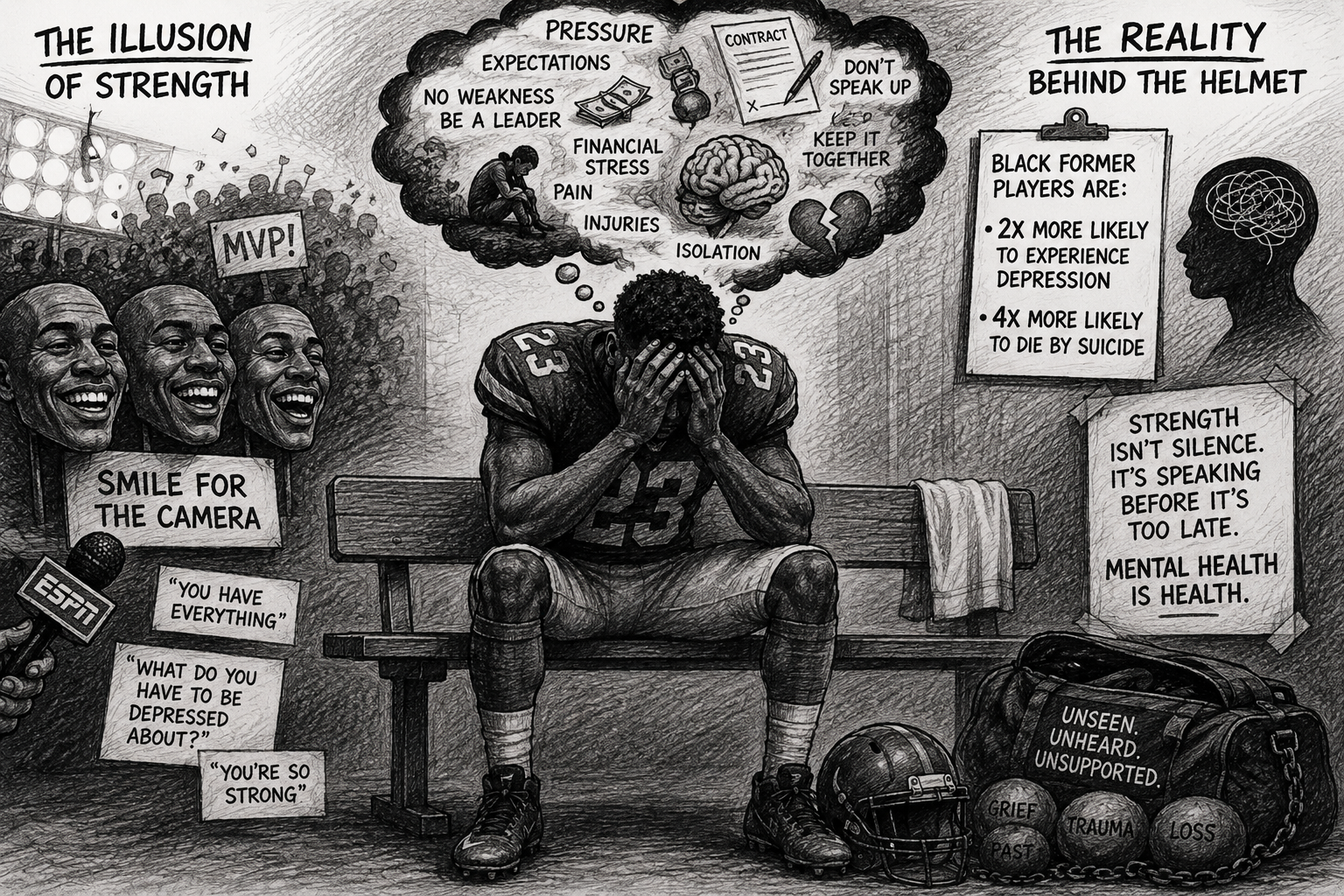
EBONY’s reporting on mental health inside football’s pressure pipeline arrives at a moment when the NFL has just passed its most significant mental health mandate in league history — requiring every team to have a full-time mental health clinician on staff beginning this year. The rule passed at the 2026 spring owners’ meetings. It passed because Marshawn Kneeland was 24 years old when he died. Because Rondale Moore was found in his home on February 21, 2026. Because Kyren Lacy was 24. Because Ty Jordan was 21. Because the list keeps growing and the league kept passing part-time requirements until the deaths became too visible to absorb with anything less than a full-time response.
The mandate is real. The timeline is the story.
That timeline is not a failure of awareness. It is a failure of design. Understanding why requires looking at what the pipeline actually is — and who it was built to serve.
What the pipeline is
Football’s pipeline — high school, college, NFL — is one of the most efficient talent extraction systems ever constructed. It identifies Black athletic talent early, invests in it selectively, moves it upward through increasingly high-stakes competitive environments, and generates enormous wealth at every stage of that movement. The players at the center of it generate the value. The institutions surrounding it — schools, conferences, bowl systems, franchises, broadcast networks, apparel companies — capture most of it.
At every level of the pipeline, the psychological demand escalates alongside the financial stakes. High school coaches want wins. Schools want rankings and recruitment attention. College programs want bowl eligibility and television revenue. NFL teams want performance, and they want it on Sundays, and they want it every Sunday for as many Sundays as a player’s body holds.
“When your child is good, the whole system starts pushing on him,” a Memphis father told EBONY, speaking anonymously out of concern that going public could affect his son’s emerging career. “Coaches want wins. Schools want attention.” His wife added: “Sometimes I watch how much pressure they put on these boys, and I wonder if anybody is asking whether they’re okay mentally.”
That question — whether anybody is asking — is the one the pipeline has historically been structured not to answer. Asking whether a player is okay mentally requires slowing down a system built for speed. It requires treating an athlete as a full person at a moment when the institution needs him to be a performer. The incentive structures at every level of the pipeline run directly against that kind of attention.
That incentive failure becomes most visible when you look at what the pipeline does to the people inside it — not their bodies, which the sport has always tracked closely, but their sense of self.
Identity as performance
The mental health crisis inside football is not separable from the identity crisis inside football. For many young men — disproportionately young Black men, who represent roughly 70% of NFL players and an even higher share of college rosters at major programs — football is not just what they do. It is who they are. It has been who they are since they were identified as talented at 12 or 13 years old and the pipeline began organizing itself around them.
When identity is performance, injury does not just end a season. It can collapse a self. When Rondale Moore missed both the 2024 and 2025 regular seasons with separate preseason injuries, he was not just sitting out games. He was watching the thing that defined him proceed without him, uncertain whether he would ever fully return to it. The isolation of injured players — kept in medical facilities, separated from teammates and game-day rhythms, stripped of the role that gave their life structure — is one of the most psychologically dangerous moments the pipeline produces. It is also one of the least supported.
The NFL’s part-time clinician requirement, which existed before this year’s mandate, was not built to catch someone in that kind of freefall. A part-time clinician serving a 53-man roster through a grueling season is a compliance measure. It is not a mental health infrastructure.
The 2026 requirement is the league’s answer to that compliance failure. It is worth examining honestly — what it actually changes, and what it leaves untouched.
What the mandate does and doesn’t fix
The 2026 requirement — full-time mental health clinicians at every team facility — is a genuine step. As of this year, every NFL team must have a credentialed mental health professional on staff, available during the season and offseason, accessible to players navigating performance pressure, injury, personal crisis, and the specific psychological weight of being a Black man in a high-visibility, high-stakes, predominantly white-ownership industry.
Some teams have gone further. The Buffalo Bills brought Dr. Desaree Festa on as a full-time sport psychologist and team clinician. The San Francisco 49ers and Kansas City Chiefs have built full wellness departments. The NFL Life Line — a free, confidential, independently operated resource — connects current and former players and their families with crisis counselors 24 hours a day. Beginning in 2026, the league is also piloting mental health programs for retired players, a population that has historically been cut off from support the moment their contracts end.
These are not cosmetic changes. They represent a meaningful shift in what the league is willing to institutionalize.
But they do not touch the pipeline that feeds the league. They do not reach the Memphis high school player whose parents worry about him quietly, who cannot speak publicly for fear of jeopardizing his career before it starts. They do not reach the college player at an SEC program managing a recruiting class, a coaching staff’s expectations, a social media presence, and a body being prepared for professional contact — all simultaneously, all at 19 or 20 years old, with none of the professional support structures the mandate just made mandatory for NFL rosters.
The mandate protects the end of the pipeline. The beginning and middle of it remain largely on their own.
That structural silence at the pipeline’s entry points is not separate from the cultural silence inside the sport itself. They reinforce each other — and they both have the same root.
The silence the sport still keeps
SSC reported earlier this week on Isaiah Rashad naming the absence of frameworks for Black men navigating sexuality publicly inside hip-hop. The observation applies with equal force here. Football has no established language for vulnerability. The culture of the sport — built across generations on the performance of toughness, the suppression of pain, the equation of emotional expression with weakness — does not simply dissolve because the league hired a clinician.
“The sport has to change what strength means,” EBONY’s reporting concludes. That sentence is doing enormous work. Changing what strength means inside a sport that has defined itself through physical dominance for more than a century is not a policy change. It is a cultural transformation — and cultural transformations require the people with the most power inside the institution to model the behavior they want to normalize.
The players who have spoken publicly — Dak Prescott on depression, Solomon Thomas on grief, Darren Waller on addiction — have helped. Every disclosure from someone the culture respects makes the next disclosure slightly safer for someone with less standing to make it. That is real and it matters.
But disclosure should not be the burden of the players the system is supposed to protect. The burden should be on the institutions that built the pipeline to ask the question the Memphis mother was asking from the sideline — whether anybody is checking whether these boys are okay — before the answer becomes an obituary.
The pipeline runs on the assumption that the young men inside it will adapt to whatever it demands. Mental health mandates are the league finally acknowledging that assumption has a body count.
Kyren Lacy was 24. Marshawn Kneeland was 24. Rondale Moore was found at home in February. Ty Jordan was 21.
The mandate passed in March. The timeline is the story. And the pipeline is still running.
If you or someone you know is struggling, please contact the 988 Suicide and Crisis Lifeline by calling or texting 988, available 24/7.