
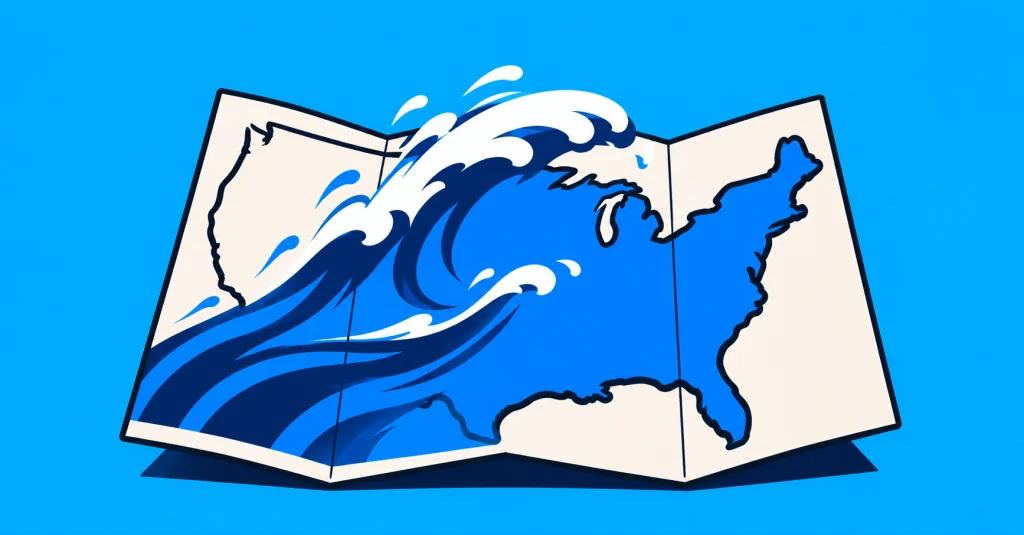
Democrats have captured both chambers of Congress, flipped Senate seats in traditionally Republican states and scored major gubernatorial victories. From Texas to South Carolina, the 2026 midterms have dramatically changed Washington’s political landscape.
From Texas and South Carolina to Kansas and Iowa, voters delivered major upsets in the 2026 midterms. Democrats captured both chambers of Congress, scored historic gubernatorial victories and expanded their reach into states Republicans have dominated for decades.
By Will Davison | November 4, 2026 | Policy | Election 2026
The political map of America looks dramatically different this morning.
Democrats have won control of both the U.S. House and Senate, flipped at least seven Republican-held Senate seats and captured governors’ mansions in states where Republicans had dominated for decades. Tuesday’s midterm elections delivered a sweeping setback for Donald Trump’s administration, fueled by voter frustration over rising living costs, the war with Iran and concerns about government accountability.
The results extended well beyond traditional battleground states. Texas elected its first Latina governor, Kansas chose its first Democratic senator in nearly a century, and South Carolina moved toward a historic Democratic Senate victory in a state Trump carried by nearly 18 percentage points in 2024.
By Wednesday morning, the Associated Press and major news organizations had projected Democratic control of both chambers, ending two years of unified Republican control in Washington.
Seven Senate seats flip, with South Carolina still counting
The Senate produced some of the election’s most consequential surprises, including victories in states that have consistently supported Republican candidates.
- Texas: Democrat James Talarico defeated Republican Attorney General Ken Paxton, becoming the first Democrat elected to the U.S. Senate from Texas since 1988.
- North Carolina: Former Democratic Gov. Roy Cooper defeated Republican Michael Whatley, flipping a Republican-held seat.
- South Carolina: Democrat Annie Andrews is projected to defeat Republican Sen. Darline Graham in one of the night’s biggest upsets. The Associated Press and Reuters have called the race for Andrews, although ballot counting continues. Her victory would make her the first Democrat elected to the Senate from South Carolina since 1998 and the first woman elected to represent the state in the chamber.
- Ohio: Former Democratic Sen. Sherrod Brown defeated Republican Jon Husted, returning to the Senate after losing reelection in 2024.
- Kansas: Democrat Adam Hamilton defeated Republican incumbent Roger Marshall, delivering the state’s first Democratic Senate victory since 1932.
- Iowa: Democrat Josh Turek defeated Republican Ashley Hinson, giving Democrats another major breakthrough in the Midwest.
- Maine: Democrat Troy Jackson defeated five-term Republican Sen. Susan Collins, ending her nearly 30-year tenure in Washington. Jackson, a former logger and Maine Senate president, campaigned on affordability, workers’ rights and health care.
Democrats also successfully defended important Senate seats.
In Michigan, Abdul El-Sayed defeated Republican Mike Rogers, becoming the first Muslim elected to the U.S. Senate. His victory kept retiring Democratic Sen. Gary Peters’ seat in Democratic hands rather than adding another Republican-held seat to the party’s flip count.
Georgia Sen. Jon Ossoff won reelection, Chris Pappas retained New Hampshire’s open Democratic seat, and Mark Warner secured another term in Virginia.
Together, the results represent a dramatic expansion of the Democratic electoral map, particularly in states Trump carried comfortably just two years earlier.
The House falls to Democrats
Democrats also captured the House, overcoming Republican efforts to redraw congressional districts ahead of the midterms.
By Wednesday morning, Democrats had flipped at least 25 Republican-held House seats, according to an Associated Press tally cited by Al Jazeera. Additional contests remained unresolved, leaving the final size of the Democratic majority uncertain.
Among the notable Democratic victories:
- Texas: Bobby Pulido and Katy Padilla Stout won Republican-held congressional districts.
- Pennsylvania: Democrats flipped multiple Republican-held seats, including those represented by Scott Perry and Rob Bresnahan.
- Iowa: Democratic challengers defeated Republican Reps. Zach Nunn and Mariannette Miller-Meeks.
- Missouri: A Democratic challenger defeated Republican Ann Wagner.
- Indiana: A Democratic challenger defeated Republican Victoria Spartz.
- North Carolina: Jamie Ager captured the Republican-held 11th Congressional District.
- New Jersey: Rebecca Bennett flipped a Republican-held congressional seat.
The gains were especially striking because Republicans had invested heavily in redistricting efforts designed to protect or expand their House majority.
Instead, Democrats won competitive races in suburban districts, traditionally Republican communities and areas that had moved toward Trump in 2024.
The takeover positions Democratic leader Hakeem Jeffries to become the first Black speaker of the U.S. House of Representatives when the new Congress convenes in January.
Governors’ races deliver historic upsets
The Democratic gains extended to state capitals, producing several victories that would have seemed unlikely earlier in the election cycle.
Texas delivered one of the night’s biggest political surprises. Democrat Gina Hinojosa defeated three-term Republican Gov. Greg Abbott, becoming the state’s first Latina governor and its first Democratic governor elected since Ann Richards in 1990.
Abbott entered the election with a substantial fundraising advantage, but Hinojosa overcame the state’s longstanding Republican dominance to secure the victory.
In Georgia, former Atlanta Mayor Keisha Lance Bottoms defeated Republican Rick Jackson, becoming the first Black woman elected governor in U.S. history. Her victory also returned the Georgia governor’s office to Democrats for the first time in more than two decades.
Ohio elected Democrat Amy Acton over Republican Vivek Ramaswamy, while Iowa voters chose Democrat Rob Sand, returning that state’s governorship to Democratic control.
Other notable gubernatorial victories included:
- Wisconsin: David Crowley defeated Republican Tom Tiffany, becoming the state’s first Black governor. The result was a Democratic hold, not a party flip.
- New Mexico: Deb Haaland defeated Republican Gregg Hull, becoming the first Native American woman elected governor of a U.S. state.
- California: Xavier Becerra became the state’s first Latino governor.
- Minnesota: Democratic Sen. Amy Klobuchar won the governorship.
- New York: Democratic Gov. Kathy Hochul secured reelection.
Republicans retained several important offices despite the broader Democratic gains. In Florida, Byron Donalds won the governorship, becoming the nation’s first Black Republican governor, while Republican Ashley Moody won the state’s U.S. Senate election.
A night of historic firsts
Beyond the partisan victories, the 2026 midterms changed the face of American political representation.
Abdul El-Sayed became the first Muslim elected to the U.S. Senate, Peggy Flanagan became the first Native American woman elected to the chamber, and New Hampshire’s Chris Pappas became the first openly gay man elected to the Senate.
The historic victories extended to governors’ mansions, where Keisha Lance Bottoms, Gina Hinojosa, David Crowley and Deb Haaland broke longstanding barriers to representation.
South Carolina’s projected victory for Annie Andrews would add another milestone: the first woman elected to represent the state in the U.S. Senate.
These breakthroughs occurred alongside Democratic victories in states and districts where Republican candidates had previously enjoyed substantial electoral advantages.
The economy became the referendum
For months, Democrats argued that Republican leadership had failed to deliver meaningful relief from high prices, economic uncertainty and mounting household expenses.
Tuesday’s results suggest that message resonated.
According to national exit polling reported by Reuters, approximately three-quarters of voters described themselves as angry or dissatisfied with the country’s direction. About 70% said they wanted Congress to provide stronger checks on presidential power, while roughly half viewed the election as an opportunity to rebuke Trump.
The war with Iran, tariffs and concerns about government accountability also shaped the electorate’s decisions.
Perhaps most telling was the geographic reach of Democratic gains. The party performed strongly not only in urban centers and suburban battlegrounds but also in rural communities, heavily Latino counties and areas that supported Trump just two years earlier.
In Texas, Democratic gains in border communities were particularly significant after Republicans had invested heavily in expanding their support among Latino voters.
The results suggest that economic dissatisfaction crossed geographic and demographic lines, creating opportunities for Democratic candidates in places where the party had struggled for years.
The bigger picture
The 2026 midterms were more than a routine change in congressional control. They demonstrated how quickly the political landscape can change when voters become dissatisfied with the direction of the federal government.
For Democrats, the victories provide the ability to challenge administration policies, investigate executive actions and influence federal spending. Control of the Senate also gives the party authority to reject presidential nominees, including potential Supreme Court appointments.
But winning power and delivering results are two different responsibilities.
Democrats will still face Trump’s veto authority, a divided electorate and pressure to address the economic conditions that helped propel them into office.
For Republicans, the results raise difficult questions about the durability of Trump’s political coalition, the effectiveness of the party’s economic message and the party’s direction ahead of the 2028 presidential election.
Voters changed more than the political map Tuesday. They changed who holds Washington accountable. The question now is whether that change will translate into meaningful relief for the Americans who demanded it.