
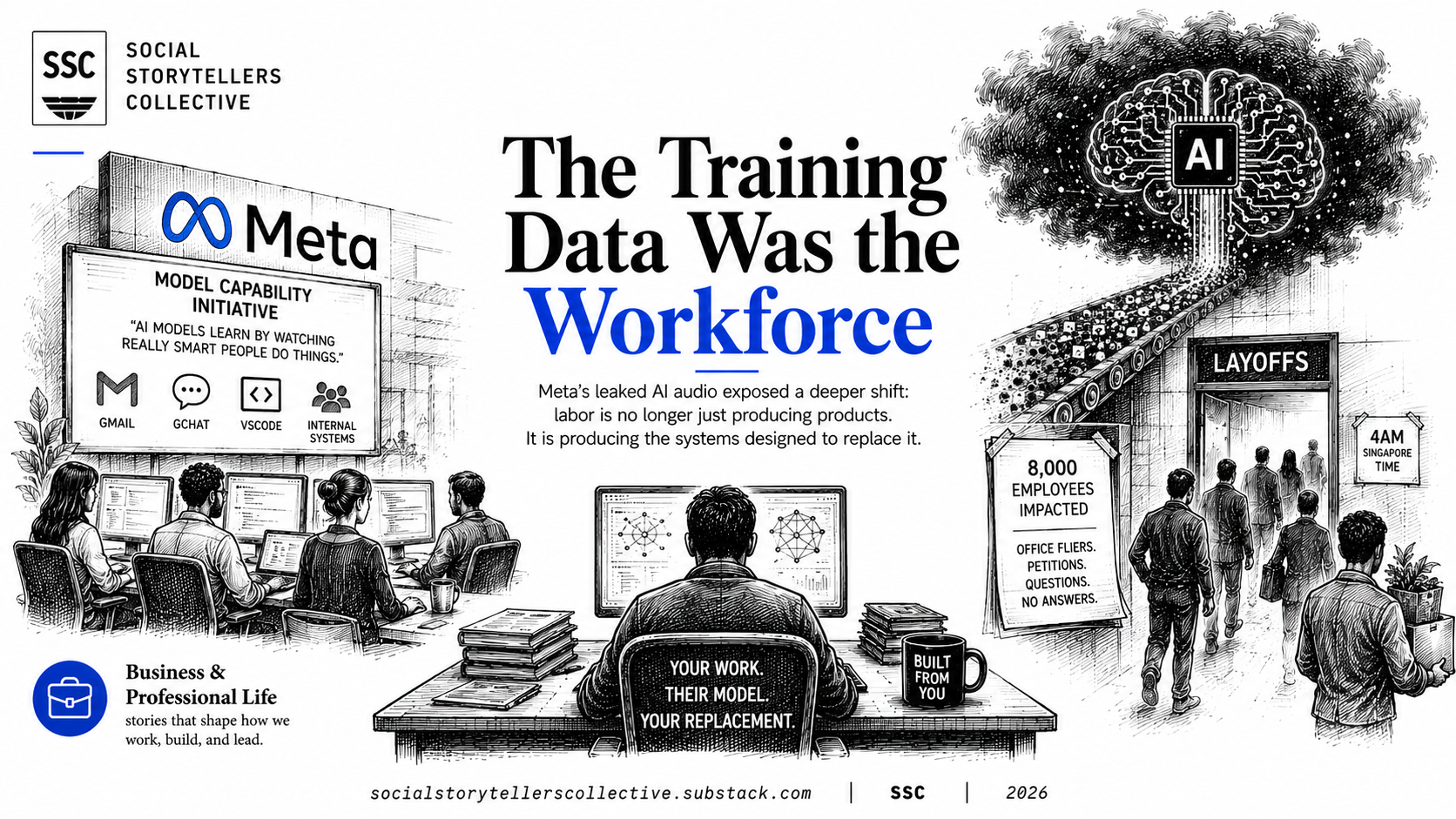
The most important thing about the Meta leak is not what Zuckerberg said. It is that he said it in the wrong order.
On April 30, employees inside Meta joined an internal all-hands where Mark Zuckerberg described the company’s “Model Capability Initiative” — a program to improve AI systems by training them on how employees actually work. The models, he explained, were learning from “watching really smart people do things.” The data sources: employee activity across Gmail, GChat, VSCode, and Meta’s internal collaboration systems. Leaked audio surfaced publicly on May 19. The following morning, layoffs began at 4AM Singapore time. 8,000 people, globally.
The sequence is the story. The workforce was first described as behavioral training infrastructure. Then it was reduced.
That sequence is not unique to Meta. It is becoming the operating logic of the modern knowledge economy — and the reason it landed so hard is that employees recognized it instantly. The language of capability building, model improvement, and knowledge transfer sounds like investment. In the context of a 4AM termination email, it reads differently. It reads like what it was: the moment a company confirms that the most valuable thing you contributed was not the work itself, but what the work taught the system about how to function without you.
This is the shift that mainstream coverage of AI layoffs consistently underframes. The story is not that Meta cut 8,000 jobs. Companies cut jobs. The story is what those workers were doing in the months before the cuts arrived — and what the company was doing with it.
Modern AI systems do not learn from public internet data alone. Increasingly, they learn from the workflows, decision patterns, coding habits, communication behaviors, and institutional memory of high-performing workers inside the organizations themselves. The employee is no longer just labor. The employee is source material. That distinction — between producing output and producing the system that replaces you — is the one that changes the politics of workplace automation entirely.
Historically, labor-saving technology automated from the bottom up. Assembly lines replaced manufacturing. Self-checkout replaced cashiers. Warehouse robotics replaced physical picking. Each of those substitutions targeted repetitive, mechanical, or physical tasks — work that was legible, codifiable, and separable from the cognitive architecture of the worker performing it.
What is happening now reaches into the cognitive infrastructure itself. Internal engineering practices, management decisions, collaboration patterns, creative workflows — these are being converted into machine-readable behavioral archives capable of teaching AI systems how organizations actually function. The target is no longer the task. It is the institutional knowledge underneath the task.
In previous generations, expertise was the thing that protected workers. Companies depended on retaining specialized knowledge internally. That dependence created leverage. AI alters the equation by turning expertise into transferable infrastructure — something that can be extracted, encoded, and deployed at scale long after the person who generated it is gone.
The ideal worker, inside this model, is someone capable of generating maximum institutional knowledge before becoming organizationally optional. That is not a conspiracy. It is an incentive structure. Silicon Valley increasingly rewards companies that demonstrate the ability to expand output while reducing labor intensity simultaneously. Investors no longer simply evaluate growth. They evaluate how efficiently firms can scale intelligence itself. Meta generated more than $164 billion in revenue in 2025 and reported net income above $62 billion — the restructuring is not about financial survival. It is about operational philosophy. The question is not whether the company can afford to keep people. It is whether keeping them is the highest-return use of the knowledge they carry.
The pattern extends well beyond Meta. Law firms are training AI on internal case research and drafting patterns. Hospitals are using physician documentation behavior to refine medical AI systems. Consulting firms deploy internal AI trained on years of accumulated client strategy work. Universities are experimenting with systems that absorb instructional structures, grading logic, and curriculum development patterns from faculty labor.
None of these are framed as extraction. They are framed as innovation, efficiency, transformation. The vocabulary does specific work. It positions the organization as the primary beneficiary of a shared investment — when the more precise description is that workers are contributing the behavioral architecture of their expertise to systems designed to reduce dependence on that expertise over time.
That is not transformation. That is institutional harvesting. And the workers who understand what they are participating in are beginning to respond accordingly.
There is a psychological dimension companies still systematically underestimate. Employment has always carried an implied social contract: workers exchange labor for compensation while institutions provide some degree of continuity, advancement, or long-term participation in return. What the Meta leak made visible — what employees at Meta and well beyond it are now processing — is the degree to which that contract has been quietly renegotiated.
Once workers begin viewing internal systems, collaboration tools, and workflow tracking as extraction environments rather than productivity infrastructure, trust inside organizations changes structurally. Surveillance and AI integration stop feeling like operational optimization. They start feeling like accelerated knowledge transfer programs where the endpoint is labor reduction. The fliers on Meta’s office walls, the internal petitions, the visceral response to a leaked audio clip — these are not isolated reactions to a single company’s bad messaging. They are the signal of a workforce recognizing, at scale, the asymmetry underneath the language.
What Meta exposed is not a scandal specific to one company’s management of a difficult layoff cycle. It is the arrival of a new corporate model — one where labor is valued not only for what workers produce, but for what organizations can permanently learn from them before reducing dependence on them altogether.
The long-term consequence of that model is not simply fewer jobs. It is the normalization of workplaces where participation gradually teaches the system how to function with less need for the people inside it. Where the most valuable thing a worker contributes is not their output but their behavioral pattern. Where expertise, once the source of leverage, becomes the very thing that accelerates your replaceability.
In previous generations, companies extracted physical labor at industrial scale. The infrastructure being built now extracts cognition itself. The workers who trained the models that replaced them did not consent to that exchange. Most of them did not know it was happening. The ones at Meta found out the same way the rest of us did — from a leak, the morning after.
This piece is part of SSC’s ongoing coverage of the credentialing economy and workforce restructuring. Read the companion analysis: The AI Layoffs Aren’t Working — Gartner’s data on why headcount reduction isn’t producing the returns companies promised their boards.