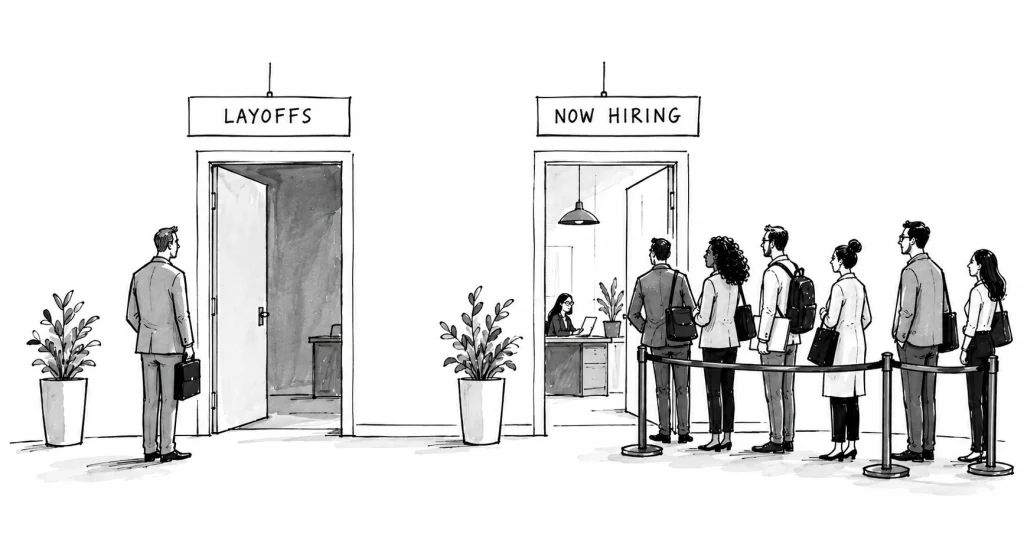
Layoffs remain remarkably low. Hiring remains restrained. Those conditions can exist at the same time—and they create very different labor markets depending on whether you already have a job.
Only 197,000 Americans filed initial unemployment claims during the week ending September 26, the lowest level since mid-July. The four-week average fell to roughly 200,000, keeping layoffs near historically low levels. On the surface, those numbers describe a labor market in remarkably stable condition.
But another set of numbers describes something less comfortable. U.S. job openings fell to about 7.08 million in August from 7.34 million in July, while voluntary quits also edged lower. Employers have added an average of about 80,000 jobs a month in 2026—an improvement over 2025, but well below the pace seen during the post-pandemic hiring boom.
Keeping Workers Is Not the Same as Hiring Them
Those signals are not contradictory. A company can decide against laying off existing employees while also deciding it does not need many additional ones. After experiencing severe labor shortages earlier in the decade, employers have reasons to hold on to workers they already recruited and trained even as they become more cautious about expanding payrolls.
That creates what amounts to an incumbency advantage in the labor market. Someone already employed may see low risk of losing a job. A recent graduate, unemployed worker or employee trying to move to another company experiences the same economy through the number of openings and the willingness of employers to hire.
The decline in voluntary quits adds another piece. Workers tend to leave jobs more readily when they believe another opportunity will be available. Fewer quits can therefore reflect stability, but they can also indicate that employees see fewer attractive places to go.
The Doorway Is Narrower Than the Room
This helps explain why labor-market statistics and individual experiences can appear disconnected. Low unemployment and low layoffs can coexist with months of applications, fewer entry-level openings and slower career movement.
The labor market does not have to collapse for workers to feel stuck. The emerging divide is between being inside the labor market and trying to enter or move through it. For millions of workers, job security may still be relatively strong. Job mobility is becoming a different story.