
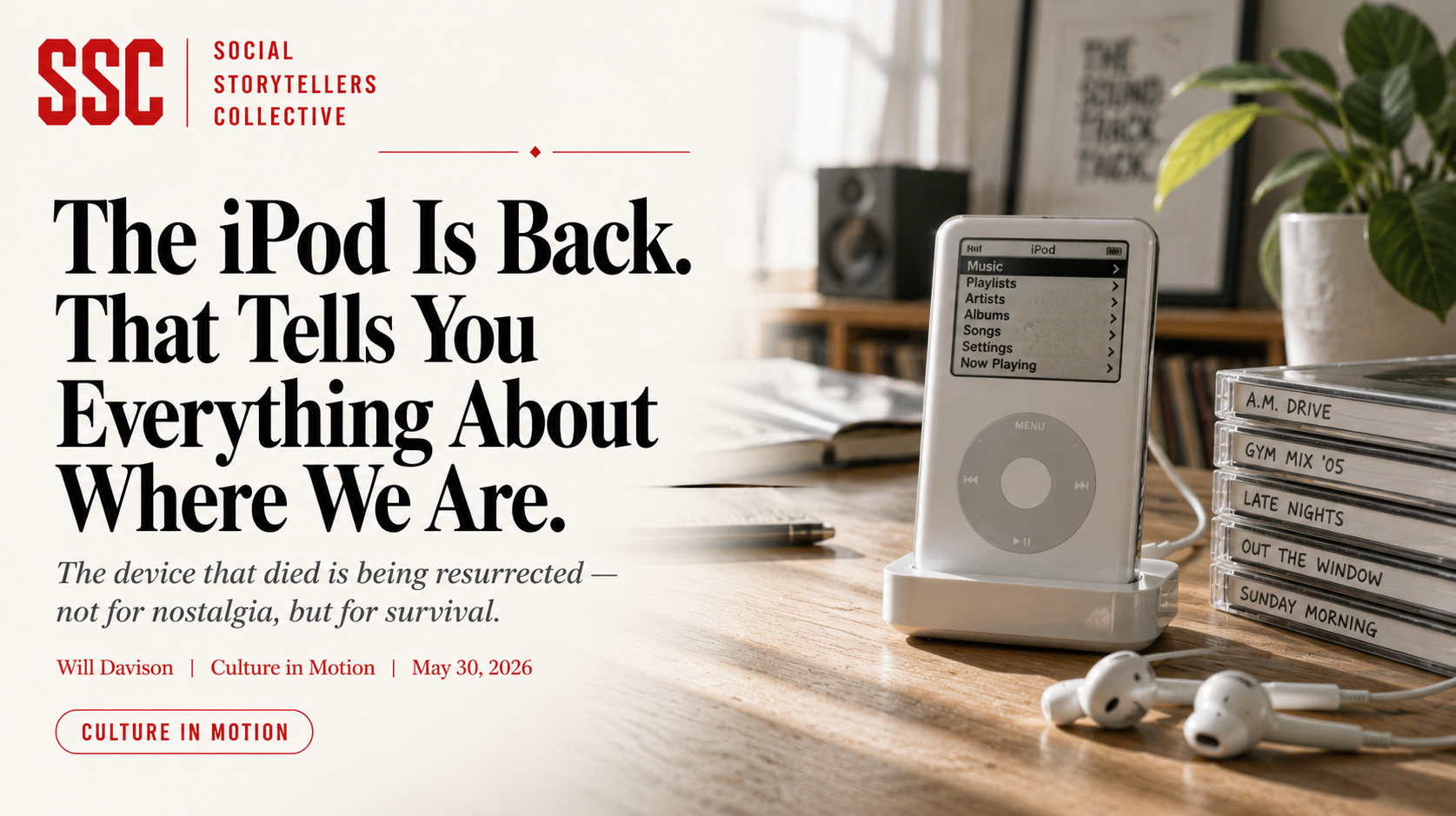
I still remember what my iPod meant to me.
It was, for a stretch of years, my most prized possession — and I treated it that way. I was meticulous about my playlists. Not casual about them. Deliberate. I built them for specific moods, specific moments, specific versions of the day I was trying to have. A playlist for early mornings before the world got loud. One for long drives. One for the gym, one for the kind of night that needed a soundtrack before it started. My iPod held all of it — and those playlists became, in the truest sense, the soundtrack of my life. The score running underneath the moments I still carry.
Then Apple started rolling things back. Quietly at first, then decisively. Features disappeared. Compatibility narrowed. The ecosystem that once centered the iPod began orienting itself around something else entirely — the iPhone, the stream, the subscription. I held on longer than most. But eventually, like millions of others, I was nudged — then pushed — toward Spotify. Toward the algorithm. Toward a relationship with music that belonged to a platform more than it belonged to me.
I did not realize how much I had given up until recently, when the data started showing that people are doing exactly what I wish I had done: going back.
According to a recent report by the Associated Press, four years after Apple discontinued the iPod, people are buying them again. Not new ones — Apple stopped making them in 2022 and has no plans to bring them back. Used ones. Refurbished ones. The ones pulled from guest room nightstands and dust-covered drawers, charged back to life with a 30-pin cable that most people have not thought about in a decade.
Back Market, a refurbished electronics platform, reported that iPod sales jumped 48 percent last year. eBay has thousands of listings. There are entire online communities dedicated to modifying them — swapping out faceplates, replacing firmware, upgrading storage. A device that the tech industry declared obsolete has become, quietly and deliberately, one of the most sought-after pieces of consumer electronics among a generation that never owned one the first time around.
The question worth asking is not why the iPod is back. The question is what it says about the world people are trying to escape when they reach for one.
We are living through an attention crisis that the people profiting from it have spent years insisting is a personal problem. The average person now unlocks their phone over 80 times a day. Social media platforms employ teams of engineers whose sole function is to make it harder to put the device down. The news cycle is not a cycle anymore — it is a continuous feed, curated to maximize emotional response and minimize the kind of quiet that allows a person to think a complete thought without interruption.
The iPod does not have social media. It does not have notifications. It does not know what is trending. It plays the music you put on it, in the order you arranged it, without suggesting anything else, without tracking your engagement, without serving you an ad between tracks. It does one thing. And in 2026, the ability to have a device that does one thing — that holds your attention without harvesting it — has become something people will actively seek out and pay for.
Ben Wood, chief analyst at CCS Insight, put it plainly: there is a growing trend, particularly among younger users, to reduce dependence on smartphones and avoid being pulled into doomscrolling when all they want to do is listen to music. What he is describing is not a preference. It is a boundary. And the fact that people are drawing that boundary with a discontinued piece of hardware from 2001 tells you how few options the current market is offering them.
This is not about nostalgia, though nostalgia is part of the story the tech press keeps telling because it is easier to cover. The young people buying refurbished iPods today were children when Apple discontinued them. They did not grow up with scroll wheels and iTunes sync cables. They grew up with Spotify and TikTok and the iPhone in their pocket at all times. What they are reaching for is not a memory. It is a model — a different relationship with technology than the one the current market has decided they should have.
The attention economy was built on a specific premise: that your time and focus are resources to be extracted, and that the best technology is the technology that extracts the most of both. Every major platform, every recommendation algorithm, every autoplay function is built on that logic. The iPod revival is a rejection of it. Not a political rejection, not an organized one — just millions of individual people deciding, quietly, that they want to listen to music without being managed while they do it.
That impulse is bigger than the iPod. It shows up in the resurgence of physical books over e-readers with built-in stores and reading trackers. It shows up in the return of film photography among people who want images that cannot be immediately shared, filtered, and optimized for engagement. It shows up in the growing number of people — particularly young people — who are buying dumb phones, or keeping their smartphones in another room, or scheduling hours of the day when the feed simply stops.
What connects all of it is the same thing: people reclaiming the right to direct their own attention. To decide what they consume, when, and at what pace. To have an experience that belongs to them rather than to the platform processing it.
The iPod is not the solution. It is the symptom of a need the market is not meeting — and the signal is worth paying attention to. When people are willing to charge up a two-decade-old device with discontinued hardware support and no streaming capability just to listen to music without being tracked, that is not a quirky consumer trend. That is a verdict on what the current options are doing to them.
The noise is not going anywhere. The feeds will keep moving, the alerts will keep firing, and the platforms will keep engineering the next mechanism to make it harder to look away. But more people are deciding — deliberately, sometimes defiantly — that their mind is not a resource available for extraction. That their attention belongs to them. That some hours of the day are theirs to fill without anyone else’s algorithm deciding what comes next.
They are putting those hours on an iPod.
And honestly — that makes sense.