
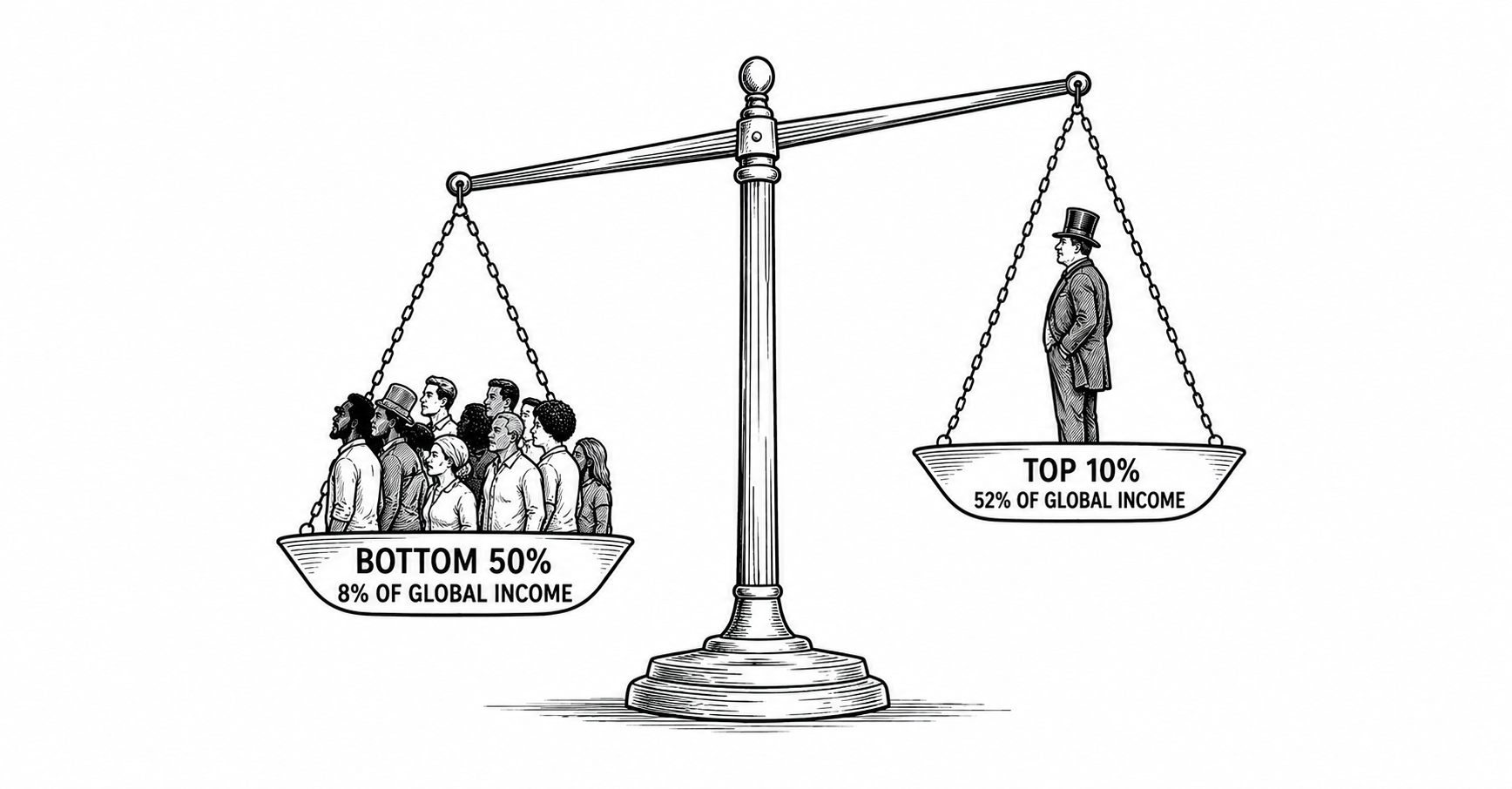
The World Inequality Lab released the Global Justice Report on June 4, 2026, at the opening of the World Inequality Conference at the Paris School of Economics — a three-day convening of more than 200 researchers from across six continents. The report is not an academic exercise in measurement. It is a blueprint: a fully quantified plan for how the global economy could be reorganized between now and 2100 so that well-being, equality, and climate stability are treated as parts of the same project rather than competing priorities.
The central argument is stated without qualification: a global transformation that reconciles planetary habitability with high standards of living for all people is possible. The condition is that three things happen simultaneously — redistribution at global scale, a deep reform of the international financial architecture, and a structural transformation of production systems away from carbon. The report is the first attempt to model all three together in a single quantified framework.
The political argument underneath the economic one is more important than the blueprint itself. Lucas Chancel, Co-Director of the World Inequality Lab, stated it directly: “The World Inequality Report 2026 shows that inequality is not inevitable — it is shaped by choices, institutions, and power.” Thomas Piketty, the lab’s other co-director, put the stakes plainly: “Only by continuing the historic movement toward equality will we be able to address the social and climate challenges of the coming decades.”
Those statements are not aspirational language. They are a structural claim: the inequality currently organizing the global economy is not a natural feature of how economies work. It is an output of specific policy decisions, tax structures, labor arrangements, and institutional designs — decisions that could be made differently.
The data behind the report confirms how extreme the current arrangement is. The top 10% of the global population captures more than half of all income. They are also responsible for roughly half of all carbon emissions — meaning the same concentration of economic power that produces inequality is producing the environmental conditions that will compound it. The bottom 50% of the global population earns approximately 8% of global income while absorbing a disproportionate share of climate consequences. The World Inequality Report 2026 documents this not as a coincidence but as a structural feature of how the current system allocates both benefit and cost.
The report proposes a Global Justice Fund — financed through a common global wealth tax — spending an average of 10.3% of world GDP annually between 2026 and 2060. That figure is deliberately calibrated against the scale of the problem. Official development aid and the combined budgets of the UN, IMF, and World Bank currently represent less than 0.4% of world GDP. The gap between what exists and what the report argues is required is not a matter of degree. It is a matter of kind.
The current political environment makes none of this easier. The U.S. has moved in the opposite direction across every dimension the report identifies as necessary: tax progressivity, labor protections, climate investment, and international cooperation. The Global Justice Report arrives as a rigorous counter-argument to the assumption that the current distribution of wealth and power is the inevitable result of how economies function.
Inequality is a choice. The evidence is in the design of the systems producing it — and in the documented existence of alternatives. What the Global Justice Report adds to that argument is the arithmetic: a fully modeled path from where the world is to where it could be, with the costs, mechanisms, and timelines specified. Whether the political will exists to walk that path is a different question. The report answers the one that has to come first: whether the path exists at all.
— SSC News Desk | Social Storytellers Collective
Get SSC analysis delivered to your inbox every day. Subscribe free on Beehiiv: socialstorytellerscollective.beehiiv.com