
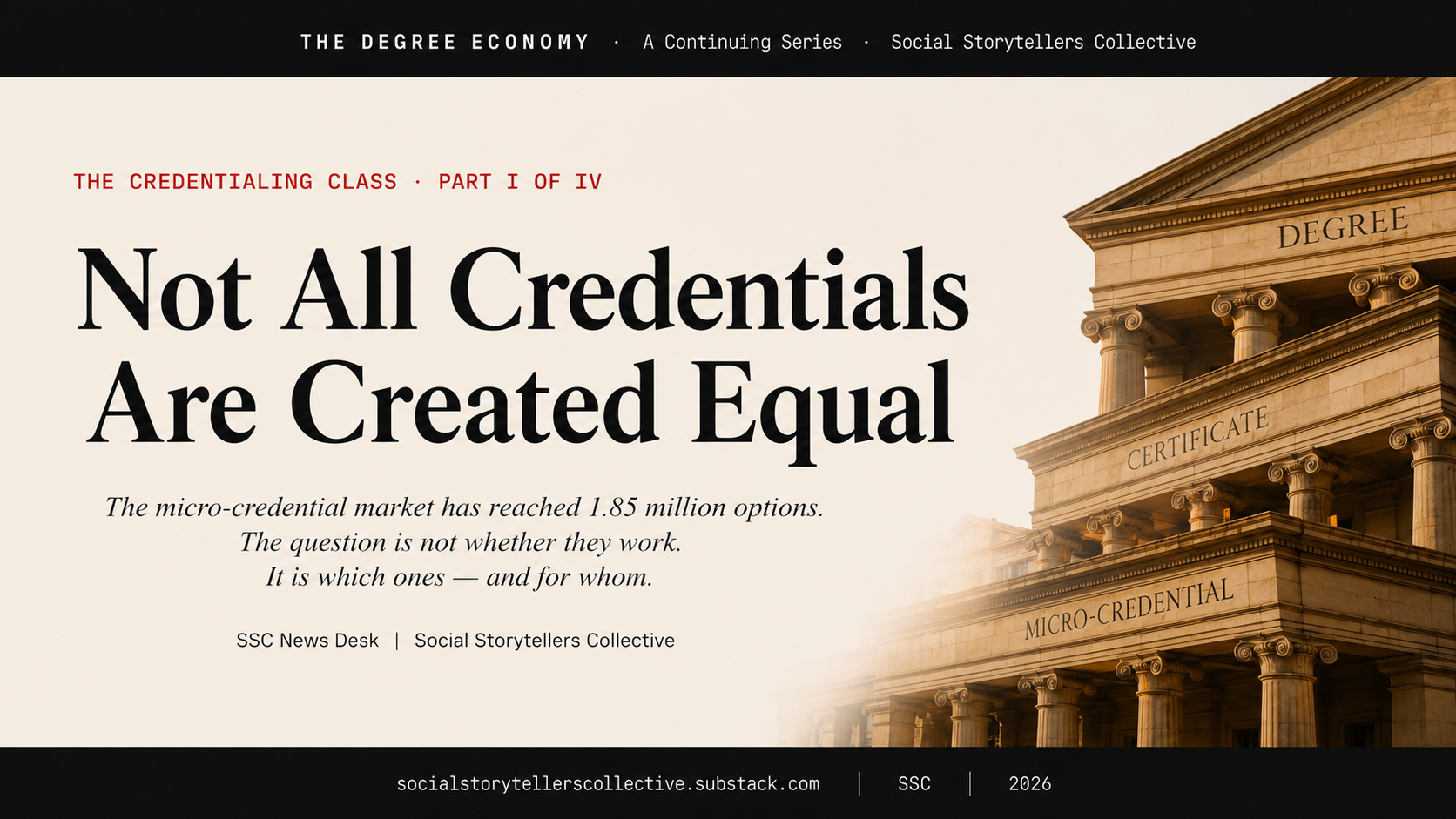
The number of credentials available has reached 1.85 million. The question worth asking is not whether micro-credentials work. It is which ones — and for whom.
There are currently 1.85 million credentials available in the United States labor market. Badges, certificates, micro-credentials, certifications, degrees, licenses — a landscape so expansive that Credential Engine, the nonprofit tasked with making it navigable, describes understanding its scale as merely “the essential first step.” The next step — making those credentials discoverable, comparable, and actionable — has not yet arrived for most of the workers being told that the credential is the answer to a deflating degree economy.
The headline numbers are compelling. The global micro-credential market is projected to exceed $3.5 billion in 2025, with an annual growth rate above 17 percent through 2030. 96 percent of employers believe micro-credentials strengthen a candidate’s job application. 87 percent have hired at least one candidate with a micro-credential in the past year. Those numbers are real. They are also the numbers that credential platforms use in their own marketing materials — which is worth keeping in mind before treating them as neutral data.
The more precise question is not whether employers value micro-credentials in the abstract. It is whether the specific credential a specific worker earns from a specific platform carries enough weight in a specific hiring context to produce a different outcome than no credential at all. That question has a more complicated answer than the headline numbers suggest — and it depends almost entirely on who issued the credential and whether the issuer has a direct relationship with the people doing the hiring.
The micro-credential landscape breaks into four tiers, and the distance between them is significant.
At the top sits the corporate-issued credential — Google Career Certificates, AWS Certification, IBM Badges, Microsoft Learn. These work because the company that issues the credential is also the company doing the hiring, or has built direct pipelines into the companies that are. 74 percent of employers in 2025 preferred candidates with verified digital skills credentials for AI-related roles over traditional degrees alone, and 44 percent of Fortune 500 companies now offer internal micro-badge pathways tied to external credentialing systems. When Google issues a data analytics certificate, it carries the weight of Google’s name into every hiring conversation. That is not a credential. That is a referral at scale.
Below that sits the platform credential — LinkedIn Learning, Coursera, Udemy, edX. These are the credentials most workers encounter first because they are the most accessible and the most aggressively marketed. What employers don’t value are certificates from unknown online platforms with no industry recognition, credentials that require nothing more than watching videos and paying a fee, badges that can’t be verified or contain no detailed information about what was learned, and micro-credentials that teach outdated skills or tools that companies aren’t actually using. LinkedIn Learning occupies a complicated middle space in this tier — it lives on the same platform where hiring happens, which gives it visibility that Udemy does not have. But visibility is not the same as trust, and a LinkedIn Learning certificate sitting next to a Google Career Certificate in the same hiring stack is not an equal comparison.
Below that sits the coding bootcamp — a 4 to 6 month intensive program that has moved from fringe to mainstream over the past decade. Bootcamp graduates now work at Google, Amazon, Microsoft, and Meta, and employers increasingly recognize bootcamp graduates as viable hires, valuing the practical experience they bring and the diverse backgrounds they carry into technical roles. The employer acceptance argument is real in 2026 in a way it was not in 2018. But the tech job market is more competitive than the late 2010s boom years that produced bootcamp culture, and the ROI depends heavily on which bootcamp, which market, and whether the graduate can demonstrate skills in an interview rather than simply on a resume.
At the foundation sits the community-rooted program — the Opportunities Industrialization Centers founded by Reverend Leon Sullivan in Philadelphia in 1964, BankWorks, the Rolex Watchmaking Training Center in Dallas, Virginia’s FastForward program. These are not the programs that generate the most press coverage or the most venture capital. They are the programs producing the most durable mobility for the workers who need it most — and the reason is structural. They are built around specific employer commitments, not generic skill acquisition. The credential is a handshake between the learner and a hiring institution, not a badge on a digital profile.
Higher education’s adoption of credentialing innovation has effectively flattened — 53 percent of institutions have embraced credentialing initiatives in 2026, nearly identical to 54 percent in 2021. The central question, as one report put it, has shifted from whether institutions should offer micro-credentials to whether they are positioned to matter to learners, employers, and the institution itself. That reframing is the right one. The credential economy is not broken everywhere. It is stratified — and the tier a worker ends up in depends less on their ambition or their aptitude than on their access to information, their proximity to networks that know the difference, and their ability to absorb the cost of getting it wrong.
The series that follows goes inside each tier. Part IV examines the platform promise — what LinkedIn Learning, Coursera, and the online course ecosystem are actually delivering versus what they are marketing. Part V looks at the programs where the short runway actually works and why. Part VI asks the hardest question: what happens when the credential expires before the debt does.
The Degree Economy is an ongoing SSC series examining the credential, the promise, and the gap between them. Read Part I at socialstorytellerscollective.substack.com