
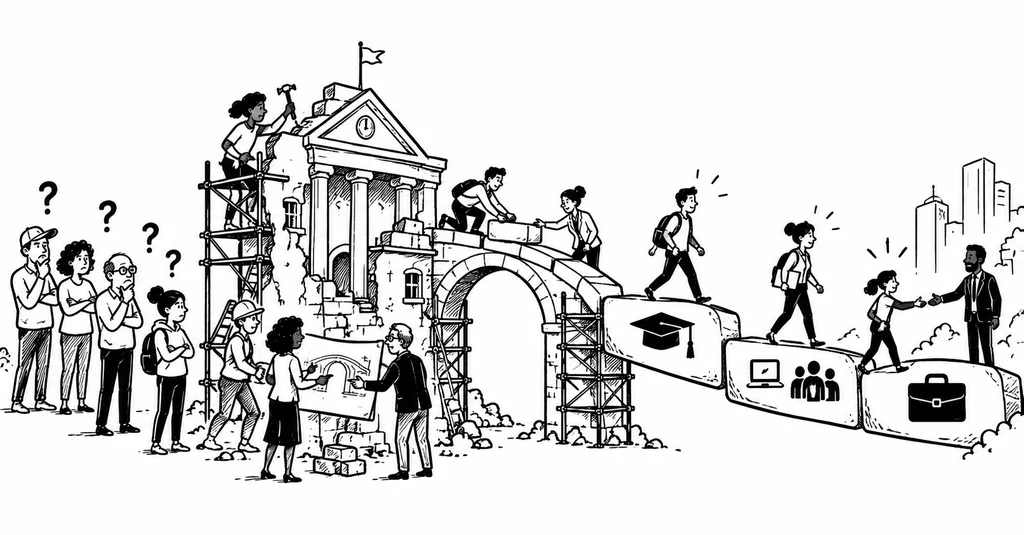
Americans are questioning the value of college at the same moment universities are redesigning what students receive from it. Those developments are increasingly part of the same story.
Only 31 percent of Americans now say a college education is “very important,” according to Gallup data released October 1. In 2013, the figure was 70 percent. At the same time, the share saying college is “not too important” has climbed from just 6 percent to 29 percent. The two positions that were separated by 64 percentage points thirteen years ago are now separated by two.
The decline is not confined to one demographic group. Gallup found decreasing assessments of college’s importance across major groups, including people who historically placed greater value on higher education. Cost appears to be part of the calculation: a separate Lumina Foundation-Gallup survey cited in the report found that only 12 percent of U.S. adults consider a four-year college education affordable.
The Public Is Reconsidering the Product
The numbers arrive just as colleges themselves are reconsidering what a degree needs to provide. As Social Storytellers Collective has reported this week, some workers are retraining for careers they believe will be harder for AI to automate, while universities are expanding internships, employer partnerships, career preparation and AI instruction as they try to prepare graduates for a labor market that is becoming harder to predict.
Those developments are connected. A degree once carried a relatively simple promise: acquire specialized knowledge, earn the credential and use it to enter a profession. Rising costs, student debt, uneven employment outcomes and rapid technological change have made that sequence less certain. Students increasingly have to evaluate not just what they want to study, but what the credential will enable them to do when they finish.
Gallup’s findings contain an important complication. Skepticism about college does not mean Americans have abandoned higher education altogether. Gallup notes that 73 percent of adults without a degree or credential say earning a two- or four-year degree is at least as important as it was 20 years ago, while 69 percent of college graduates say the same. Most parents also continue to prefer that their children pursue a two- or four-year degree immediately after high school.
Colleges Are Responding to the Same Uncertainty
The result is not simply declining confidence in college. It is a renegotiation of what people expect college to deliver. Students still see value in education, but cost and employment outcomes are becoming harder to separate from the academic experience.
Workers are reconsidering which careers are worth preparing for. Universities are reconsidering how education connects to those careers. Now the public is reconsidering how much value to assign to the credential itself. The degree is not disappearing. The burden on colleges to prove what comes with it is getting heavier.