
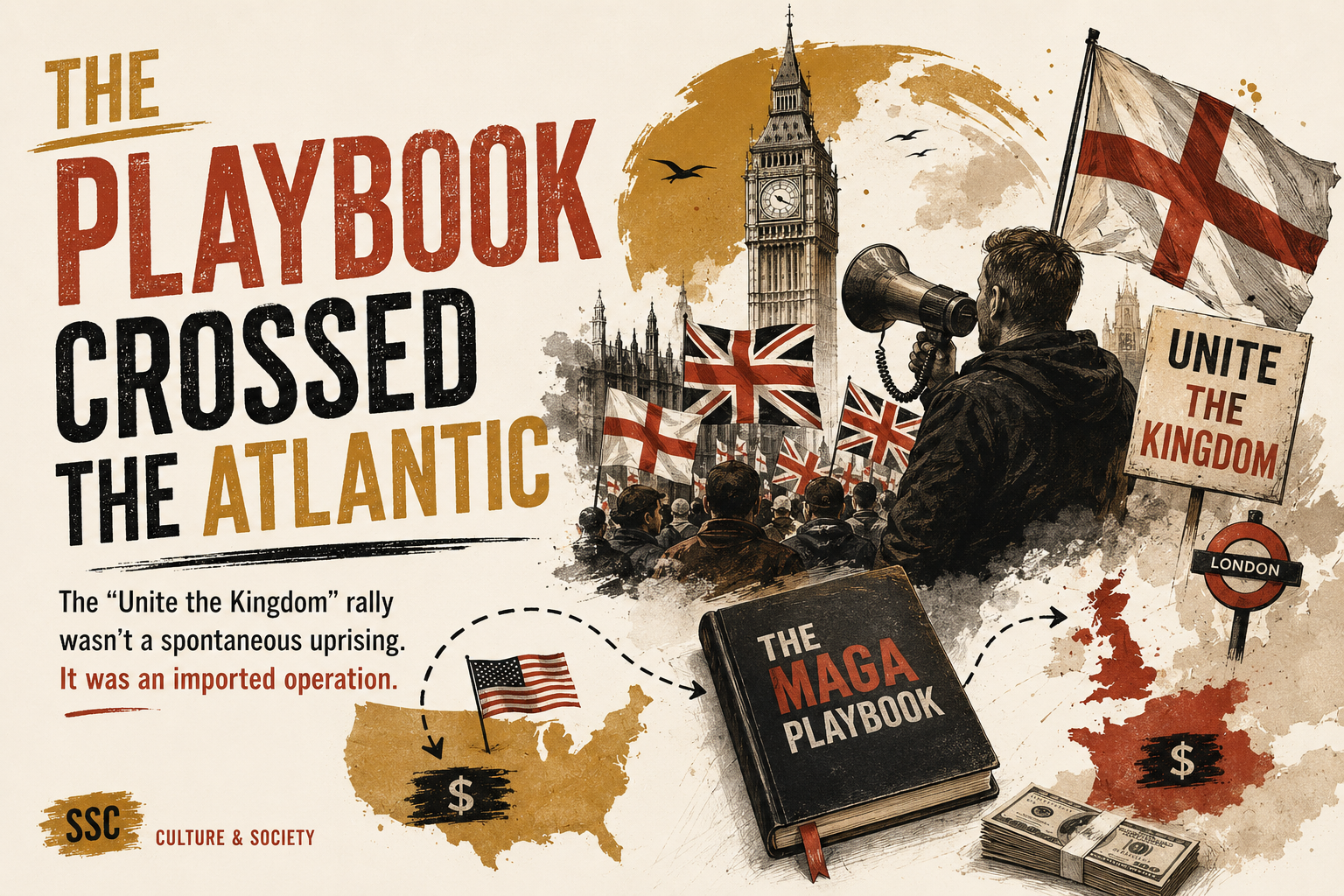
Tens of thousands of people marched through central London on Saturday under the banner of “Unite the Kingdom” — a rally organized by Tommy Robinson, whose real name is Stephen Yaxley-Lennon, the co-founder of the English Defence League and one of Britain’s most prominent far-right figures. Crowds carrying Union Jacks and St. George’s Cross flags chanted “we want Starmer out” and “give us back our country.” Some wore red “Make England Great Again” hats — a deliberate echo of the American MAGA aesthetic. Robinson himself has promoted the idea of a “Make Europe Great Again” movement, modeled explicitly on the political infrastructure Donald Trump built in the United States. The visual language of the march was not accidental. It was a template, reproduced with intent.
The Metropolitan Police deployed 4,000 officers for what it called its largest public order operation in years — a £4.5 million mobilization that included armoured vehicles, police horses, drones, helicopters, and live facial recognition systems. Forty-three people were arrested across the day’s demonstrations. Four officers were assaulted. Prime Minister Keir Starmer blocked eleven foreign speakers from entering the country ahead of the rally, describing their presence as “not conducive to the public good.” The state response to a single day of protest was larger and more expensive than many standing security operations.
Crowd estimates varied sharply, which is itself a story about how polarization shapes the reporting of public events. Hope Not Hate, the UK’s leading anti-extremism organization, reported the rally drew significantly smaller crowds than organizers projected. Outlook India reported attendance of 110,000. Robinson claimed “millions of patriots.” The Met offered no official figure. When a political movement controls its own crowd size narrative — and when mainstream media cannot agree on a number — the spectacle has already succeeded on its own terms regardless of the headcount.
What received less attention than the crowds is the money. The rally was funded in substantial part by American donors: $200,000 from Andy Miller and $100,000 from businessman Robert Shillman. During his speech, Robinson publicly thanked Elon Musk for what he described as continued support. A closed-door meeting of European conservative and nationalist figures was held in Paris under the “Make Europe Great Again” banner in the days before the London rally — a gathering aimed at strengthening coordination between European right-wing movements and Trump-aligned conservatives in the United States. The Center for the Study of Organized Hate, which analyzed the event ahead of its occurrence, described the British far-right scene as “a professional operation: backed by foreign funders, circulating chronic disinformation and synthetic content on social media, and amplified by supporters in public office.” The rally was not a grassroots expression of popular anger. It was a funded, coordinated, transnational political operation wearing the aesthetic of organic outrage.
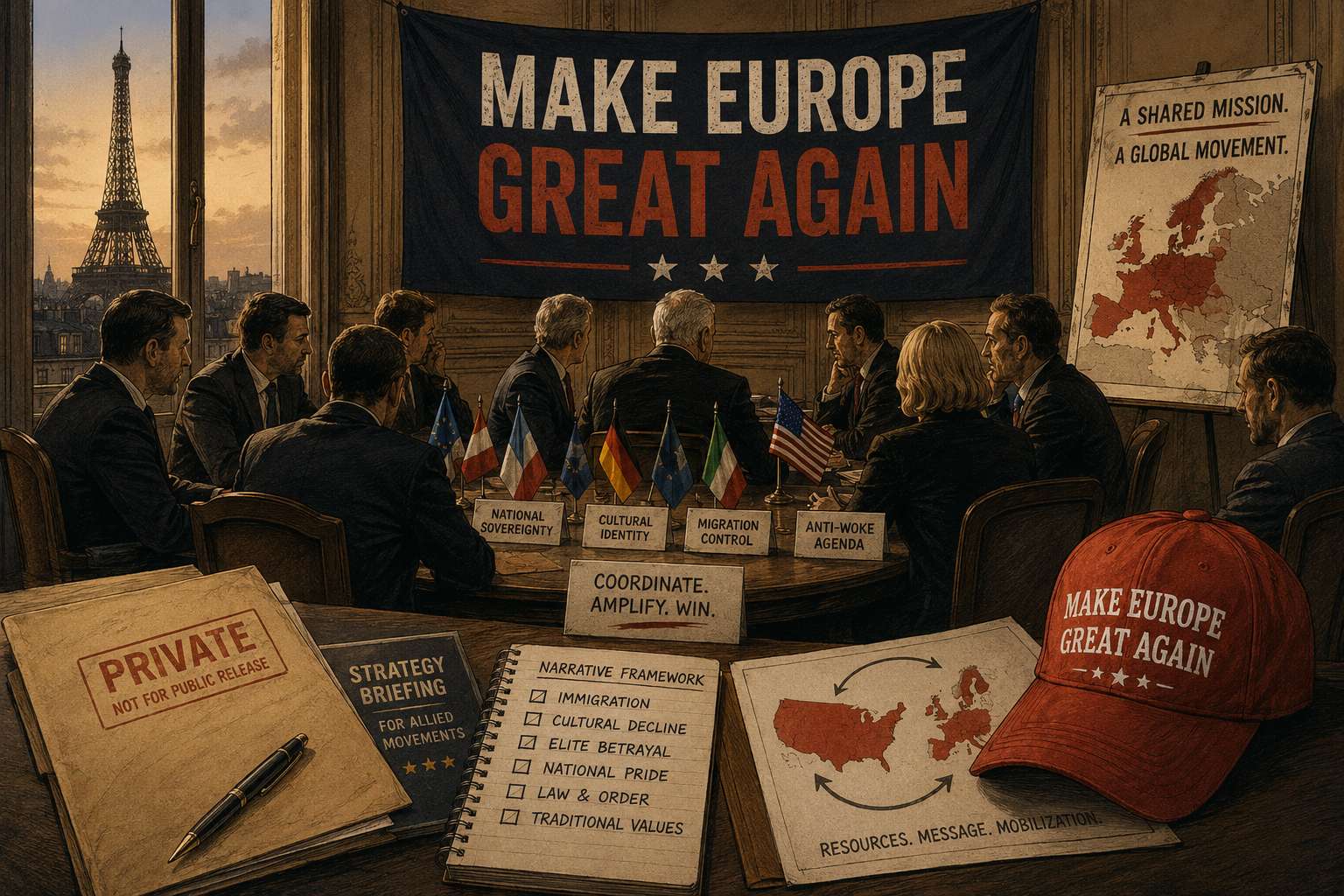
That distinction matters because of what it reveals about the current structure of far-right political organizing. The MAGA model was never only about American electoral politics. It was an infrastructure: media channels, funding networks, social media amplification, and a visual identity system portable enough to cross borders without losing legibility. “Make England Great Again” hats work because the original design primed audiences globally to read what they mean. The slogan doesn’t need translation. The grievance framework — immigration, cultural displacement, government betrayal, national reclamation — is modular. It can be attached to almost any political context because it operates on emotion rather than policy specifics.
Robinson has played a central role in facilitating those transatlantic connections for years. His legal history — he has been convicted of fraud, contempt of court, and other offenses — has not diminished his operational capacity. If anything, the criminal record has become part of the martyr narrative that makes him legible to the same audiences that elevated Trump’s legal battles into political fuel. The mechanism is the same on both sides of the Atlantic: persecution as proof of authenticity, institutional opposition as confirmation of power, every legal consequence reframed as evidence that the system fears the movement.
The same day Robinson’s rally moved through the West End, a Nakba Day march commemorating the 75th anniversary of Palestinian displacement in 1948 moved through a separate part of London. Organizers estimated their crowd at more than a quarter of a million — significantly larger than the Unite the Kingdom demonstration by most accounts. The two marches occupied the same city on the same afternoon with almost no overlap in geography, grievance, or political framework. London held both simultaneously. That is not unusual. What is unusual is the speed at which British political culture has absorbed a foreign aesthetic framework and operationalized it domestically — and how much American capital is behind the infrastructure making that absorption possible.
The march on Saturday was the second Unite the Kingdom rally. The first was held in September 2025. The fact that there is already a second one — larger, better funded, and more internationally connected than the first — is the detail that matters most for understanding where this goes. Political movements with professional infrastructure and transatlantic donor networks do not hold one rally. They build toward elections, legislation, and the normalization of a political vocabulary that was considered fringe until it wasn’t. That process has a precedent. The United States lived through it. Britain is watching the same playbook run on a different stage — and some of the people funding it are the same.
SSC | Politics & Institutions — May 16, 2026 — Social Storytellers Collective News Desk