
Editor’s Note: This piece builds on two earlier SSC reports from this week. On Wednesday, SSC examined ADP’s May private payroll report showing 122,000 jobs added — the strongest month for private payrolls since January 2025. On Thursday, The Other Side of May’s Jobs Number documented the parallel reality: Challenger, Gray & Christmas recorded 97,006 announced job cuts in the same month, the highest May total since 2020, with artificial intelligence named as the leading stated cause for the third consecutive month. This morning’s BLS report confirmed 172,000 jobs added in May and 1.8 million Americans out of work for 27 weeks or more. This piece examines what happens to the workers the headline left behind — after the cuts, after the benefit clock runs out, and after the data stops counting them. Updated on June 5, 2026 at 12:57pm.
Yesterday, SSC examined ADP’s May private payroll report and raised a question the headline number left unanswered: which workers are being reached by this growth, and which ones are still waiting for the labor market to find them. Thursday’s report from global outplacement firm Challenger, Gray & Christmas begins to answer it — and the answer complicates the narrative considerably.
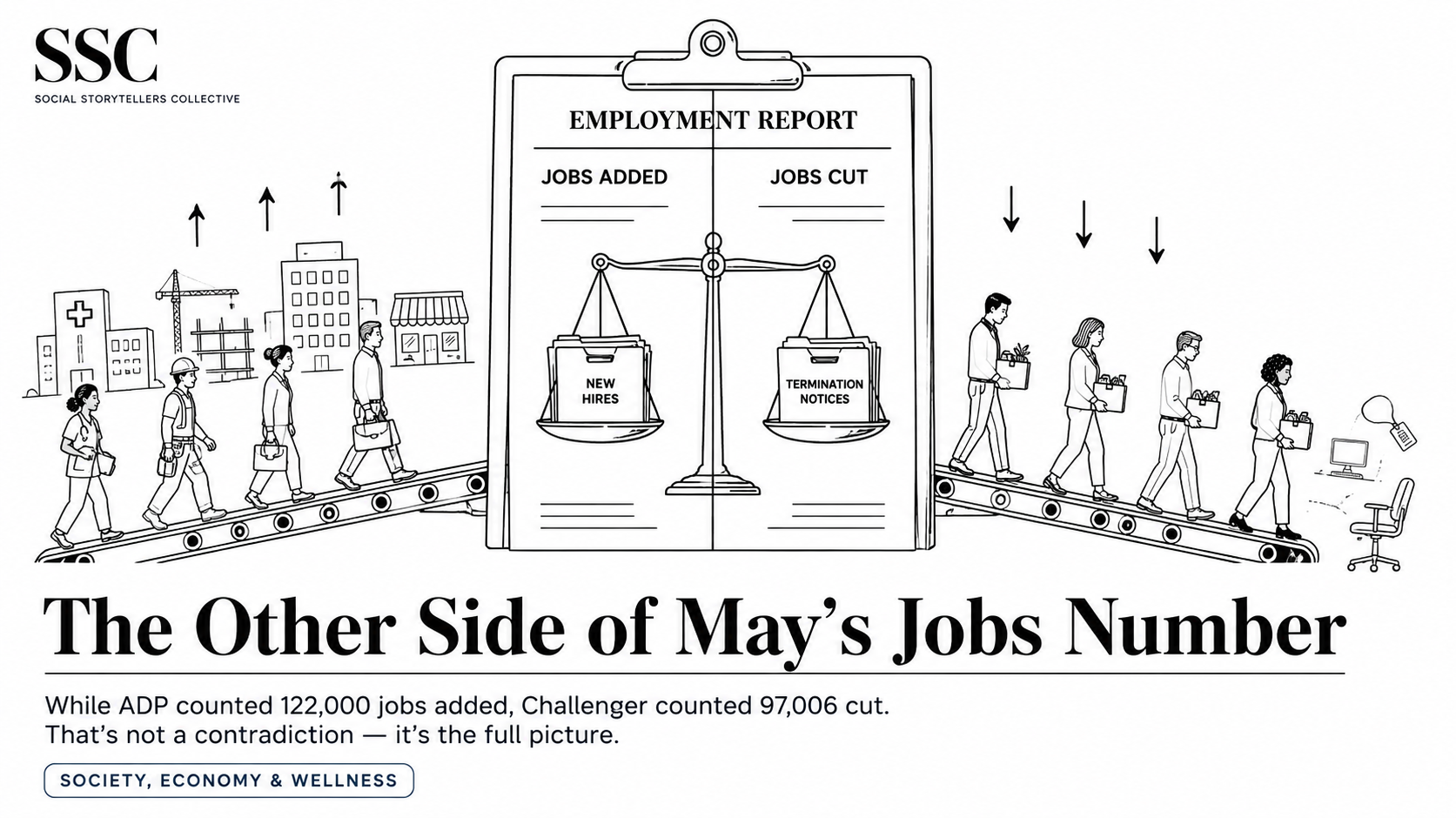
U.S. employers announced 97,006 job cuts in May, a 16 percent increase from April and the highest May total since 2020. While ADP was counting jobs added, Challenger was counting jobs eliminated — and both were happening simultaneously, inside the same economy, in the same month. A labor market that produces both numbers in the same reporting period is not sending a mixed signal. It is sending a precise one: growth and displacement are no longer running on separate tracks.
Challenger, Gray & Christmas identified artificial intelligence as the leading stated reason for job cuts for the third consecutive month. AI-related cuts totaled 38,242 in May alone — the highest single-month total since the firm began tracking the category. The technology sector recorded its highest cut level since March 2023. These are not isolated data points. They are a pattern, and patterns at this scale reflect deliberate decisions about how corporations are choosing to reposition labor costs as they restructure around AI adoption.
Andy Challenger, labor and workplace expert and chief revenue officer of Challenger, Gray & Christmas, named the mechanism directly in a statement accompanying the report: “On top of the headline AI story, we’re seeing a sharp rise in cuts tied to acquisitions and mergers and a jump in bankruptcy-related losses, which tells me companies are restructuring aggressively as they reposition for an AI-driven economy.”
The operative word is reposition. Workers are not being let go because the economy is contracting. They are being let go because corporations are reorganizing around a different cost structure — one where AI absorbs functions that human workers previously performed, and where the resulting savings flow to the balance sheet rather than back into wages or workforce investment.
This is the context the ADP headline left out. A month that added 122,000 private sector jobs also shed nearly 97,000 announced cuts. The net arithmetic may look encouraging. The distributional reality is more complicated. The jobs being added are concentrated in small businesses — which, as SSC reported this week in The May Jobs Number Looks Strong. Read the Details Before You Celebrate., disproportionately carry lower wages, fewer benefits, and greater economic vulnerability. The jobs being cut are concentrated in sectors where AI adoption is accelerating and where corporate restructuring is being used as cover for permanent workforce reduction.
The labor market is not broken. It is producing headline numbers that signal stability while the underlying architecture shifts in ways that will take months or years to fully surface in the data. Friday’s BLS employment report for May will add another layer. SSC will be watching not just the unemployment rate, but what the sector and wage breakdowns reveal about where May’s strength was actually located — and who was left outside of it.
The economy added jobs in May. It also cut them at the highest May rate since the pandemic. Both things are true. The workers absorbing the cuts and the workers benefiting from the additions are not the same people — and that gap is what the headline number was never designed to show.