
Part of Culture in Motion — an ongoing series examining who defines culture, how it’s interpreted, and how both are reshaped over time.
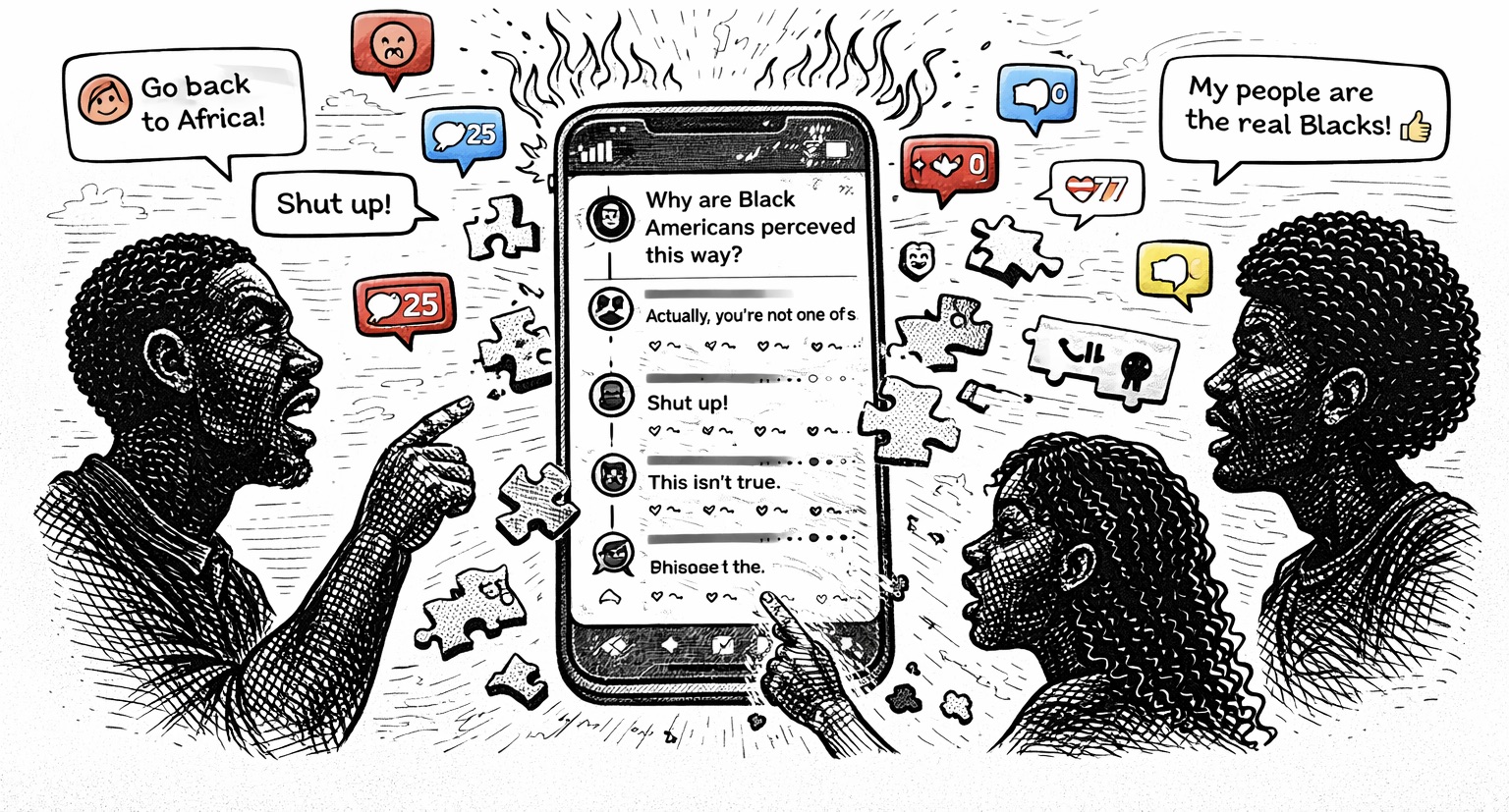
A recent post on X questioning how Black Americans are perceived — and what happens when that perception is rejected — quickly drew thousands of views and a wide range of responses. Some replies were affirming. Many were not. What followed was not a conversation in the traditional sense, but a layered collision of perspectives: hostility, projection, internal disagreement, and competing claims about identity all unfolding in the same space at the same time.
The speed and tone of those responses are not incidental. Black identity in an American context has long functioned as a pressure point in public discourse. When that identity is framed outside of deficit or limitation, it often produces a predictable reaction. Some responses attempt to reassert hierarchy through dismissal or insult. Others shift the conversation into alternative narratives about origin, belonging, or legitimacy. The result is not dialogue — it is fragmentation.
What stands out is how many of the responses are not actually engaging the original point. Instead, they project outward — reframing Black identity through external assumptions, historical distortions, or ideological positions that predate the conversation itself. The thread becomes less about what was said and more about what people bring to it. The replies reveal preexisting beliefs looking for a place to land.
The thread also reflects internal tension within the broader Black diaspora. Questions of identity, lineage, and cultural connection are not new, but platforms like X collapse those conversations into a single, highly visible stream. As Why the Foundational Black American Conversation Matters examined, the misreadings between Black Americans and members of the broader diaspora stack up quickly — and the online environment accelerates them, flattening a genuinely complex history into competing declarations with no shared framework for resolution.
The structure of the platform plays a direct role in how this unfolds. Content that generates strong emotional reactions — disagreement, outrage, affirmation — is more likely to be surfaced and amplified. As a result, the most extreme or polarizing responses rise to the top, creating the impression that they represent the majority. They rarely do. But they shape the tone of the conversation regardless. As The Comment Section Is Now the Story documented, the algorithm does not prioritize clarity or accuracy — it prioritizes engagement. And engagement, more often than not, is driven by conflict.
This is where the distortion becomes most visible. What appears to be a broad, representative exchange is often a curated slice of the most reactive voices. Identity becomes content. Disagreement becomes distribution. And the original point is quickly overtaken by the reactions it produces.
Moments like this are often interpreted as evidence of division or dysfunction. In reality, they reveal something more structural. The conversation is not breaking down on its own — it is being shaped by a system that rewards escalation over understanding. The thread is not just a snapshot of opinion. It is a case study in how discourse is constructed, amplified, and distorted in real time — and how the communities at the center of that distortion are the last to control what it produces.