
For years, social media platforms promised frictionless conversation at scale. Post instantly. Reply endlessly. Stay online continuously. The feed was always open. The architecture assumed that more conversation was always better — more engagement, more time on platform, more behavioral data to sell against.
X just revealed how thoroughly that assumption has been abandoned.
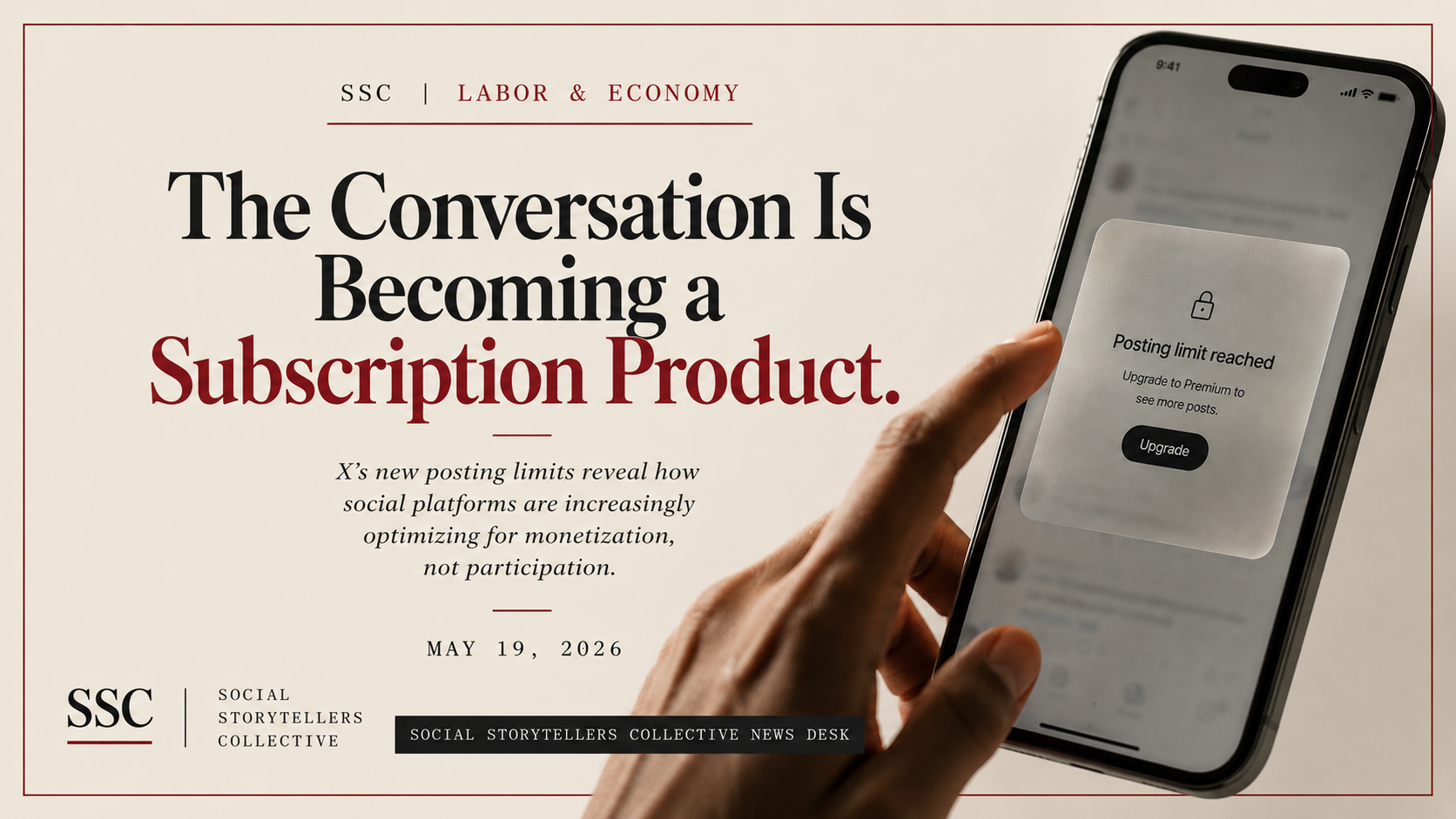
Free users are now capped at 50 posts per day — including tweets, reposts, and quote posts — plus 200 replies, with a cooldown timer that activates before you hit the limit. These are not temporary adjustments. They are architectural decisions. A deliberate reorganization of who gets to speak, how often, and at what cost. The platform that spent a decade optimizing for maximum engagement is now optimizing for maximum conversion. The goal is no longer to keep you talking. It is to make you pay to keep talking.
The thread that erupted in response said the quiet part out loud in real time. “We are officially in the pay-to-participate era of social media,” @DailyCompassss wrote, pulling 38 impressions in the first hour — a post that named the shift more precisely than most coverage did. @ratincrisiss put it blunter: “x/twitter is just greedy for money i swear because it wants non premium users to buy premium.” @Mosquito called it plainly: “This platform is getting more commercialized as day goes by.” And @souljahhh simply: “Somebody buy this app from Elon already.”
The pushback against the pushback was equally revealing. @LvlZeroGamingTV posted “If you tweeting 50+ posts in a day I advise you to go get a life” — pulling 48,000 impressions — and @Shirink_13 asked “Who replies 200 times and who makes 50 posts daily?” Both responses reflect a genuine segment of the user base that sees the limits as reasonable. That tension is real and worth sitting with. For the majority of casual users, 50 posts a day is not a constraint they will ever encounter.
But the people who will encounter it are not peripheral. Heavy posters, independent commentators, journalists, fan communities, meme accounts, and hyper-online cultural participants were once treated as the engines of engagement — the people whose activity made the platform worth being on for everyone else. They are now being treated as a conversion opportunity. Post more than 50 times today and the platform has identified you as someone who needs this badly enough to pay for it.
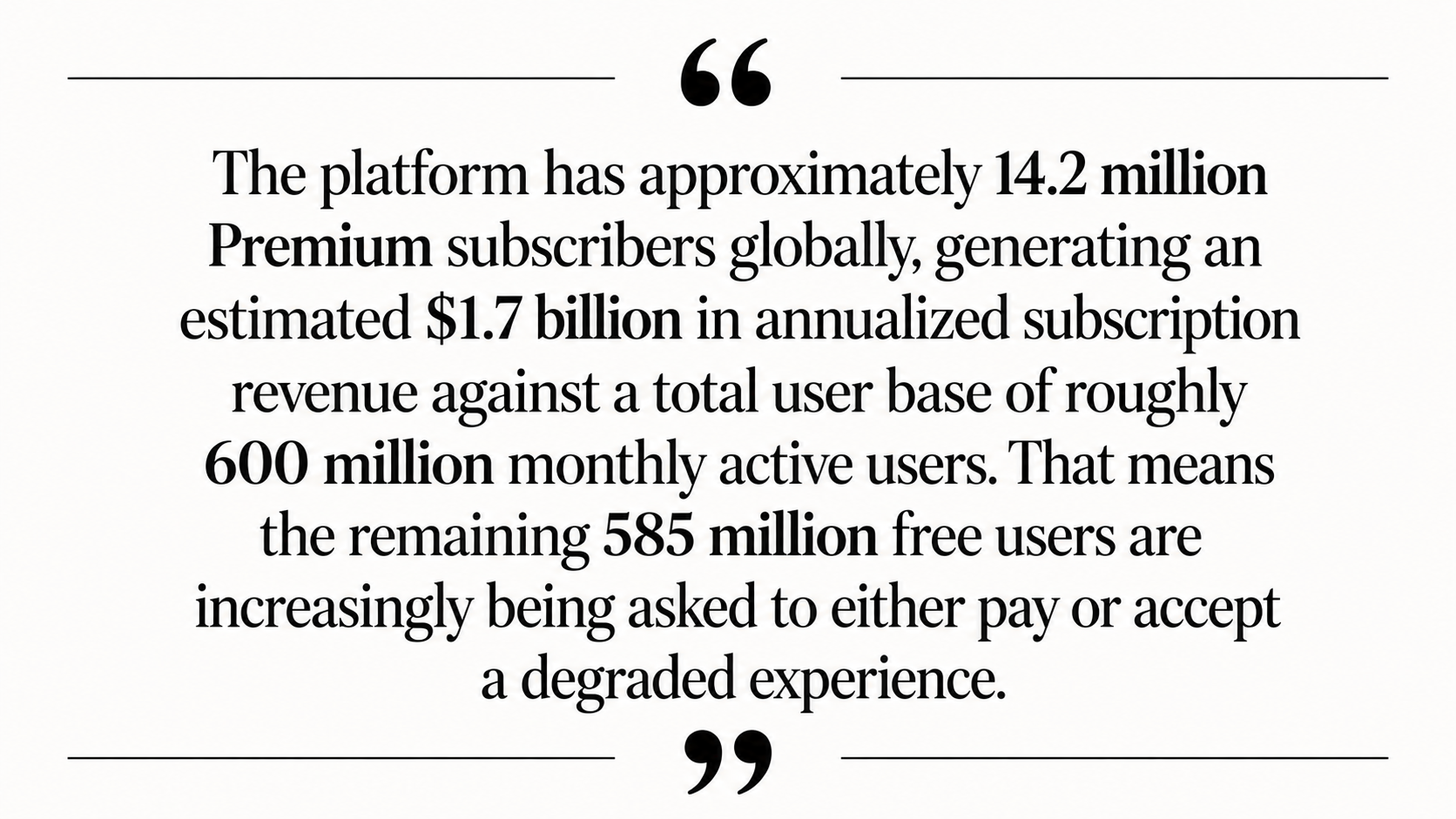
To understand the stakes of that conversion strategy, the numbers matter. X has approximately 14.2 million Premium subscribers globally, generating an estimated $1.7 billion in annualized subscription revenue — against a total user base of roughly 600 million monthly active users. That means the platform is asking the remaining 585 million free users to either pay or accept a degraded experience. The posting limits are the mechanism. The math is the motive.
Those numbers also sit inside a longer story of erosion. Daily users of X have declined consistently since Musk acquired it in 2022. On election day in 2024, X had only 162 million daily users — and a day later, that number had already dropped by 5 million. The Wall Street Journal reported that daily active users for September 2023 had dropped by 16 percent among mobile app users, while other major platforms remained stable or grew. The mass exodus that followed the 2024 election was the largest single departure event since the acquisition — more than 115,000 accounts deactivated on the day after the election alone, the most dropped accounts in a single day since Musk took over.
Where did they go? Bluesky reached 42 million users in 2026 — a tenfold increase compared to 2024. Threads surpassed 275 million monthly users. The migration was not random. Journalists, scientists, LGBTQ+ communities, and Black Twitter — long the cultural engine of the platform — were among the most organized departures. “Black Twitter was one of the cornerstones of Twitter,” Bluesky spokesperson Emily Liu said at the time. “We’re eager to welcome this community.” The communities that made X worth being on were the first ones to leave when the environment became hostile enough to justify the cost of rebuilding elsewhere.
The business logic is not complicated. Unrestricted engagement produces noise, moderation costs, and advertiser anxiety. Tiered access produces subscribers, predictable revenue, and a user base that has demonstrated willingness to pay. Visibility, posting frequency, reach, verification, and now basic participation itself are being restructured into a layered product. Social media is beginning to resemble a gated utility more than an open digital commons — and the gate is a credit card.
One user noted the limits apply only to unverified accounts — which means the architecture is also a sorting mechanism. Verified users, paying subscribers, and premium accounts retain the experience that X is removing from everyone else. The conversation is still happening. It is just being reorganized around who has paid to be in it.
What the thread also exposed — and what the coverage largely missed — is that users already understand this. They named it immediately, correctly, and without equivocation. @GoxBirds noted the platform “constantly changes things and provides zero notification.” The absence of transparency is itself a feature of the model: implement the limits, wait for the reaction, let the conversion funnel do its work.
The backlash is real. The platform dependency is realer. Most of the people posting about leaving X are posting about it on X. The network effects are still too powerful to abandon — the audience is still there, the cultural conversation still runs through it, and leaving means losing the room. The resentment and the reliance are not contradictions. They are the business model.
Social media was built on the premise that the crowd was the product, and the product was free. The crowd is still there. The free part is ending.