
Part of The Access Shift — an ongoing series examining how access is being quietly reshaped across American life.
NEWS DESK | SOCIAL STORYTELLERS COLLECTIVE
The science is not the obstacle. The tool exists, it works, and demand has already been confirmed across 16 countries. What remains uncertain is whether the system will fund it at the price point that makes scale possible. That uncertainty is not abstract. It is being decided now — in donor budgets and procurement negotiations — and it will determine whether hundreds of thousands of infants are born free of preventable infections.
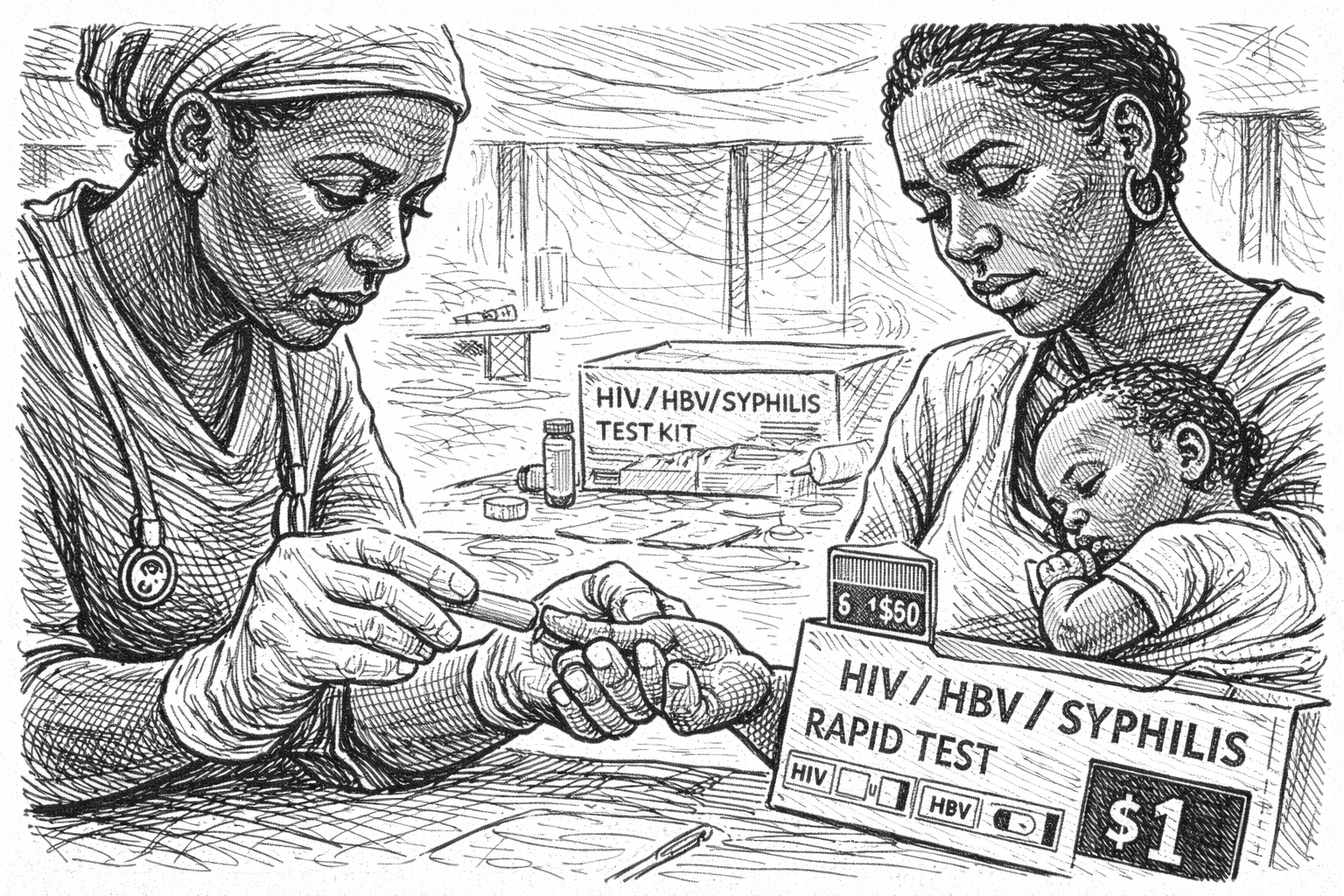
In July 2025, the World Health Organization prequalified the first bundled rapid diagnostic test capable of detecting HIV, hepatitis B, and syphilis from a single finger-prick sample. Designed for use at the point of care, the test is as much a systems solution as a clinical one. It collapses three screening pathways into one, reduces the burden on frontline health workers, and addresses a long-standing gap that has left hepatitis B screening far behind even in settings with strong antenatal care coverage.
That gap is structural. In many high-burden countries, up to 95% of pregnant women are tested for HIV, but fewer are screened for syphilis, and hepatitis B coverage lags further still. These disparities are not driven by a lack of knowledge or intent. They reflect fragmented procurement systems, siloed disease programs, and the operational strain of running parallel testing workflows in under-resourced environments. The triple test addresses those constraints directly.
The Clinton Health Access Initiative analysis makes clear that price is the pivot point. At approximately $1 per test, triple diagnostics could be more cost-effective than existing single or dual approaches, expanding coverage without increasing overall system cost. The precedent already exists. A similar effort to scale dual HIV/syphilis testing drove prices below $1, enabling rapid adoption across countries that carry the vast majority of the global burden. The same principle applies here: price determines access, and access determines outcomes.
But the funding environment is moving in the opposite direction. Donor budgets are tightening at the exact moment this tool requires investment to scale. As SSC reported in Aid Cuts HIV Treatment, reductions in U.S. foreign aid have already disrupted HIV programs across sub-Saharan Africa. In constrained systems, hepatitis B is typically the first to be deprioritized — with the weakest funding base and the least institutional protection. Modeling shows that at higher price points, hepatitis B screening will decline sharply, and even existing HIV and syphilis gains could begin to erode.
Why This Matters
This is what access looks like in practice — not as a concept, but as a set of decisions made far from the communities they affect. The science exists. The delivery model exists. The demand exists. The price point that makes scale possible is within reach. What’s missing is sustained financial commitment. As SSC has tracked across HIV Treatment Didn’t Collapse — But What’s Holding It Up Should Concern You and 250 Million Americans Facing Health Insurance Premium Increases, when systems contract, the people with the least margin lose access first — and recover last.