
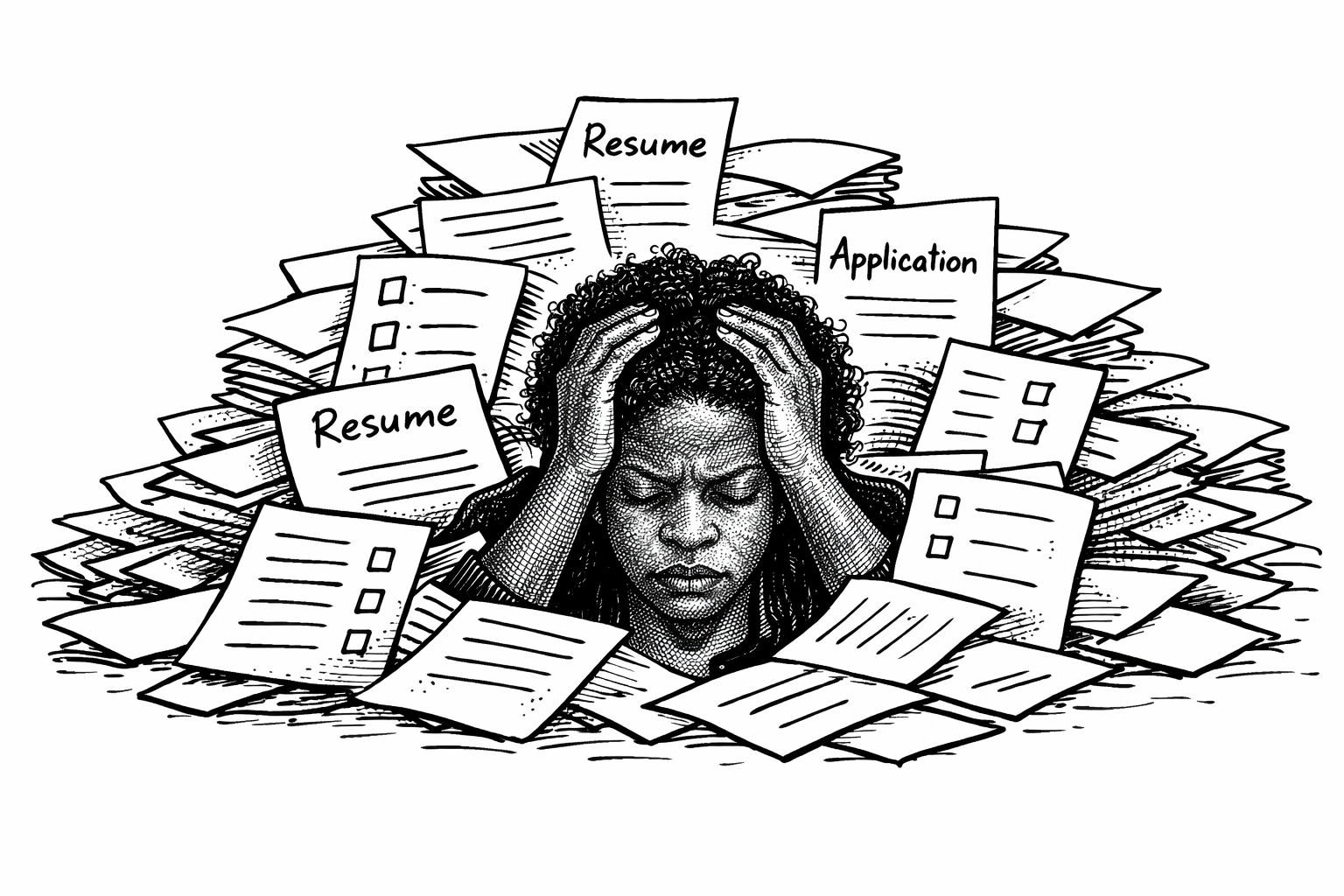
Even in periods of economic growth, the labor market does not recover evenly. Black unemployment in the United States has stood at approximately 7.7 percent as of early 2026, compared to 3.7 percent for white workers — a gap that has remained remarkably consistent across decades, political administrations, and broader economic conditions. That persistence is itself the story. It suggests the disparity is not a temporary deviation from a fair system, but a structural feature of how the labor market operates.
At a national level, unemployment is often framed as a shared economic condition. When rates fall, it signals recovery. When they rise, it signals strain. But those aggregate numbers obscure how uneven that recovery actually is. Black workers are consistently more exposed to labor market volatility — more likely to be laid off during downturns and slower to be rehired during periods of growth. Improvement at the headline level does not translate into equal stability across the workforce.
The burden of that instability is not evenly distributed within the Black workforce itself. Black women consistently face some of the highest unemployment rates in the country — estimated at around 6.4 percent in early 2026, above the national average and well above the 3.3 percent rate for white women. This gap reflects more than sector concentration. Black women are disproportionately represented in care, service, and administrative roles that are more vulnerable to disruption, while also navigating structural barriers tied to caregiving responsibilities, wage disparities, and hiring bias. They are also more likely to serve as primary or co-primary earners in their households, meaning instability in their employment carries a broader ripple effect — impacting not just individual income, but overall household economic security.
The causes reflect a set of reinforcing patterns rather than any single factor. Black workers remain overrepresented in sectors most sensitive to economic fluctuations — service and logistics roles that are often the first to contract. Hiring processes across industries continue to rely heavily on networks, referrals, and subjective assessments of “fit,” which can systematically limit access to opportunity in ways that rarely appear in official labor statistics but shape outcomes that are both measurable and persistent. The disparity is also evident in duration — Black workers experience longer periods of unemployment than white counterparts even when education levels are comparable, and among college graduates, Black unemployment remains higher. The gap cannot be explained by qualifications alone. It points to differences in how opportunity is distributed and accessed across the labor market.
Recent data reinforces how quickly that gap can widen. Black unemployment rose from approximately 6.0 percent in early 2025 to 7.7 percent in early 2026, even as the broader labor market showed relative stability. That pattern reflects a long-standing dynamic in which even modest economic slowdowns are felt more immediately and more intensely by Black workers — widening disparities that had only partially narrowed during stronger periods.
Policy conversations often focus on job creation, but the persistence of this gap suggests that availability alone is not the issue. The labor market does not just determine how many jobs exist — it determines who has access to them. Without addressing the mechanisms that shape hiring, retention, and advancement, disparities remain embedded in the system itself. If the same gap continues to appear across different economic conditions, the question is no longer whether the labor market is recovering. It is who that recovery is actually reaching — and who it consistently leaves behind.