
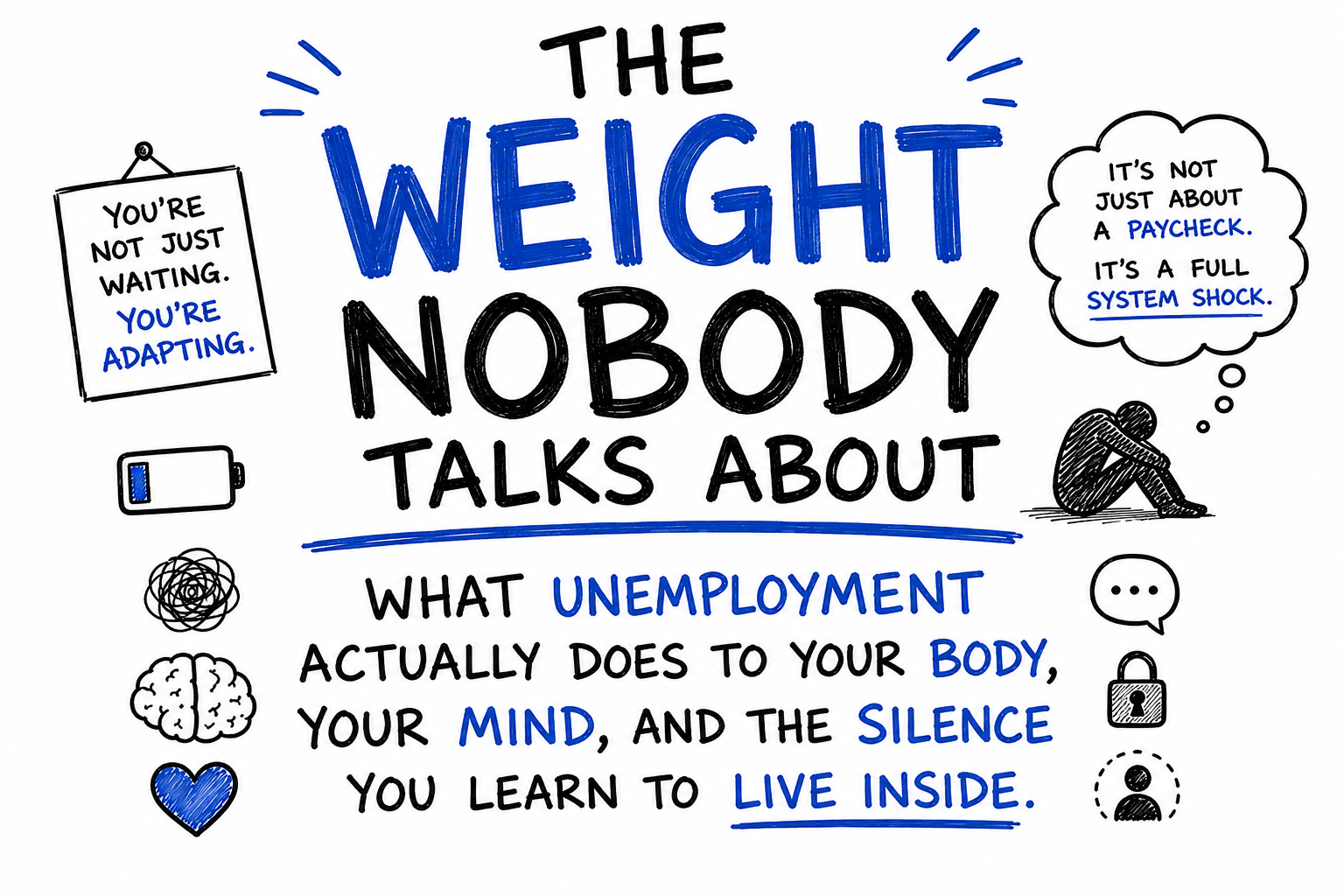
Nobody tells you about the 10 o’clock feeling.
Not the one where you wake up without an alarm for the first time in years and feel free. That feeling lasts maybe a week. The one that comes after — the one that settles in and stays — is different. It is the feeling of waking up and having nowhere to go. Of watching the morning arrive with nothing to organize it. Of understanding, somewhere below conscious thought, that today looks exactly like yesterday and probably like tomorrow, and that the structure you spent years complaining about was actually the thing holding you together.
That is where unemployment lives. Not in the job boards or the rejection emails or the cover letters you write and rewrite and send into silence. In the 10 o’clock feeling. In the hours that follow.
What it does to the body first
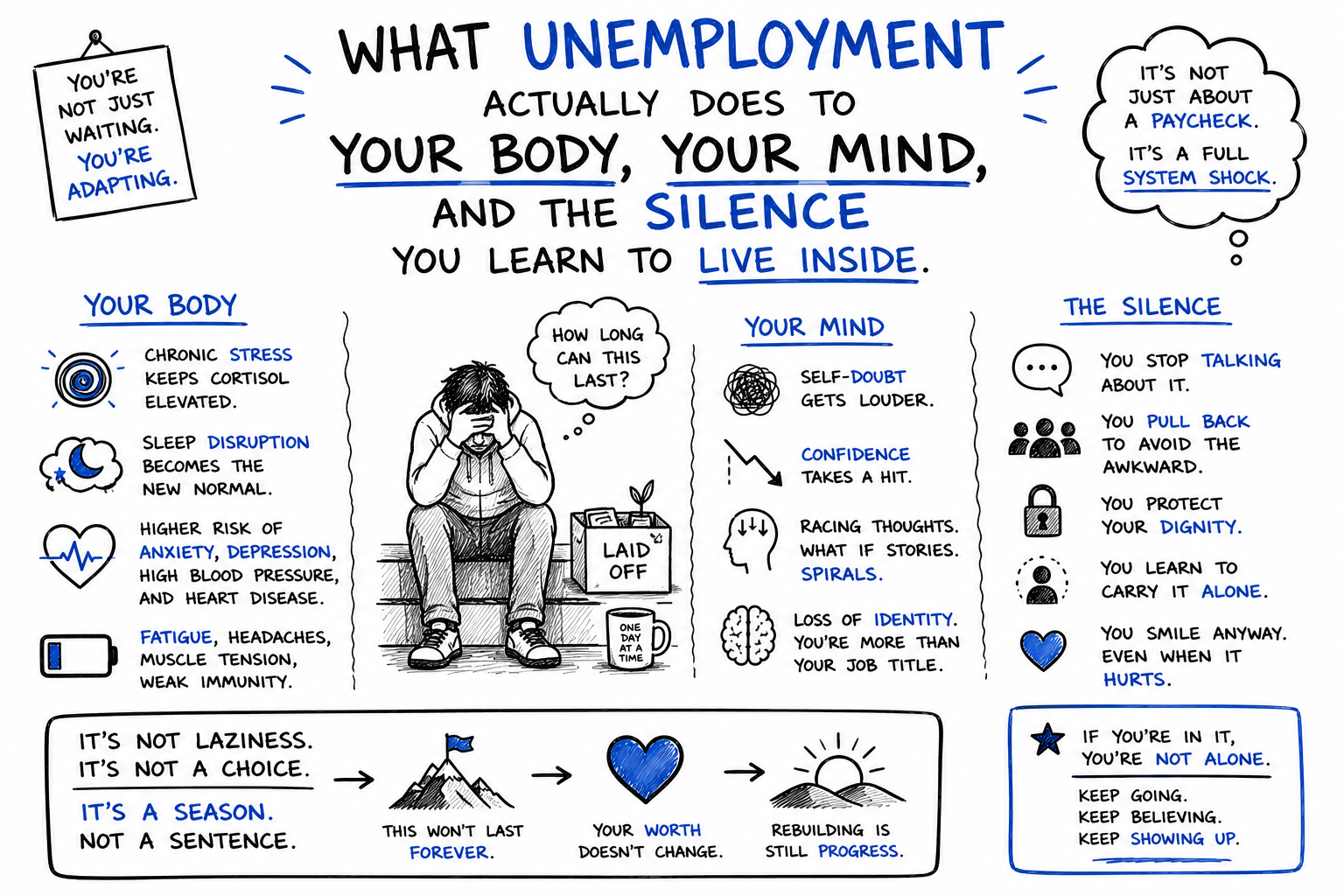
The mind and the body are not as separate as we pretend. Prolonged uncertainty registers in the body before it becomes a thought. You notice it in your energy first — a heaviness that is not quite fatigue but is not quite alertness either. Getting off the couch requires a negotiation. The shower gets postponed. Meals become irregular because meals were organized around a schedule and the schedule is gone.
This is not laziness. It is the nervous system responding to a sustained threat. When the brain perceives danger without a clear resolution, it holds the body in a low-grade state of alert that is exhausting to maintain over time. The cortisol that was designed to help you run from predators is now running quietly in the background of every unanswered application, every LinkedIn post that didn’t land, every conversation where someone asks how the search is going and you have to decide how honest to be.
Sleep changes. Sometimes you sleep too much because sleep is the only place where the fear quiets. Sometimes you can’t sleep at all because the thoughts come loudest at 2am when there is nothing left to distract from them. Either way, you wake up unrestored. And the cycle continues.
What it does to the mind
The thoughts have a specific architecture. They are not random. They follow a loop.
It starts with the practical: I need to apply to more jobs. Then it moves to evaluation: I have applied and nothing has happened. Then it moves to interpretation: maybe something is wrong with my approach. Then it moves somewhere darker: maybe something is wrong with me. Then it moves to prediction: what if this doesn’t resolve. Then it moves to catastrophe: what does my life look like if this goes on for another three months, six months, a year.
And then, usually, something interrupts — a notification, a noise, a need to eat — and the loop resets. Until the next quiet moment, when it starts again.
Psychologists call this ruminative thinking. The colloquial version is being stuck in your head. The lived version is being trapped in a room where the walls keep moving closer and you cannot find the door and nobody outside knows you are in there because you have learned to say “the search is going” when people ask.
The silence is the part that does the most damage. Unemployment is a condition that many people experience and almost nobody discusses honestly, because there is still enough cultural shame attached to it that the instinct is to manage the perception rather than name the reality. So you perform okayness in public and carry the weight privately. And private weight, carried alone, compounds.
What it looks like from the outside
From the outside it often looks like withdrawal. The person who used to call doesn’t call as much. The person who used to make plans finds reasons not to. The person who was always engaged, always present, always moving — is quieter now. Slower. Sometimes their affect has flattened in a way that is hard to name but easy to feel.
What looks like apathy is often exhaustion. What looks like disengagement is often self-protection — because sustained rejection, even impersonal and bureaucratic rejection, erodes the appetite for situations where rejection is possible. What looks like giving up is often a person conserving the last of their energy for the moments that matter most, because everything costs more when you are running on empty.
The people who love them often don’t know what to say. So they say nothing, or they offer advice — have you tried networking, have you updated your LinkedIn, have you considered — and the person smiles and says yes and means thank you and feels more alone than they did before the conversation started.
What living in it actually feels like
There is a specific quality to fear that lives without language. Not the fear of something happening — that fear has an object, a shape, a direction. This is the fear of not knowing what is going to happen. Of uncertainty that has no timeline and no resolution visible from where you are standing.
It lives in the body as a low hum. In the mind as a background process that never fully closes. In the daily routine as a performance of normalcy that takes more energy to maintain than the actual work of job searching. You make the list. You send the applications. You follow up. You do the things you are supposed to do. And then you sit with the silence of having done them and wait.
The waiting is the hardest part. Because in the waiting there is nothing to control, nothing to optimize, nothing to do that guarantees a different outcome. And for people who have built their identity around competence, capability, and contribution — which is most people who are devastated by job loss rather than relieved by it — the powerlessness of waiting is its own particular kind of suffering.
What holds
This piece is not going to tell you to meditate, or network more intentionally, or reframe unemployment as an opportunity for growth. Those things may be true and they are not the point right now.
The point right now is that what you are experiencing has a name. It is not weakness. It is not failure of character or discipline or ambition. It is what sustained uncertainty does to a human nervous system — a system that was designed for shorter-term threats with clearer resolutions, not for the slow, bureaucratic, impersonal grind of a modern job search in an economy that is restructuring faster than most people can absorb.
What holds, in the experience of many people who have been through this and come out the other side, is not a strategy. It is a person. One conversation with someone who does not need you to perform okayness. One moment of honesty about what the inside of this actually looks like. One acknowledgment that the silence is real and the fear is real and the weight is real — and that none of it means what the worst version of your thinking says it means.
The silence is not permanent. Even when it feels structural. Even when it has been going on long enough that you have started to forget what the other side felt like.
You are still in the room. That matters more than you know right now.
If you are navigating unemployment and the mental health toll that comes with it, the 988 Suicide and Crisis Lifeline is available 24/7 by call or text. You do not have to be in crisis to reach out.