
The Fair Housing Act was signed in 1968. It prohibited discrimination in the sale, rental, and financing of housing. It was supposed to dismantle the architecture of exclusion that had locked Black families out of homeownership for generations — the redlining, the restrictive covenants, the federally backed mortgage programs that financed the white middle class while explicitly denying access to Black neighborhoods. In 1968, the gap between white and Black homeownership was 27 percentage points. By 2026, that gap has grown to 28.4 points. The law did not close it. It barely moved it. And now it is getting worse.
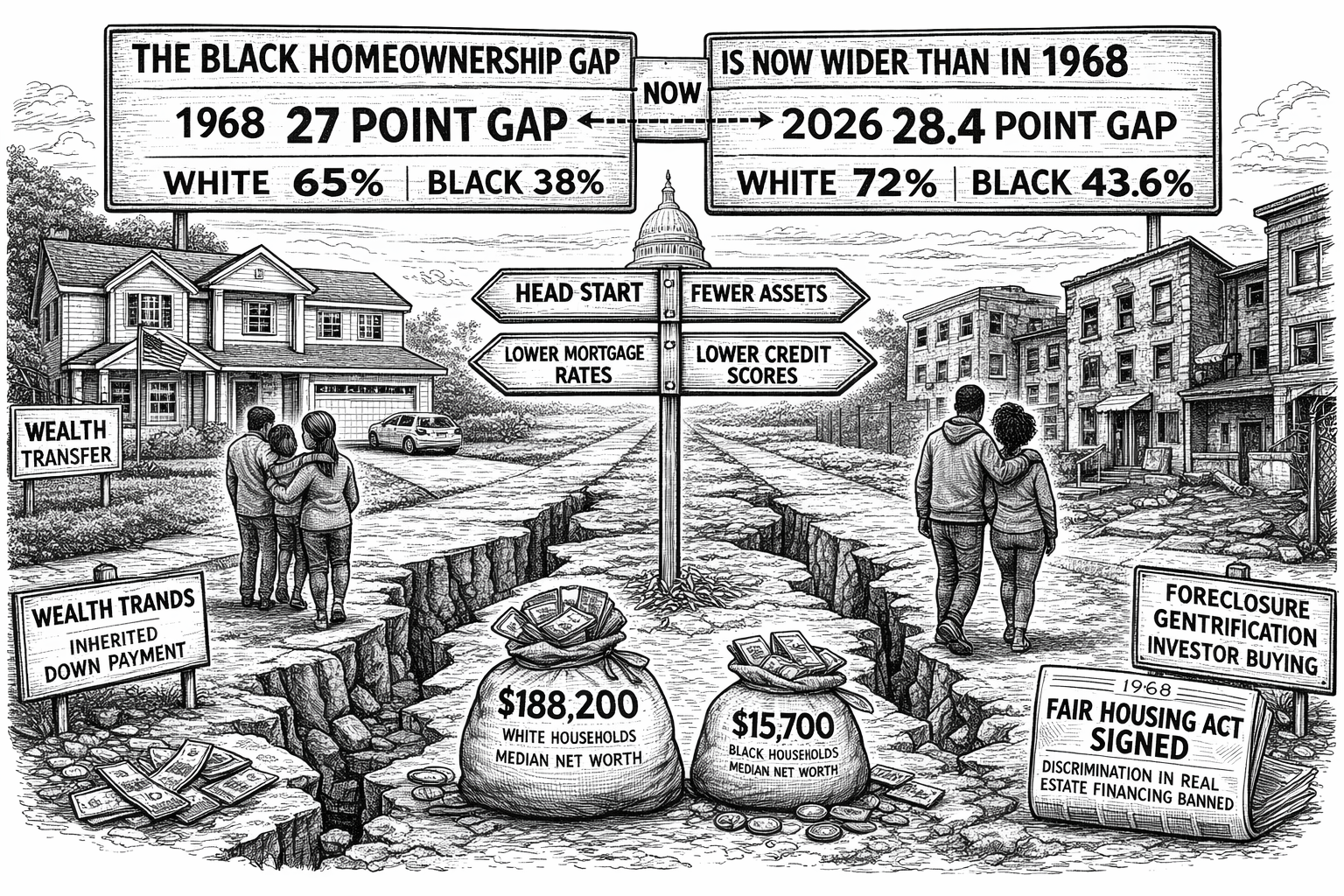
Just 14% of Black Gen Zers and 32% of Black millennials own their homes — about half the rate of white Americans in the same generations. In recent years, the gap has widened as homeownership declined for young Black adults while rising for young white adults. The drivers are structural and compounding. For every $100 in wealth held by white households, Black households have just $15. Black men face an unemployment rate of 7.1% — roughly double the 3.7% rate for white men. Black homebuyers are twice as likely to have their mortgage applications rejected as white buyers. And the credit scoring systems that determine mortgage eligibility continue to embed and transmit the historical discrimination they were supposed to replace — rewarding the inherited wealth and financial history that Black families were systematically prevented from building.
The Senate passed the 21st Century ROAD to Housing Act in March 2026, which would address redlining and limit corporate ownership of single-family homes. Whether it advances through the House is unclear. In the meantime, the economic conditions facing Black homebuyers are deteriorating. Black unemployment spiked to nearly 17% during the Great Recession and again during the pandemic — compared to 9% and 14% for white Americans — worsening the savings and credit profiles that young Black buyers are now carrying into the highest mortgage rate environment in decades.
This is not an American exceptionalism story. A January 2026 study from the University of Stirling found that in England and Wales, only 20% of Black African households own their homes — compared to 68% of white British households. The gap exists across different legal systems, different housing markets, and different histories of explicit policy discrimination. What the US and UK share is not the specific mechanism but the outcome: a racial wealth gap expressed most clearly and most durably through homeownership rates that have refused to close across generations. As SSC documented in The UK Housing Crisis Has a Race Problem No One Wants to Name, the framing of these gaps as economic — driven by individual income, credit scores, and market conditions — is a narrative that consistently obscures the discrimination producing those very conditions. The same obscuring is happening on both sides of the Atlantic, and the same communities are absorbing the cost.
As SSC covered in The Black Recession Is Already Here and What Doesn’t Make It Into the Cart, the economic pressure hitting Black communities right now is not a new story landing on a stable foundation. It is a new pressure landing on a foundation that was never allowed to solidify. Homeownership is the primary mechanism through which American families build generational wealth. The median net worth of homeowners is 40 times higher than that of renters. Every year the gap persists is a year that wealth compounds on one side and doesn’t on the other.
Why This Matters
Fifty-eight years after the Fair Housing Act, the racial homeownership gap is larger than it was the day the law was signed. That is not a policy failure in progress. It is a policy failure that has already happened — repeatedly, across administrations, across market cycles, and across generations of Black families who did everything they were told to do and still found the door closed. The 21st Century ROAD to Housing Act is a beginning. The gap it is trying to close took a century to build.