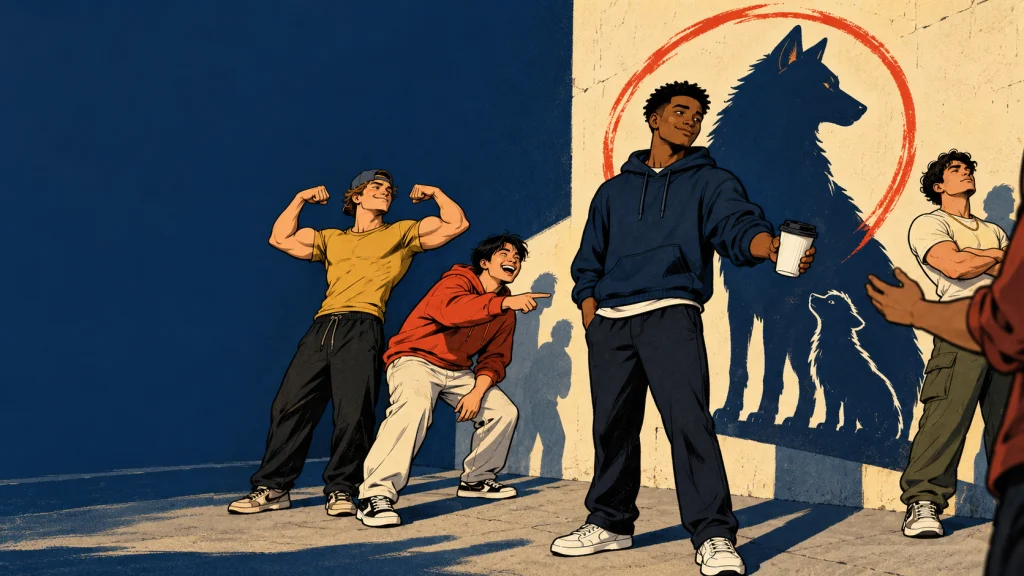
Few insults travel faster online than “beta.” It shows up in comment sections, group chats, gaming lobbies and dating-app complaints, aimed at any man who seems too agreeable, too emotional, too attentive to a partner or too unwilling to dominate a room. The word sounds scientific, as if it describes a fixed rung on a natural ladder. It does not, and the story of how it got here shows how much pressure young men are under right now.
The Science Behind “Alpha” Fell Apart Decades Ago
The alpha-beta idea traces back to wolves, and to wolves in the wrong setting. In 1948, Swiss researcher Rudolph Schenkel described captive wolves fighting for dominance, and in 1970 biologist L. David Mech popularized the “alpha” label in his book The Wolf. The trouble was that captive wolves are unrelated adults forced to share an enclosure, which produces conflict that rarely happens in the wild.
Mech spent the following decades studying wild wolves and reached a different conclusion. In a 1999 paper, he explained that a wild pack is usually a family, parents and their offspring, and that the so-called alphas are the mother and father. He has said he wishes he could take the alpha concept back, and he reportedly asked his publisher to stop printing the book. The science moved on, but the vocabulary escaped into self-help seminars, dating advice and eventually the internet.
How “Beta” Became a Weapon
By the 1990s, “beta male” had become shorthand for a man seen as passive or weak, and in the 2010s it took on a harder edge. Incel forums and the broader manosphere used it to shame men who supported feminism or treated women as equals, and it often traveled alongside cruder insults meant to question a man’s loyalty and nerve. The label stopped describing behavior and started policing it.
That policing has found a new home. As we reported last week, the second wave of red pill content is already on TikTok, packaged as gym routines, discipline and money advice. Much of it rests on the same alpha-beta sorting, with the promise that a man can escape the bottom of the ladder if he hardens up and follows the program.
Young Men Are Absorbing the Message
The numbers suggest the message is landing. A 29-country survey by Ipsos and King’s College London, published in March, found that 31% of Gen Z men agree a wife should always obey her husband, compared with 13% of baby boomer men. Thirty percent of Gen Z men said men should not tell their friends “I love you,” and 21% said men who do child care are less masculine, against 8% of boomers.
Those findings sit alongside a loneliness problem that is hard to separate from them. A quarter of American men ages 15 to 34 told Gallup they felt lonely for a lot of the previous day, well above the 15% median for young men across wealthy countries. We explored the same tension this week in Gen Z Was Supposed to Rewrite Gender, and it runs through our look at the friendship recession.
A worldview that treats tenderness as weakness makes connection harder at the exact moment many young men need more of it. If saying “I love you” to a friend counts against you, and asking for help marks you as beta, isolation starts to look like strength.
The Traits Being Mocked Are the Ones That Hold Lives Together
Strip away the insult and look at what usually gets called beta: listening, patience, sharing household work, showing up for children, admitting fear, apologizing, cooperating instead of competing. Those are the habits that keep marriages, friendships, workplaces and families running. They are also, as Mech’s wild wolves showed, how real packs survive, through parents raising their young together rather than through constant fights for rank.
Pop culture has started to notice. Social media’s “golden retriever boyfriend,” the warm, openly devoted partner, spread as a compliment rather than a punchline. The tension is that young men hear both messages at once: be tougher, harder and more dominant from one feed, and be kinder, steadier and more emotionally available from another.
I have watched this play out up close. A college friend, whom I’ll call Kevin, was the kind of guy people labeled beta: too eager to please, quick to avoid confrontation and willing to put other people’s approval ahead of his own self-respect. His girlfriend at the time was cheating on him, and when his friends, including me, told him we had seen her out with another man, he stayed angry at us for weeks instead of confronting her.
Looking back, the label stuck because of patterns anyone could see. Kevin agreed with people to avoid rejection, struggled to state his boundaries, leaned on other people’s approval to feel confident, backed down even when he had good reason to stand firm and gave far more than he got in hopes of earning respect or affection. Those were real problems, but they were problems of confidence and boundaries, not proof that he was less of a man.
Being kind, quiet or nonconfrontational does not make a man weak, and people often mistake humility for a lack of confidence. Being seen as beta is about how others read a man’s behavior, not an objective measure of his masculinity or worth. Confidence, boundaries and self-respect count for far more than fitting an alpha-or-beta stereotype, and the question underneath it all is who gets to define strength in the first place.
A Weekend Question Worth Sitting With
For many Black men, the conversation carries extra weight. A lot of them grew up hearing that toughness was protection, and that showing softness in public could be dangerous, a pressure we wrote about in Being the Strong One Shouldn’t Mean Carrying Everything Alone. The same pull toward strength and leadership surfaced in our analysis of why more Black men moved toward Trump in 2024, where male leadership and respect came up again and again.
None of that makes ambition, confidence or physical strength a problem. The problem is a ranking system built on a misread study of captive animals, sold back to young men as a law of nature. If the biologist who popularized “alpha” has spent a quarter century trying to retire it, the rest of us can stop letting it decide who counts as a man.