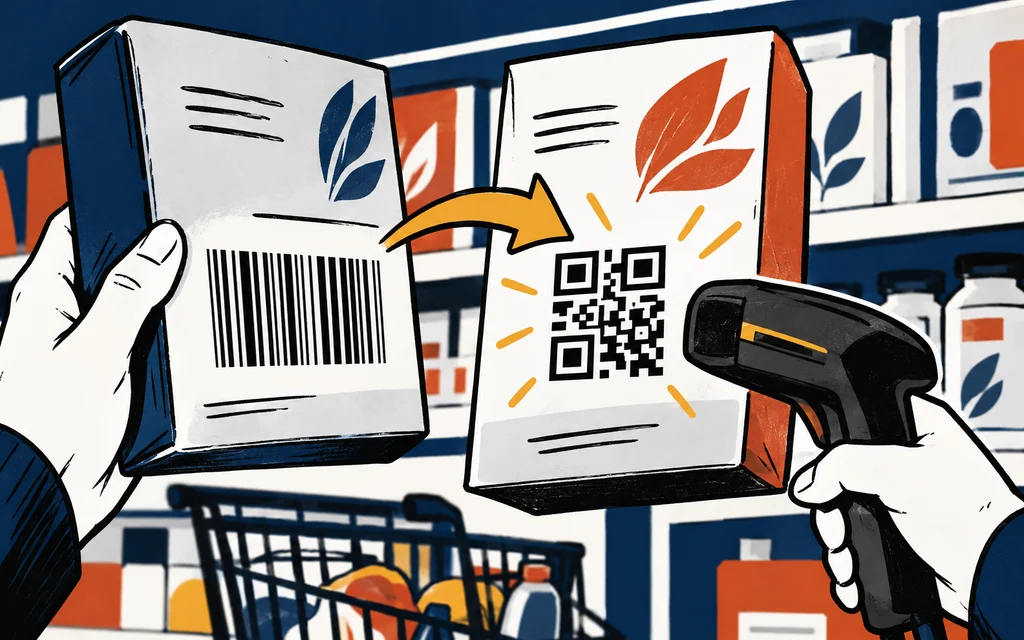
The shift is not just about replacing one symbol on a package. Retailers and suppliers may need to rebuild the data systems behind how products are tracked, sold and recalled.
The familiar UPC barcode is approaching one of its biggest changes in 50 years. GS1, the standards organization behind the codes used across global retail, is pushing retailers toward 2D codes such as QR codes under its Sunrise 2027 initiative. Katherine Laidlaw reported for The Hustle that the transition is already underway as retailers upgrade scanners and manufacturers prepare packaging for codes capable of carrying far more information than traditional barcodes.
A standard barcode mainly identifies what a product is. A 2D code can connect that product to a much larger set of information, including its origin, ingredients, allergens, expiration dates, authenticity, environmental information and disposal instructions. The same code can potentially work at checkout, inside a warehouse and for a shopper looking for more information. That capability has become more important as regulators and manufacturers seek better product traceability during recalls and other supply-chain problems.
The difficult part is not printing a square on a package. Companies have to make sure the data behind that code is accurate, current and accessible across inventory, checkout and supply-chain systems. The Hustle reported that Unilever recently upgraded roughly 45,000 SKUs, illustrating how large the undertaking can become for companies with extensive product catalogs. Smaller suppliers may face an even harder transition if they have older packaging, limited technology budgets or less sophisticated product databases.
Consumers could also encounter more useful product information without forcing manufacturers to fit everything onto a label. Research cited in The Hustle found 79% of consumers preferred QR codes, although preference does not necessarily mean shoppers want to scan every product. The value is having additional information available when it is actually needed — during a recall, when checking allergens, verifying authenticity or learning where something came from.
For retailers and suppliers, 2027 is less a barcode deadline than an infrastructure deadline. Companies that wait until major retailers require the new codes could find that redesigning packaging is the easy part. Building and maintaining the information connected to those codes may take considerably longer.
Source: Katherine Laidlaw, “Why barcodes are about to go extinct,” The Hustle, Oct. 1, 2026